LANDE
Lande is a surname with roots in the Germanic linguistic tradition, deriving ultimately from the Middle‑High German word land, which denotes a piece of land or territory. As an occupational designation it was commonly awarded to individuals who owned or worked upon a tract of land, or who resided near a notable geographical feature such as a field or a meadow.
The surname also possesses Anglo‑Saxon origins. In Old English it appears as land, used in the Middle Ages to distinguish a rural inhabitant from one of the towns. A second possibility arises from early medieval English and Old French, where the term la(u)nde referred to a forest glade; thus some bearers of the name were associated with a clear space within woodland. In the specific instance of the place recorded as Landa in 1163 in Leicestershire, the surname could have been locational, with an alternate spelling of Lawn appearing in the same period.
From a continental perspective, the surname appears in Scandinavian contexts where lande translates to “lands” or “countryside”, suggesting an inhabitant or owner of rural property. In French, the same word means “heath”, “moor” or “barren land”, indicating a geographical aspect of the original bearers’ residence. These differing meanings highlight the surname’s broad geographic and symbolic associations across Europe.
In certain Jewish (Ashkenazi) families, Lande also occurs as a surname, though its specific etymological significance in that context is not clearly established. Consequently, the surname is a product of multiple cultural streams, each contributing a distinct semantic layer.
The earliest surviving record of a version of the name is found in the Northamptonshire Pipe Rolls, dated 1205 and belonging to the reign of King John (1199–1216). The entry lists Thomas de la Lande, signalling that the surname had already entered civil documentation in the early twelfth century.
Archival evidence of the name’s continuity in England appears in the marriage of Richard Land and Elizabeth Fuller, which took place at St. James’s, Clerkenwell in London in 1579. In the early fifteenth century, George Land (aged 22) and Sarah Land (aged 18) departed from the Dorset port of Weymouth in March 1635, thereby becoming among the earliest documentued bearers of the name to settle in New England.
A heraldic grant associated with the Land family depicts a shield divided by a gyronny of eight gold and black squares, with a red bend across the centre. The crest above the shield is described as a church entwined with trees proper, symbolising a connection between faith and the natural world.
Variations of the surname include, but are not limited to, Land, Landi, De Lande, Landy, Landa, Landeau, Landau, Landes and Lander. When families migrated, prefixes or suffixes were sometimes added to conform to local linguistic customs: for instance Van Lande in the Dutch tradition or di Lande in the Italian. Patronymic forms such as Landesson or Landesdottir occasionally appear where naming conventions included the father's name as part of the lineage.
In contemporary times the surname remains relatively common in Norway, the United States, France, Russia and, notably, within the Marathi community in Maharashtra, India. Statistical data indicates that Norway has the highest concentration of individuals carrying the surname, with the United States following closely behind.
In sum, the surname Lande demonstrates a complex tapestry of origins, spanning Germanic occupational roots, Anglo‑Saxon topographical usage, and continental European geographical references. Its persistence through centuries of record and the breadth of its modern distribution attest to the enduring nature of this name across cultures and languages.
Similar and related surnames
Related and similar names are generated algorithmically based on the spelling, and may not necessarily share an etymology.
How to communicate the surname Lande in...
Braille
⠇⠁⠝⠙⠑
Morse
.-...--.-...
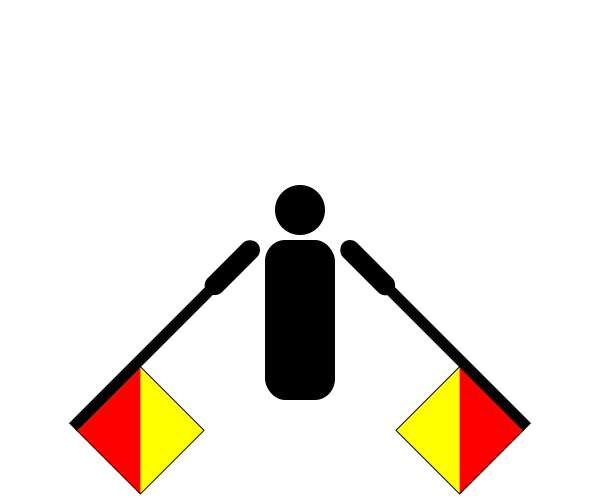
Semaphore




There are approximately 68 people named Lande in the UK. That makes it one of Britain's least common surnames. Only around one in a million people in Britain are named Lande.