LAMP
Lamp is a surname with roots that can be traced back to early medieval Europe, particularly the Germanic peoples of the Low Countries and Central Europe. Its persistence through centuries and across borders demonstrates the adaptability and resilience of surnames that were originally descriptive or occupational in nature.
In the Middle High German language, the word lampen means “lamp” or “lantern.” The surname is therefore understood to have begun as an occupational name for someone who manufactured or sold lamps, or who acted as a lamp bearer at public or private events. The occupation of lamp making was vital in a pre‑electric age society and associated surnames arose naturally to distinguish individuals within growing communities.
Another line of etymology points to the pre‑5th‑century personal name Landbehrt, combining the elements land (territory) with berht (bright). While the semantic connection to “light” may have been symbolic, the name’s popularity can also be linked to the veneration of St. Lambert, Bishop of Maastricht, who lived around the year 700 AD. Saint Lambert’s name was widely adopted across the Frankish realms, a fact reflected in early medieval records such as the Domesday Book entry for Gozelinus filius Lamberti of Yorkshire in 1086.
The earliest documented spelling of a name closely related to Lamp dates to 1148, when Richard Lambert is recorded in the Pipe Rolls of Hampshire. Other notable records include Tiddemus filius Lamberti of Hamburg (1262) and William Lambhyrde in the 1255 Essex Assize Court Rolls, an instance of the Old English occupational form meaning “lamb‑herd.” These examples illustrate that the name was initially non‑hereditary and varied in spelling as it evolved.
Over the course of the 12th and 13th centuries the surname survived in numerous spellings, including Lambert, Lambard, Limprecht, Lambrich, Lambertini, and Lemmens. Later Dutch and German variants such as Lampe and Lomp reveal a continued association with light or bulk material, and Jewish communities produced variations like Lam and Lampe in Eastern Europe. In Scandinavia the name appears as Lampi or Lampenius, while the Italian form is virtually identical: Lampi.
Geographically, Lamp can be found today primarily in Germany and Austria, where it retains its occupational heritage. In the Netherlands it remains scarce, and in England it entered the population through medieval migrations. The name crossed the Atlantic with German and Austrian settlers, most notably with Charles Lambert’s 1635 expedition to the Caribbean, and with larger influxes in the 19th century that brought the surname to Pennsylvania, Ohio, and Maryland. Presently, Lamp families also exist in the United States, Canada, the Czech Republic, Romania, and England, often with spelling shifts to the shortened form Lam.
Despite its many variants and international spread, the core of the surname Lamp remains firmly anchored in the notion of light, whether literal or metaphorical. Its resilience over a millennium highlights the broader patterns of surname evolution, where occupational, geographic, and personal descriptors have blended into enduring family identities across continents.
Typical given names associated with the Lamp surname
Male
Female
Similar and related surnames
Related and similar names are generated algorithmically based on the spelling, and may not necessarily share an etymology.
How to communicate the surname Lamp in...
Braille
⠇⠁⠍⠏
Morse
.-...---.--.
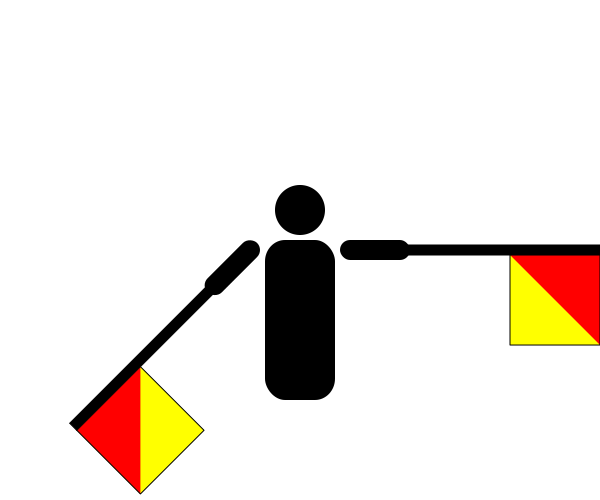
Semaphore



There are approximately 32 people named Lamp in the UK. That makes it one of Britain's least common surnames. Fewer than one in a million people in Britain are named Lamp.
Origin: English
Region of origin: British Isles
Country of origin: England
Religion of origin: Christian
Language of origin: English
