LAMMERT
Lammert is a surname of German origin, traditionally associated with the German-speaking regions of Europe and, more recently, with immigrant communities in North America.
The name derives from the personal name Lambert, itself a compound of the Old Germanic elements land – meaning land or territory – and berht – meaning bright or famous. Consequently, Lammert can be understood as bright land or famous land. The surname is patronymic, indicating descent from a male ancestor named Lambert.
Historical documentation of the name dates back to the medieval period. The earliest recorded spelling is that of Richard Lambert in the Pipe Rolls of Hampshire in 1148, a period when the monarch was King Stephen (1135–1154). Earlier references appear in the Domesday Book of 1086 for the Yorkshire entry of Gozelinus fillius Lamberti, and a 1220 record from Norfolk names Peter Lamberd. Additional early instances include John Lambarde in a Rochester Consistory Court record of 1544 and a 1594 marriage record in Saint Mary Magdalene, Bermondsey, London involving an Avis Lampard and George Lane.
In the Middle Ages the name gained popularity partly through the influence of weavers from Flanders, who revered St. Lambert, bishop of Maastricht. The Latin form of the name, Lanbert, and the cognate Old English personal name Landbeorht also contributed to the proliferation of the surname across England following the Norman Conquest.
In contemporary times Lammert remains most widespread in German-speaking areas. Within Germany it is especially common in the northern state of Lower Saxony, where more than 6,600 people bear the name, making it the 475th most frequent surname. It is also found in neighbouring North Rhine‑Westphalia and the southern state of Bavaria. In Austria the surname is notably frequent in the northern states of Carinthia and Tyrol, ranking 482nd and 314th respectively. The name is present throughout German‑speaking Switzerland, particularly in the eastern region where it ranks 319th. In the Italian region of South Tyrol and the small European micro‑state of Luxembourg the surname also occurs, reflecting historic Germanic migration patterns. In the United States, the 2010 census recorded fewer than 10,000 individuals with the surname, indicating its relative rarity outside Europe.
Numerous variations of the surname exist, reflecting regional pronunciation and orthographic differences. The most common variants include Lamert, Lamerts, and Lemert. Other forms are found in documents such as Lammers, Lammeret, Lemmert, Lammertz, Lemmertz, and Lammersdorfer. Related surnames that share a linguistic root include Hammert, Heimert, and Lauber, the latter deriving from the element helm meaning helmet, while Heimert incorporates heim meaning home. Such variants can often denote the geographical origin of a family line or the particular branch of the broader name group.
Understanding the historical and linguistic context of Lammert provides insight into the migration, occupation, and social status of its bearers. The name’s strong association with nobility and rulership in its Germanic roots, coupled with its presence in medieval legal and administrative records, reflects the prominence of those who carried it in their communities. For researchers tracing genealogical connections, recognising the full spectrum of its variants and geographic distribution is essential for accurate lineage reconstruction.
Similar and related surnames
Related and similar names are generated algorithmically based on the spelling, and may not necessarily share an etymology.
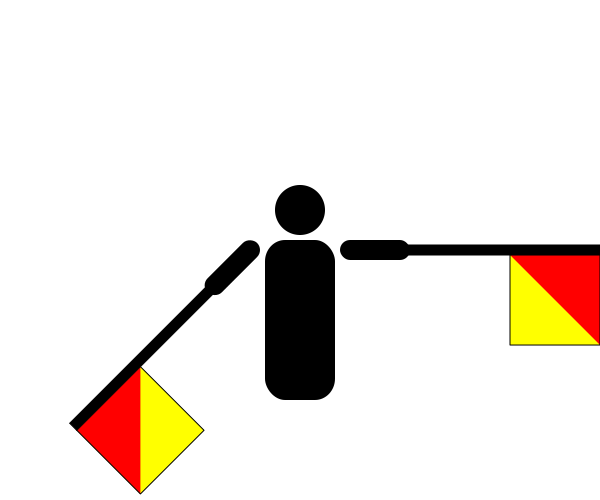
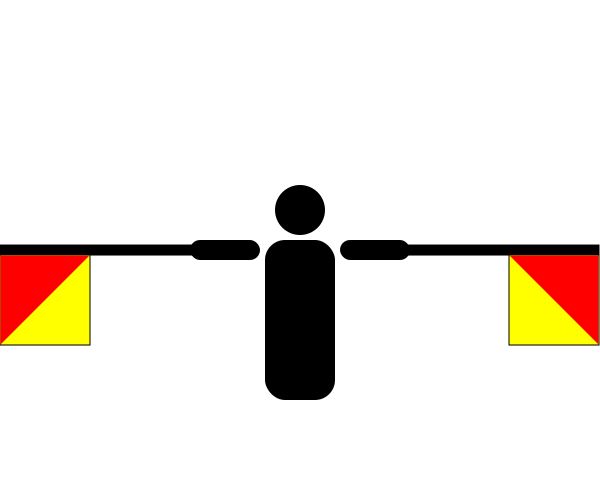
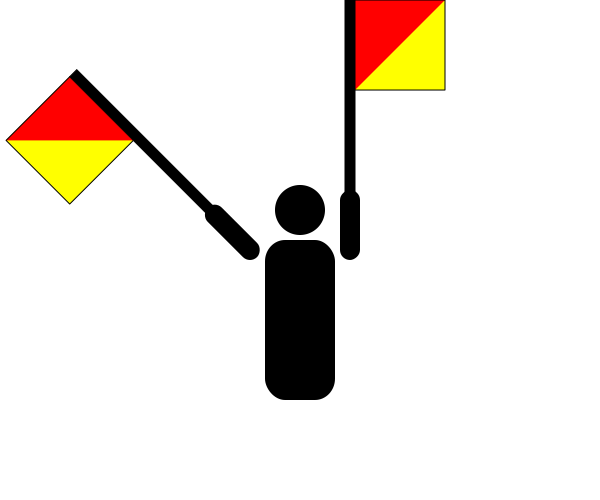
How to communicate the surname Lammert in...
Braille
⠇⠁⠍⠍⠑⠗⠞
Morse
.-...-----..-.-
Semaphore



Sorry, we don't have any statistics on this name. That's probably because it's very uncommon in Britain.
