LAMBERTH
Lamberth is a surname of English origin that has its roots in the Old English personal name Lambert, a compound of the elements land, meaning 'land' or 'territory', and berht, meaning 'bright' or 'famous'. The derivation of the surname reflects a meaning that can be rendered as 'bright land' or 'famous land'.
The addition of the suffix -th turns the personal name into a patronymic form, signalling 'son of Lambert'. Over time, the patronymic became a fixed family name and expanded into distinct variations such as Lambeth, Lamberth and Lambirth, largely because of regional dialectal differences and inconsistencies in early spelling practices.
In the early medieval period, Lamberth functioned also as a locational surname. It originated from a village that is now incorporated into the district of Lambeth in London. The village of Lambeth is first mentioned in the Anglo‑Saxon Chronicles for the year 1043, at that time spelt Lambehyde, a form thought to refer to a wharf where lambs were shipped. In 1332 the name appears officially in the Feet of Fines in an entry for Richard de Lambeth, recorded as a citizen of London.
Later church records provide further examples of the surname: in 1786 Thomas Lamberth was married to Esther Hagar at St George’s chapel, Hanover Square; in 1795 Mary Lambeth married William Gray at the same church. These entries confirm the continued use of the surname into the eighteenth century.
While the name is most firmly anchored in England, its origins in the Germanic personal name Lambert have produced comparable surnames across continental Europe, including Lamberti in Italy, Lambert in France, and Lambertus in the Netherlands. The surname Lamberth itself has been noted in countries with Germanic language traditions, such as Germany, Belgium, the United States and Canada, often as a result of migration. However, the exact modern distribution of the name is not definitive without a comprehensive study of archival records and modern registries.
In summary, the surname Lamberth evidences a dual heritage: it is both a patronymic name derived from the Old English Lambert and a locational identifier linked to the historic village of Lambeth. Its orthographic variations reflect the linguistic fluidity of early English and the subsequent spread of the name across English‑speaking and Germanic‑language regions. The name persists today as a marker of familial lineage tracing back to an early medieval ancestor named Lambert or a community known as Lambeth.
Typical given names associated with the Lamberth surname
Male
- Andrew
- Brian
- Curt
- David
- Ian
- James
- John
- Lee
- Mark
- Michael
- Paul
- Peter
- Richard
- Stephen
- Thomas
Female
- Anita
- Christine
- Emma
- Joanne
- Kate
- Kathleen
- Marcia
- Monika
- Patricia
- Rebecca
- Rene
- Sandra
- Sarah
Similar and related surnames
- Lambert
- Lambeth
- Lambirth
- Lambart
- Lambarth
- Laimbeer
- Lamber
- Lamberd
- Lamberg
- Lambern
- Lambers
- Lamberte
- Lamberti
- Lamberto
- Lamberton
- Lamberts
- Lambertt
- Lamberty
- Lambertz
- Lambery
- Lambor
- Lambort
- Lambrechts
- Lamburt
- Lember
- Lembert
- Lambeath
- Lamberger
- Lamberson
- Lambertini
- Lambertsen
- Lambertson
- Lambertucci
- Lambirsh
- Lambrechs
- Lambrecht
- Lambret
- Lambrith
- Lamperth
Related and similar names are generated algorithmically based on the spelling, and may not necessarily share an etymology.
How to communicate the surname Lamberth in...
Braille
⠇⠁⠍⠃⠑⠗⠞⠓
Morse
.-...----.....-.-....
Semaphore


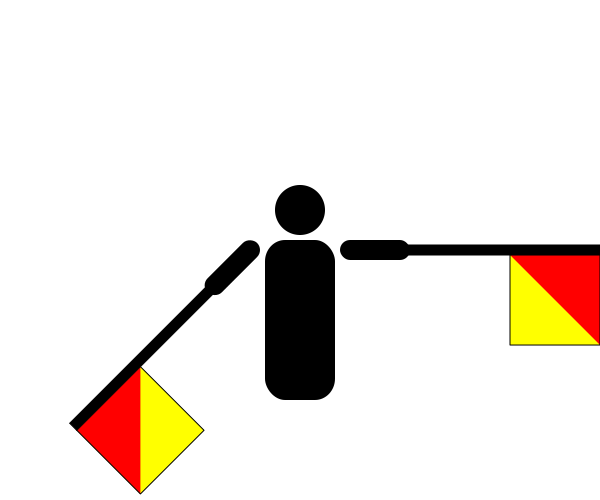
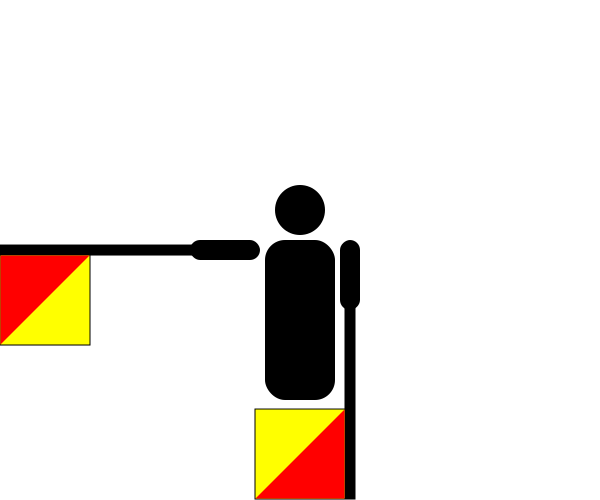

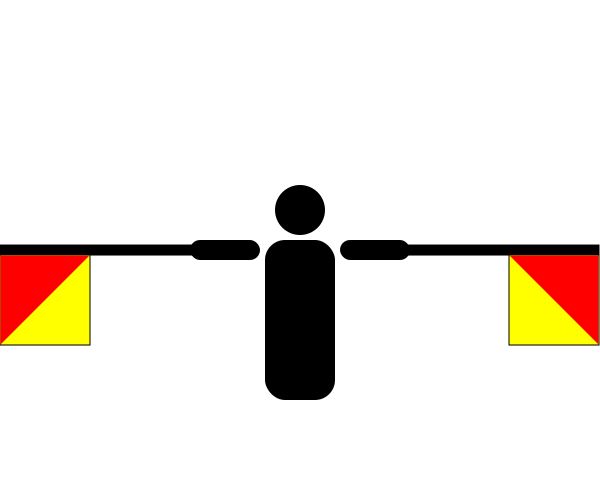
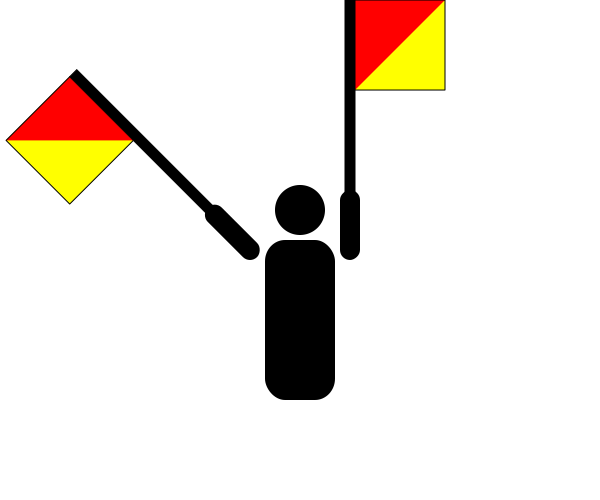

There are approximately 176 people named Lamberth in the UK. That makes it one of Britain's least common surnames. Only around three in a million people in Britain are named Lamberth.
Surname type: From given name or forename
Origin: English
Region of origin: British Isles
Country of origin: England
Religion of origin: Christian
Language of origin: English
