LALOR
The surname Lalor originates from the Gaelic language of Ireland, specifically from the Old Irish name Ó Leathlobhair. The prefix Ó denotes a male descendant of a particular ancestor, in this case of someone named Leathlobhair. The personal name Leathlobhair is composed of the elements leath, meaning “half”, and lobhar, meaning “leper” or “the sick”. Thus the name is often translated as “descendant of the half‑leper”, though the medieval nickname may have had a metaphorical connotation rather than indicating a literal illness.
The name has been anglicised in several forms, including Lalor, Lawlor and Lawler. In the earlier period the prefix Ó was invariably retained, but over time it was dropped and the surname came to be recorded simply as Lalor. These variations are all recognised as belonging to the same Gaelic lineage.
The Lalor sept was one of the seven septs of Laois, a province in eastern Ireland that is now called County Laois. Their territory lay near the Rock of Dunamase, a significant hillfort in that county. The clan’s presence in this region is recorded as far back as the seventeenth century; the earliest surviving record of the spelling Lalor is dated 1577 and refers to a man named Harry Lalor who fought in the Mullaghmast massacre under the reign of Queen Elizabeth I. The surname remains concentrated in County Laois to the present day and is found among the descendants of the ancient Irish kings of that area.
In the nineteenth century, bearers of the name played notable roles in Irish political history. James Fintan Lalor, for example, was a prominent revolutionary and journalist who championed democratic reforms and opposed British rule. Another distinguished individual was Peter Lalor (1823–1889), who led the insurgent miners at the Eureka Stockade in Australia and later became speaker of the Legislative Council of Victoria. These figures illustrate the spread of the Lalor name beyond Ireland through emigration and the involvement of its bearers in significant historical events.
Following the Great Famine and subsequent waves of emigration, people bearing the surname Lalor settled in numerous English‑speaking countries, including the United States, Canada, Australia and the United Kingdom. In these countries they are generally regarded as descendants of Irish immigrants. As with many Irish surnames, the Lalor family has retained its Christian identity and often appears in genealogical records where the original Gaelic spelling coexists with its anglicised forms.


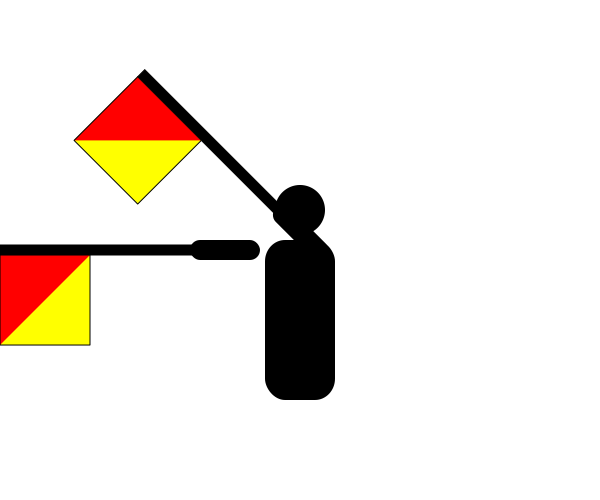
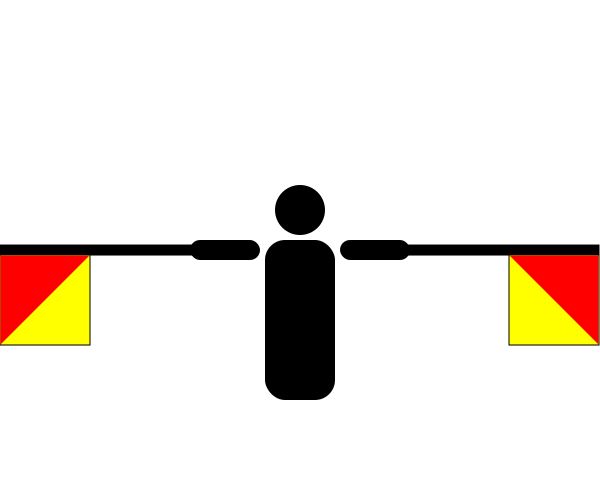
Typical given names associated with the Lalor surname
Male
- Adam
- Adrian
- Anthony
- Colm
- David
- James
- John
- Joseph
- Michael
- Patrick
- Peter
- Stephen
Female
- Aileen
- Anna
- Anne
- Catherine
- Dawn
- Helen
- Lorraine
- Margaret
- Mary
- Michelle
- Patricia
- Ruth
- Sally
- Sarah
Similar and related surnames
Related and similar names are generated algorithmically based on the spelling, and may not necessarily share an etymology.
How to communicate the surname Lalor in...
Braille
⠇⠁⠇⠕⠗
Morse
.-...-.-..---.-.
Semaphore
There are approximately 355 people named Lalor in the UK. That makes it one of Britain's least common surnames. Only around five in a million people in Britain are named Lalor.
Origin: Celtic
Region of origin: British Isles
Country of origin: Ireland
Religion of origin: Christian
Language of origin: Gaelic