KUHNE
Kuhne is a surname of German origin that has been documented in records across Europe and beyond since the medieval period. The name is derived from the Middle High German word kühne, which translates as “bold” or “brave.” In some contexts it has an occupational connotation, stemming from the word kūnne meaning “craftsman.” Consequently, individuals who earned the name may have originally been noted for their courage, their willingness to take risks, or their skilled work in trades such as blacksmithing, weaving or carpentry.
Historical evidence suggests that the surname developed from the older personal name Kuoni, recorded before the seventh century. This name is believed to mean “brave one” and belongs to a wide group of Germanic names that were common in the early medieval era, including Albert, Frederick and Wilhelm. These names generally convey associations with strength, victory and courage, and their proliferation is often linked to a period of heightened warfare and instability following the collapse of the Roman Empire.
The earliest instances of the surname in hereditary form appear in the late thirteenth century. A charter from the German town of Elsabe dated 1297 records a person named Conrad Conradi (Conrad, the son of Little Conrad). Subsequent entries in the mid‑fourteenth century, such as Rudolf Kunzelman in Ulm and Cunzelman in Switzerland, further demonstrate the name’s early use in a European context.
Throughout the centuries, Kuhne has appeared in a wide range of spellings. In German‑speaking regions the name has been rendered as Coenraad (in Czech), Kondrat (in Russia), Corradi (in Italy), Cunradi (in Tuscany), and Korlat (in Hungary). Diminutive forms include Kienzle, Kunc, Kunz, Kuntz, Kunzel and Zunzelman. Patronymic variations such as Kurten, Coners, Conerding, Conradsen, Coenraets and Kondratovich are also documented, as are compound surnames like Kuhnemund and Kuhnewald.
In contemporary usage, the surname remains predominantly German, with significant concentrations in the northern states of Schleswig-Holstein and Hamburg, and in the central states of Hesse and Baden-Württemberg. The name is also common in Austria and Switzerland. It is less frequent in the Netherlands, Belgium, Denmark and the United Kingdom, where it has been recorded in a variety of forms such as Kuen, Koen, Koenne, Koehn, Koehne, Kuenne and Koning (the Dutch word for “king”).
After the nineteenth century, migration patterns saw the name transit to the United States, where it entered the official census rolls as a top‑five‑thousand surname. In North America the highest concentrations of individuals bearing the name are in the Midwest, particularly in Wisconsin and Minnesota. The diaspora continued to spread the surname to other parts of the world, including Canada, Australia, South Africa and the United Kingdom, largely as a consequence of mid‑twentieth‑century movements of German immigrants following global conflict.
The historical trajectory of Kuhne illustrates how a name that originally denoted courage or craft could evolve into a multifaceted surname, reflecting both personal qualities and professional affiliations. Its spread across Europe and the Americas demonstrates the dynamic nature of surname transmission in the context of linguistic variation, migration and regional identity.
Similar and related surnames
- Caine
- Cone
- Coon
- Coune
- Cownie
- Cuine
- Cune
- Ghani
- Gunn
- Gwyn
- Gwynn
- Gwynne
- Kahn
- Kane
- Kanu
- Kean
- Keen
- Keene
- Ken
- Kenn
- Keown
- Keun
- Keune
- Kewn
- Khen
- Khon
- Khun
- Kiani
- Koehn
- Koehne
- Koene
- Kon
- Koone
- Koun
- Kuhn
- Kuhnel
- Kuhnen
- Kuhner
- Kuhnke
- Kuhns
- Kun
- Kuna
- Kunde
- Kune
- Kunes
- Kuney
- Kuni
- Kunn
- Kunne
- Kuns
- Kunu
- Kunz
- Kuun
- Kyne
- Quan
- Quinn
Related and similar names are generated algorithmically based on the spelling, and may not necessarily share an etymology.
How to communicate the surname Kuhne in...
Braille
⠅⠥⠓⠝⠑
Morse
-.-..-....-..
Semaphore
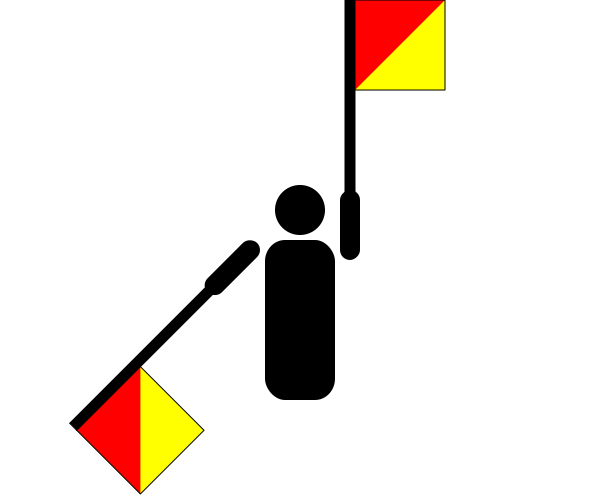


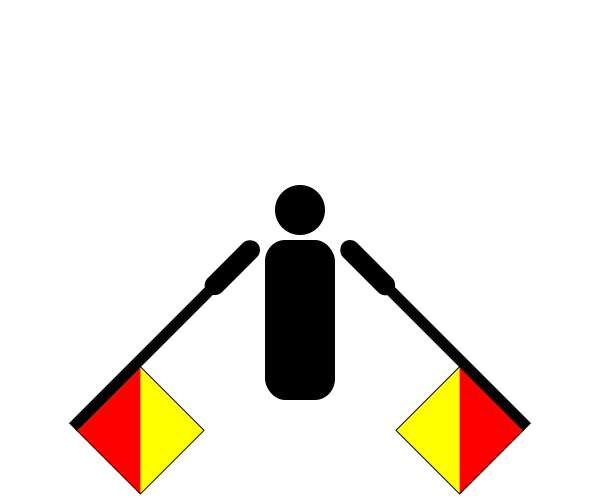

There are approximately 55 people named Kuhne in the UK. That makes it one of Britain's least common surnames. Only around one in a million people in Britain are named Kuhne.
Region of origin: Europe
Country of origin: Germany
Language of origin: German
