KUBIK
Kubik is a family name that traces its earliest roots to Poland, where it appears as a surname of Polish origin. The name is derived from the Polish noun kubek, meaning “cup.” Historically it was associated with an occupation; it was a common practice to adopt an occupational epithet as a surname, and so Kubik would have identified a maker or seller of cups, or a person who specialised in the manufacture of such wares.
In addition to its occupational derivation, the surname has been linked to a descriptive nickname. A person with a noticeably round or cup-shaped head might have been called kubek as a term of endearment or remark, leading to the family name Kubik over time.
Beyond Polish usage, the root word appears across Central and Eastern Europe with differing local meanings. In Czech and Slovak contexts the term is often read as “cube” or “cuboid,” while in other Slavic languages it took on meanings such as “hollow” or “retreating,” “cottage,” or “woodcutter.” In Serbia, the word can mean “dog-like” or “brave,” suggesting the name may also reference traits of courage or loyalty. Consequently, the surname Kubik can signify a range of occupations and attributes, from those who cut wood for fuel to families dwelling in hollow valleys or small cottages.
The geographical spread of the name is considerable. Its highest concentrations remain in Poland, the Czech Republic, Slovakia, Ukraine, and to a lesser extent in Hungary, Romania, and Belarus. German-speaking areas such as Germany and Austria also record the name, as do parts of Western Europe including France, Belgium, and the Netherlands, where it is less frequent. In recent decades migration has brought the surname to North America and Australasia, with significant numbers settling in the United States – particularly in the Midwest states of Pennsylvania and Ohio – and in Australia.
Variations of the surname are common and often reflect linguistic or orthographic adjustments. In the Czech Republic the spelling Kubík is prevalent, while the Polish equivalent may appear as Kubikowski or Kubiczek. Other forms seen in the diaspora include Kubicka, Kubić, and the anglicised Kubeck, Kubicki, Kapik, Kupicka, and Kapic. These variants all stem from the original root, differentiated by suffixes and phonetic adaptations.
An alternative historical pathway for the surname is mentioned in a early medieval context. The name Kubik has been linked to the ancient Hebrew given name Yaakov, which translates as “following‑after.” In the biblical narrative, Jacob – whose name has numerous medieval European variants such as Jacobus, Jacobo, Jankel, and Yakov – is known for taking the elder Esau’s birthright. The surname’s potential derivation from this Hebrew personal name suggests an earlier, possibly Jewish, connection, though the name was not originally confined to any single religious community. Across the centuries, many holders of the name have adopted it regardless of faith, and it has become firmly established within broader European onomastic traditions.
Typical given names associated with the Kubik surname
Male
- Grzegorz
- Jacek
- Jaroslaw
- Joseph
- Leszek
- Marcin
- Michal
- Peter
- Richard
- Sebastian
- Tomasz
Female
- Anna
- Bozena
- Ewelina
- Joanna
- Justyna
- Katarzyna
- Malgorzata
- Maria
- Monika
- Natalie
Similar and related surnames
Related and similar names are generated algorithmically based on the spelling, and may not necessarily share an etymology.
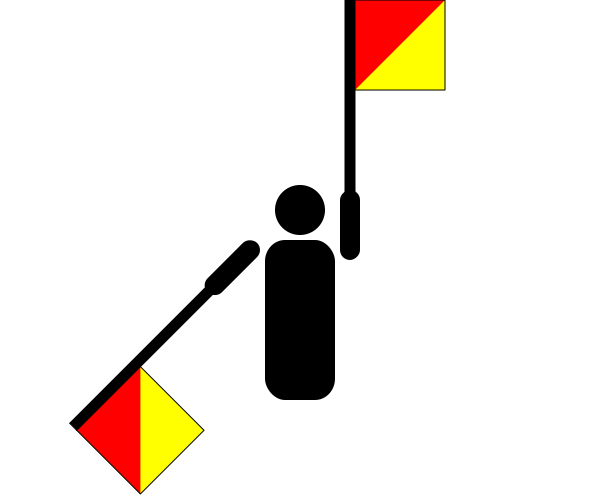
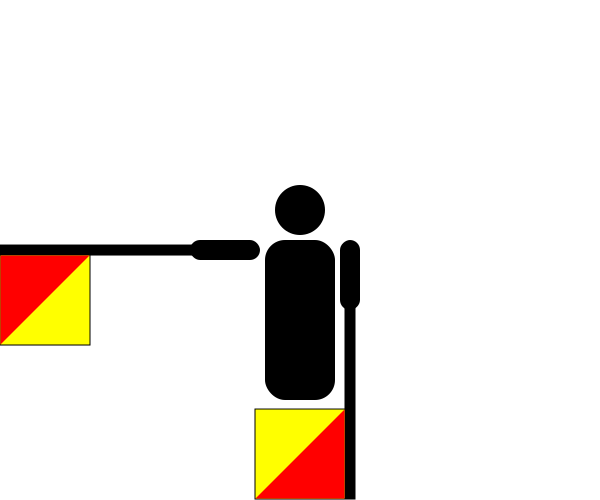
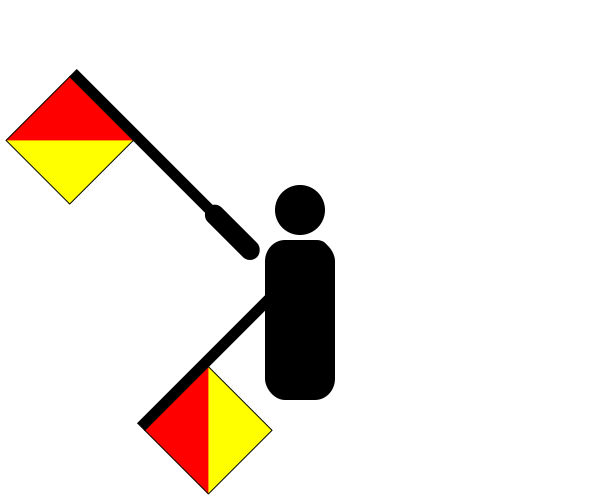
How to communicate the surname Kubik in...
Braille
⠅⠥⠃⠊⠅
Morse
-.-..--.....-.-
Semaphore

There are approximately 158 people named Kubik in the UK. That makes it one of Britain's least common surnames. Only around two in a million people in Britain are named Kubik.
Region of origin: Europe
Country of origin: Poland
Language of origin: Polish
