KRUG
Krug is a surname of Germanic origin, first documented in European records of the twelfth century. The name derives from the Middle High German word krug, meaning jug or pitcher, and it is commonly associated with occupations that involved the manufacture or sale of such vessels.
The occupational origin of the surname is most often linked to a potter or a maker of jugs and other earthen or metal vessels. In medieval times it was also used as a descriptive surname for a manufacturer or merchant of glass and pottery, specifically mugs and pitchers. An alternate hypothesis places the name in the tavern profession, where krug was also a term for an inn or tavern, thereby describing an innkeeper.
Historical records provide early attestations of the name. A reference to Johann Krug of Grimmenthal in 1375 is recorded, while earlier documents mention Lotze Crugir of Kassel in 1351 and Henecke Krogher of Hannover in 1420. The surname remains in use today, with a notable bearer being Paulus Kruger, who served as president of the Free Boer Republic of the Transvaal from 1881 to 1902.
The surname has many orthographic variants that reflect regional dialects and historical spelling practices. Common forms include Krüger, Krueger, Kruck, Krucker, Kroger, Kroge, Kroge, Krogmann, Krochmann, and Krugmann. Scandinavian adaptations such as Krogsgaard, Krogh, and Krøgher, as well as Anglicised versions like Cryg and Krigen, have all been documented and share the same root.
In terms of geographic dispersion, the surname is most common in German‑speaking regions, including Germany, Austria, Switzerland, and the German parts of northern Italy. It is also found in Poland, Ukraine, Russia, and Kazakhstan, particularly within former Soviet republics. In the United States, the name has spread nationwide, with significant concentrations in Illinois, Wisconsin, Minnesota, New York, Pennsylvania, Maryland and California. Current estimates place the number of American bearers of the surname at around sixteen thousand.
The term krug also carries biblical significance, as some have linked it to references in the Bible concerning the chalice used at the Passover seder, suggesting a spiritual connotation for those who adopted the name. However, the predominant evidence supports its occupational and geographical origins rather than a purely symbolic one.
Similar and related surnames
Related and similar names are generated algorithmically based on the spelling, and may not necessarily share an etymology.
How to communicate the surname Krug in...
Braille
⠅⠗⠥⠛
Morse
-.-.-...---.
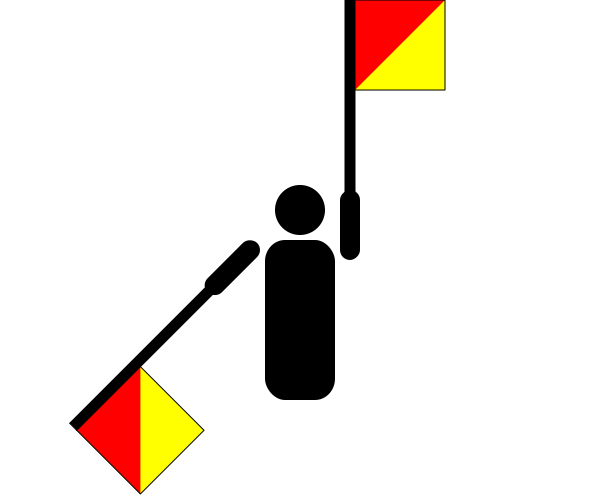
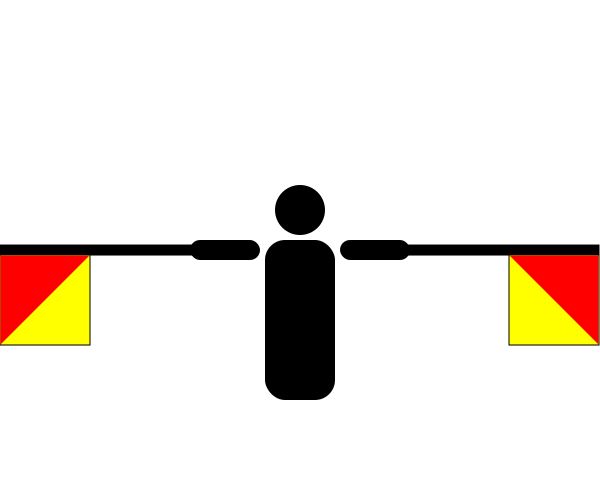
Semaphore


There are approximately 76 people named Krug in the UK. That makes it one of Britain's least common surnames. Only around one in a million people in Britain are named Krug.
Region of origin: Europe
Country of origin: Germany
Language of origin: German
