KOPF
Kopf is a surname of German origin, derived from the Middle High German word kopf, which translates directly to head in English.
The name traditionally functioned as a topographic or occupational surname. It was commonly bestowed upon individuals who possessed a distinctive or prominent head, or alternatively upon those who served as a headman or leader within a community. In medieval contexts, the surname could also denote a person of intellectual distinction or a thinker who was regarded as the “head” of a group.
Historical records illustrate a wide range of spellings that have been used to identify the same family line. Variants such as Kop, Kopp, Koppe, Koppke, Koppeck, Koppen, Kopfen, Kopfer, and Kopmann have appeared in German and Dutch documents, while Kopec and Kopta are recognised in Polish and Czech usage respectively.
In German historical sources it is recognised that the surname may have arisen either as a nickname for a person with a bald or otherwise striking head, or as an occupational designation for a maker of cups or flasks. Such vessels, particularly when inverted, bear a resemblance to a bald head, a visual analogy that may have informed the surname’s application.
Poland presents an alternative interpretation, where the name can be locational, applied to someone residing at the head of a valley or hill. In the case of the spelling Kopczynski, the surname has been understood to refer to a landowner or a person who possessed the land upon which a hill stands. In both Poland and the Czech Republic a secondary meaning relates to the occupation of chimney sweep, a worker who must literally climb to the top of a chimney in the course of his trade.
Early documentary evidence of the name in German municipal records includes figures such as Bertholdus Koppo of Augsburg in 1221, Henrich Kopf of Ravensburg in 1321, and Elewardus Copman of Hamburg in 1485. These instances confirm the surname’s utilisation well before the modern era.
Beyond the Germanic sphere, the surname has become common in Austria and has spread globally through migration. In the United States concentrations of individuals bearing the surname are most pronounced in the states of Ohio, Pennsylvania, and New York, a pattern that mirrors historical immigration routes from German-speaking regions.
Over time the surname has undergone spelling variations that reflect regional dialects, transliteration practices and the influence of other languages. Forms such as Koepp, Köpff, Koepf, Kipf, and Kopfe illustrate how orthographic standards have evolved. In English‑speaking contexts, some bearers of the name have Americanised or Anglicised it, occasionally translating it directly to Head.
Compound surnames that incorporate Kopf also exist, for example Kopfschneider, meaning head cutter, and Kopfpeter, meaning Peter’s head. These variations demonstrate the surname’s integration into a broader system of compound naming within Germanic linguistic traditions.
In contemporary usage, Kopf remains an established surname within German, Austrian and wider diasporic communities, retaining its historical associations with leadership, topography, and distinctive physical characteristics. Its etymological roots in the word for head continue to inform scholarly understanding of its origin and early application.
Similar and related surnames
Related and similar names are generated algorithmically based on the spelling, and may not necessarily share an etymology.
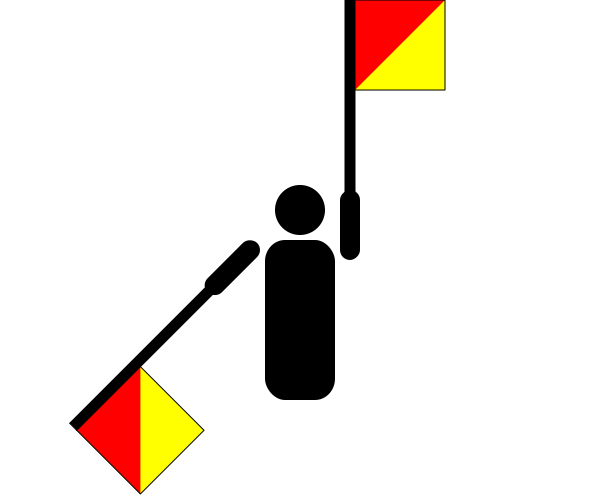
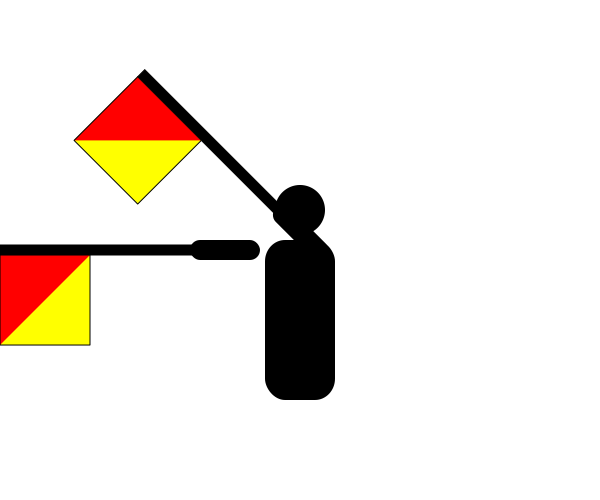
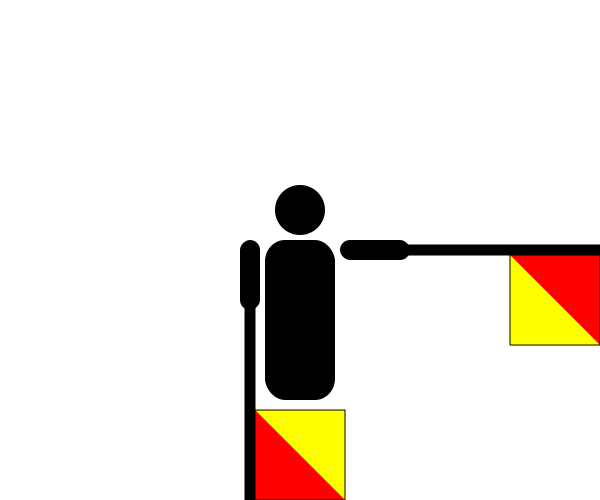
How to communicate the surname Kopf in...
Braille
⠅⠕⠏⠋
Morse
-.----.--...-.
Semaphore

There are approximately 24 people named Kopf in the UK. That makes it one of Britain's least common surnames. Fewer than one in a million people in Britain are named Kopf.
