KOCK
Kock is a surname of several European origins, most commonly found in the Dutch, German, and Anglo‑Scottish linguistic traditions. The name is traditionally understood as an occupational designation, referring to individuals who practised the culinary trade, but it also carries a topographic dimension in certain cases.
In the Dutch context, Kock derives directly from the word kock, the Dutch term for a cook. The surname would have originally been applied to a person who was employed in preparing food in a household or public setting, or who was otherwise noted for his culinary skill. The Dutch form of the name is generally written Koch or Koc, though the spelling Kock has been recorded as well.
German usage of the surname is similarly occupational, stemming from the Middle High German word koc, meaning cook. A separate meaning exists in the Middle High German word kok, from which the name can denote a person living near a chapel, a topographic association. The name appears in many Germanic language regions, and variants such as Koch, Kocher, Koechle, Koechling and others have arisen over time due to dialectical differences and the lack of standardised spelling until the early twentieth century.
In Scotland, England, and Ireland, Kock is occasionally seen as a variant of the older place-based surnames Knock, Knox and related forms. These surnames originate from the Old English word cnocc or the Gaelic cnoc, meaning a round-topped hill, and indicate a topographical association with a hilltop or a locality named Knock. Historical transcriptions include names such as John de Cnoc in 1260, Nicholas Knok in 1279, and Thomas atte Knocke in 1296, illustrating the antiquity of the surname in the British Isles.
Official records from medieval and early modern periods confirm the persistence of the name across Europe. Examples include a Joseph, the son of Thomas and Angel Knock, christened in 1691 in London, and a John Knock who married in 1645. The spread to North America began with Protestant migration in the seventeenth and eighteenth centuries, bringing the name to the United States where it remains in use.
Modern demographic data show that Kock remains common in Germany, where variants such as Koeck, Koch, and Kueck are found. In the Netherlands, the surname is typically spelled Koch or Koc, with a significant concentration in North Holland, South Holland, and Zeeland. In Sweden, the name was introduced through German immigration in the eighteenth and nineteenth centuries, and currently over eight thousand individuals bear the name. Denmark, particularly the island of Bornholm, records more than one thousand holders of the surname. The name can also be encountered in Belgium, Sweden, Latvia, Estonia, and Russia, reflecting its broad European distribution.
Throughout its history, the surname Kock has demonstrated resilience and adaptability, surviving through shifts in spelling conventions, migrations, and the blending of occupational and locational identities. Its enduring presence across diverse linguistic communities illustrates the common cultural heritage that underpins European surname practices.
Typical given names associated with the Kock surname
Male
- Daniel
Female
- Joanna
Similar and related surnames
Related and similar names are generated algorithmically based on the spelling, and may not necessarily share an etymology.
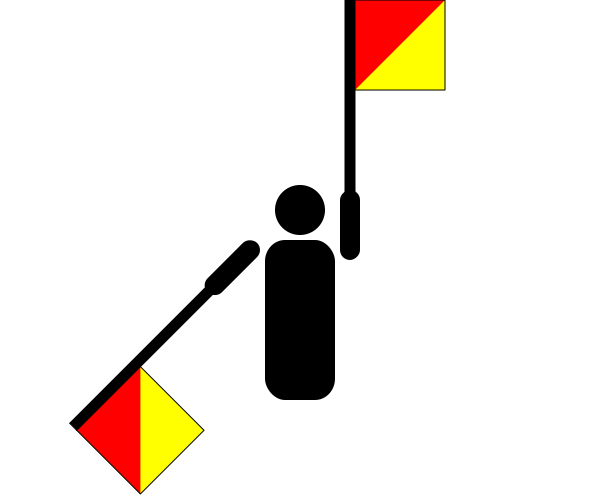
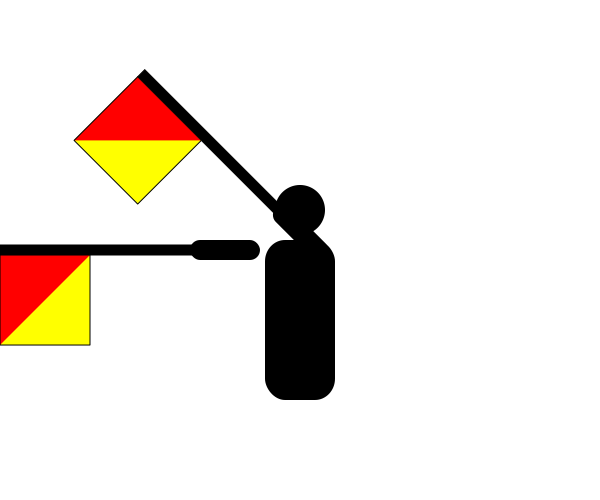
How to communicate the surname Kock in...
Braille
⠅⠕⠉⠅
Morse
-.-----.-.-.-
Semaphore

There are approximately 101 people named Kock in the UK. That makes it one of Britain's least common surnames. Only around two in a million people in Britain are named Kock.
