KNIPE
The surname Knipe is an English family name with roots that extend into both Norse and Old English linguistic traditions. According to historical etymology, it is derived from the Old Norse word knípr, meaning a steep hill or cliff, a characteristic that explains its status as a locational name. This origin points to a population that originally settled in the rough, elevated terrain that defines parts of northern England.
The earliest documentary appearance of the name in England dates from the 12th century, where a record in the Pipe Rolls of Durham lists a Richard Knap in 1176. Contemporary handwriting of that period distinguishes Knap and Knape as spellings that appear in a number of medieval documents. By the late 14th century the spelling had evolved to become Knipe, as seen in the 1379 witness list for a clerk who was involved in a trial in Lichfield. Over the centuries the name has persisted in a handful of forms, including Knyp, Knippe and Knyppes.
Arising as a topographic and, at times, occupational label, Knipe may have denoted either a dwelling by a knobby hill or an individual who served at a young age, deriving from the Old English word cnapa – a servant or boy. The duality of these origins is reflected in the name’s continued association with physical peaks and with descriptors of energy, loyalty and ambition.
The family name is concentrated in the northern regions of England. In the 20thcentury census the name was most common in the counties of Lancashire and Yorkshire, and more particularly in the towns of Burnley, Blackburn, Leyland and Ashton‑under‑Lyne. Cumbria and West Yorkshire also show a significant number of bearers, a pattern that aligns with the geographical meaning of the surname. Across the Irish Sea, the name can be found in the northern counties of Armagh and Cavan, where early 17th‑century records point to migration from northern England.
Internationally, Knipe has spread far beyond the United Kingdom. In the United States it is most frequently encountered in the mid‑west and California, usually rendered as Knapp, while in Australia notable concentrations appear in the suburbs of Sydney. A minor presence exists in Wales and in the Republic of Ireland, where the name is relatively uncommon.
In addition to its English lineage, some sources regard Knipe as the anglicised form of the Dutch surname Kneppel, a word meaning “stump”. This explanation suggests a possible occupational origin relating to carpentry or footwear production, although it is less frequently cited than the English-derived accounts.
Variants, plural forms and related surnames provide further insight into the evolution and migration of the family name. Common variants include Nype, Nyppe, Knippe, Knypp and Knypes. Surnames that share a similar topographic or occupational derivation are Knibb, Knob, Knowles and Knox. Historical records have linked Knopp and Knoppé to the word knob – a lumpy hill – showing that families with the surname Knipe likely inhabited comparable landscapes.
According to the latest United Kingdom census the surname Knipe is borne by approximately eleven thousand people. The majority of these individuals reside in England, with a small number recorded in Scotland and Wales, reflecting the surname’s predominant English origins while acknowledging its broader distribution across the British Isles.
Typical given names associated with the Knipe surname
Male
- Christopher
- Darren
- David
- James
- John
- Kevin
- Paul
- Peter
- Richard
- Robert
- Stephen
- William
Female
- Adrienne
- Dorothy
- Elizabeth
- Helen
- Janet
- Jean
- Jennifer
- Joan
- Margaret
- Mary
- Sally
- Sarah
- Susan
- Yvonne
Similar and related surnames
Related and similar names are generated algorithmically based on the spelling, and may not necessarily share an etymology.
How to communicate the surname Knipe in...
Braille
⠅⠝⠊⠏⠑
Morse
-.--....--..
Semaphore
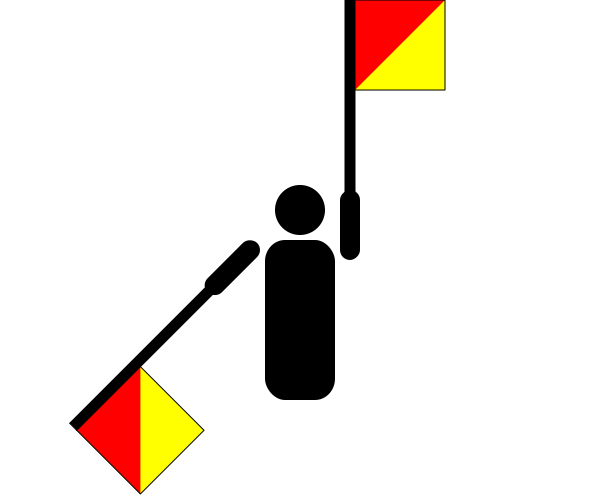
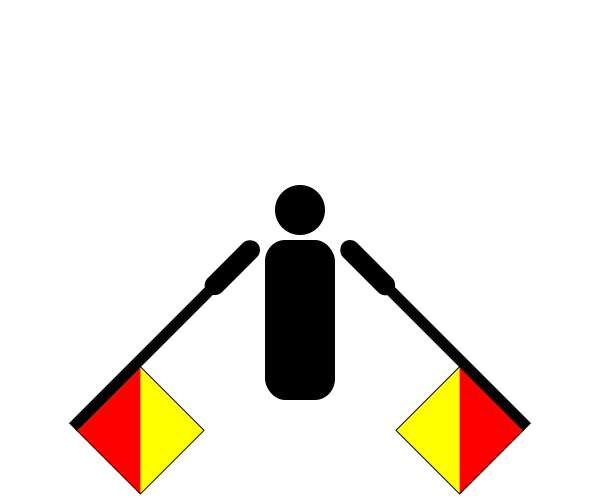
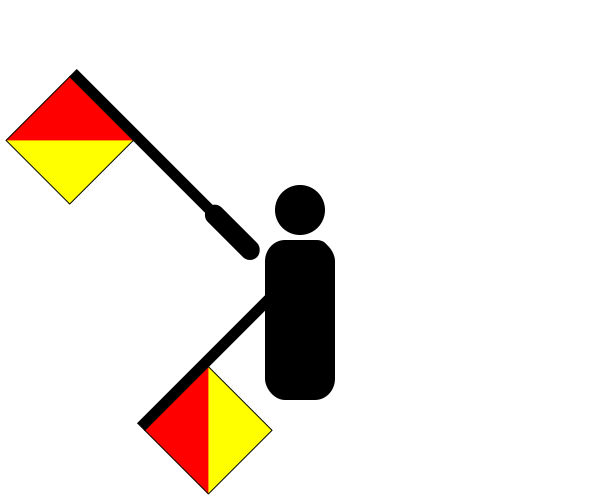


There are approximately 1,017 people named Knipe in the UK. That makes it roughly the 7,286th most common surname in Britain. Around 16 in a million people in Britain are named Knipe.
Origin: English
Region of origin: British Isles
Country of origin: England
Religion of origin: Christian
Language of origin: English