KNIGHTS
Knights is an English surname that originally derives from the Middle English word knight, which denoted a mounted warrior or, later, a servant in a noble household. The name was first applied as a nickname or occupational designation to a person who served as a knight or possessed the qualities associated with knighthood, such as bravery or chivalry. Over time, Knights became a hereditary family name, often signalling a lineage that could be traced back to a historical connection with knighthood or the medieval nobility.
The earliest form of the word is the Old English and Anglo‑Saxon cniht, meaning “a mounted soldier” and indicating a man of importance and substance. By the late Middle Ages the term knight described both horse‑soldiers and people who had been conferred a status by the king for loyal service, even if they had not seen battle. In these circumstances a knight might be known as Sir Knight, a title that later lost its suffix in most English usage.
As the social structure of medieval England evolved, the occupational and status implications of the term broadened. The surname Knights was often used to identify the son or descendant of an individual who bore the title knight(), and so carried a patronymic sense. Variations of the name proliferated, reflecting regional spelling differences and phonetic shifts: Knight, Knights, Knyvett, Knivett, Knivit, Nevet, Nevit, Newit and Newet.
Recorded instances of the surname date back to the mid‑12th century. The Pipe Rolls of Norfolk (1166) contain the entry Godefridus Niht, and the Norfolk pipe rolls name Oscetel Cniht in the same period. The Oxford Oseney Rolls (1200) list Walter le Knit and the Assize Rolls of Worcester (1221) record William Knicht. The Somerset Subsidy Rolls (1327) mention Alicia Knyghtes. A later example is the marriage record of Elizabeth Knight and William Smith (1622) in Dublin, and the unusual name of Know God Knight, a Puritan, whose son John was christened at St James Church, Clerkenwell, London (1 July 1638).
The coat of arms granted to the family in 1550 bears the blazon: per chevron engrailed silver and black, three giffins passant counterchanged. This heraldic device reflects the martial connotations of the name and the family’s association with the chivalric tradition.
Today, the surname Knights remains a marker of English heritage, linking present‑day bearers with a lineage that stretches back to the Anglo‑Saxon era and the early days of the medieval knighthood. The enduring use of the name testifies to its historical significance and the continuity of traditional English surnames through the centuries.
Typical given names associated with the Knights surname
Male
- Andrew
- Christopher
- David
- John
- Mark
- Michael
- Paul
- Peter
- Richard
- Robert
Female
- Claire
- Emma
- Jane
- Julie
- Karen
- Margaret
- Michelle
- Patricia
- Sarah
- Susan
Similar and related surnames
Related and similar names are generated algorithmically based on the spelling, and may not necessarily share an etymology.
How to communicate the surname Knights in...
Braille
⠅⠝⠊⠛⠓⠞⠎
Morse
-.--...--.....-...
Semaphore
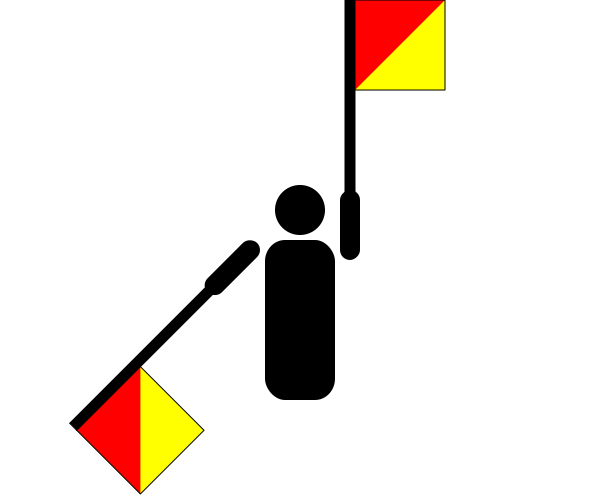
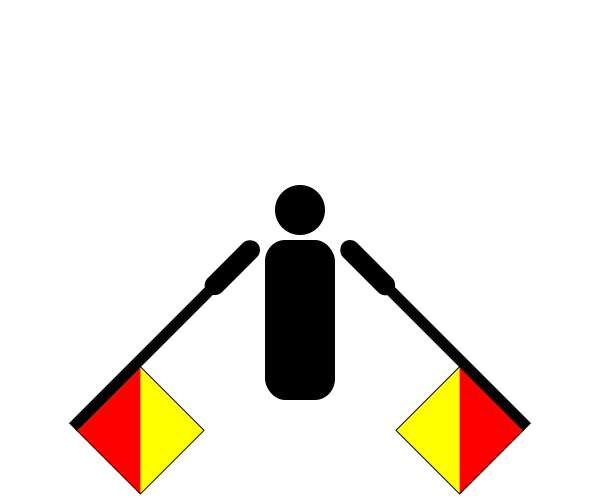
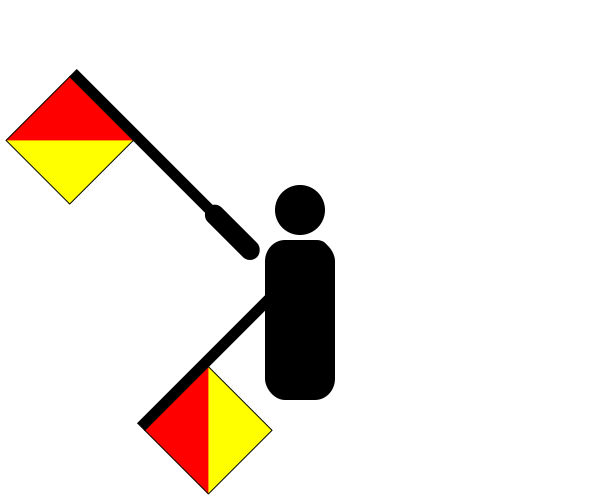


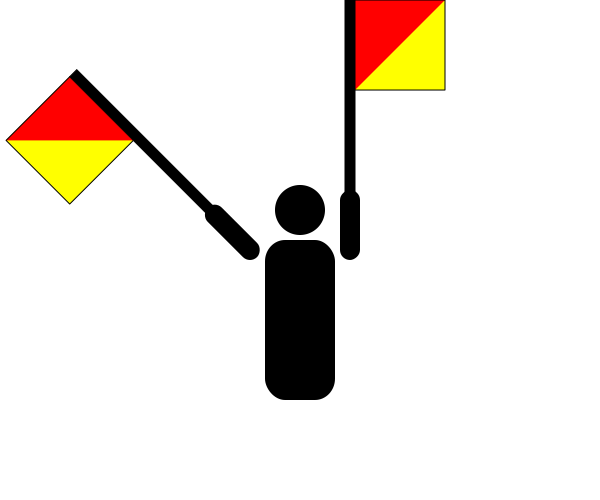

There are approximately 7,014 people named Knights in the UK. That makes it roughly the 1,343rd most common surname in Britain. Around 108 in a million people in Britain are named Knights.
Origin: English
Region of origin: British Isles
Country of origin: England
Religion of origin: Christian
Language of origin: English

Famous people named Knights
- Christopher Knights - Voice actor, film editor and camera operator
- David Knights - Musician
- Darryl Knights - Football player
- Lionel Charles Knights - Literary critic (1906 to 1997)
- Bethan Knights - Distance runner
- David Knights-Whittome - Photographer (1876 to 1943)
- Tony Knights - Football player (1940 to 2001)
Names and descriptions courtesy of Wikipedia, and may contain errors. This is not intended to be an exhaustive list of every famous person with this name.