KNELL
Knell is an English surname with roots that can be traced back to the early medieval period. The name is recorded as early as the twelfth century and has been documented in various legal and property records across England.
The derivation of the surname is twofold. In the Middle English period the word knell denoted the solemn toll of a bell, a sound that was often associated with death or solemn service. Consequently the name may have been used as a nickname for a person who lived near a church, a bell tower or who performed the task of ringing bells for the community. An alternate origin lies in the Anglo‑Saxon term cnyll, meaning a small hill or hillock, a cognate of the modern word knoll. Topographical surnames that referred to a hill, a summit or one's proximity to one were among the earliest established in England.
The earliest known written instance is that of Alvredus de Knelle dated 1220 in the Curia Regis rolls of Sussex. The name also appears in the Domesday Book of 1086 as Chenille, a place later recorded as Cnulla and Knulle in the Book of Fees of 1242 and 1249. The locational form of the name is linked to the village of Knill in Herefordshire, from which several families took their surname when they migrated to other parts of the country.
A notable bearer of the surname is William Adolphus Knell (d. 1875), a marine‑painter who exhibited at the Royal Academy and the British Institution between 1826 and 1866. One of his paintings, Landing of Prince Albert, was purchased for the royal collection. The prominence of the name in artistic circles during the Victorian era is well recorded in contemporary directories and art catalogues.
In modern times the surname remains uncommon. In the United Kingdom it is primarily seen in the Midlands, with approximately 150 individuals recorded in Derbyshire and Nottinghamshire. In the United States the name appears in small numbers, chiefly in Pennsylvania and Indiana, where each state hosts about 350 people with the surname. The diaspora has produced a wide range of spellings such as Knill, Knoll, Knyll, Knolle, Knott and others, reflecting both phonetic variation and the influence of immigration processes. The persistent connection of the surname to bell‑ringing, hilltop topography or the historic locality of Knill underlines the deepening historical ties that have survived to the present day.
Typical given names associated with the Knell surname
Male
- Christopher
- David
- Ian
- James
- John
- Matthew
- Michael
- Paul
- Peter
- Stephen
- Thomas
Female
- Amanda
- Charlotte
- Diana
- Elizabeth
- Hazel
- Jacqueline
- Josephine
- Laura
- Linda
- Margaret
- Maureen
- Patricia
- Samantha
- Sarah
- Tracy
Similar and related surnames
- Knill
- Kneller
- Knall
- Kneale
- Kneal
- Kneel
- Kneil
- Kneill
- Knol
- Nall
- Neal
- Neall
- Neeal
- Neel
- Neil
- Nel
- Nele
- Nell
- Nella
- Nelle
- Nelles
- Nelli
- Nellie
- Nells
- Nelly
- Nels
- Nelz
- Niell
- Niells
- Nill
- Nille
- Knealey
- Nalls
- Neail
- Neale
- Neally
- Neals
- Neele
- Neels
- Nehls
- Neill
- Neillie
- Neilly
- Neils
- Nela
- Neli
- Nellas
- Nelley
- Nellis
- Nelu
- Niel
- Nielly
- Nil
- Nilles
- Nills
- Nol
- Noall
Related and similar names are generated algorithmically based on the spelling, and may not necessarily share an etymology.
How to communicate the surname Knell in...
Braille
⠅⠝⠑⠇⠇
Morse
-.--...-...-..
Semaphore
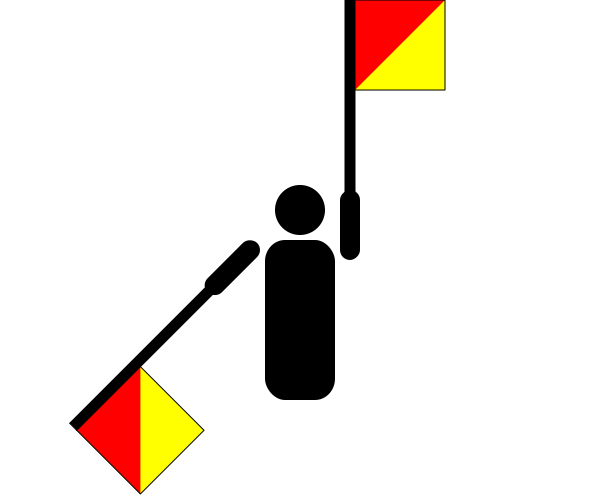
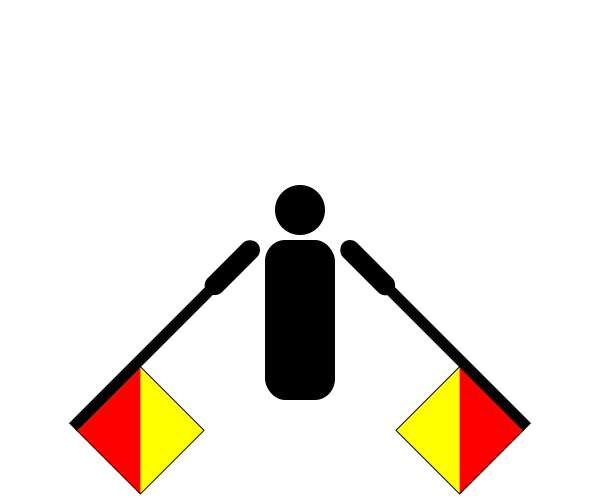


There are approximately 1,021 people named Knell in the UK. That makes it roughly the 7,255th most common surname in Britain. Around 16 in a million people in Britain are named Knell.
Surname type: Location or geographical feature
Origin: English
Region of origin: British Isles
Country of origin: England
Religion of origin: Christian
Language of origin: English
