KLEE
The surname Klee is of German origin, deriving from the Middle High German word kle, which translates as “clay” or “mud.” The name was originally a topographic designation given to individuals who resided near clay-rich or marshy ground. In some cases, it functioned as an occupational marker for those who worked with clay, such as potters, brickmakers or tile makers, who would have been involved in the production and supply of building materials.
Another line of etymology connects the surname to the Middle High German kle meaning “clover,” itself stemming from the Old High German kleo. Under this view, Klee could have been a metonymic occupational name for a clover grower who supplied forage for cattle. This interpretation is supported by the appearance of related surnames—Kleeman, Kleeborn, Kleehuhler, Klees and Kleewein—which are listed in German church registers from the late sixteenth century.
The earliest recorded instance of the name appears in 1361 as Hans Kle, a tenant farmer in Oberstdorf, Southern Germany, during the reign of Emperor Charles IV, the Holy Roman Emperor. Further early evidence is found in the marriage of Barbara Klee to Niclass Jeckels on 22 August 1574 at Birkenfeld, Oldenburg, and in the christening of Barbaram Klee on 19 April 1583 at Pfalf, Germersheim, Baden.
A coat of arms was granted to a family of this name at Cleves. The blazon consists of a gold shield. Two blue swords are crossed diagonally; three green trefoils—one positioned in the chief, one to the left and one to the right—are placed on the field. The trefoil motif likely alludes to the clover or clod of earth associated with the surname.
Variations of the spelling—such as Clee, Kleem, Klein, Kley, Klemen, Kleemann, Kleeman, Kleesen, Kleese, Kleesmann and Kliemann—are found across Germanic, Yiddish, Dutch, Afrikaans and English‑speaking records. In England, the surname was adopted by individuals of German descent immigrating during the nineteenth century, and the name can sometimes be seen as a variant of Klay, itself a Germanic surname.
In contemporary times, the surname is mainly concentrated in Germany, Switzerland and Austria, with a notable density in the German state of Brandenburg where it ranks as the twenty‑third most common surname. In the United States, approximately 40,000 people carry the name, largely in Pennsylvania, California, New Jersey and New York, reflecting the pattern of German immigration in the 1800s.
The surname Klee therefore encapsulates a range of occupational and locational origins tied to clay and clover, a linguistic heritage reflected in diverse spellings and a preserved heraldic symbol that signals the historical depth of the name across Europe and America.
Typical given names associated with the Klee surname
Male
- Adam
- David
- Martin
- Nicholas
- Paul
- Peter
- Richard
- Robert
- Stephen
- Steven
- Stuart
Female
- Alexandra
- Caroline
- Catherine
- Christine
- Jennifer
- Jillian
- Laura
- Lauren
- Linda
- Sarah
Similar and related surnames
Related and similar names are generated algorithmically based on the spelling, and may not necessarily share an etymology.
How to communicate the surname Klee in...
Braille
⠅⠇⠑⠑
Morse
-.-.-....
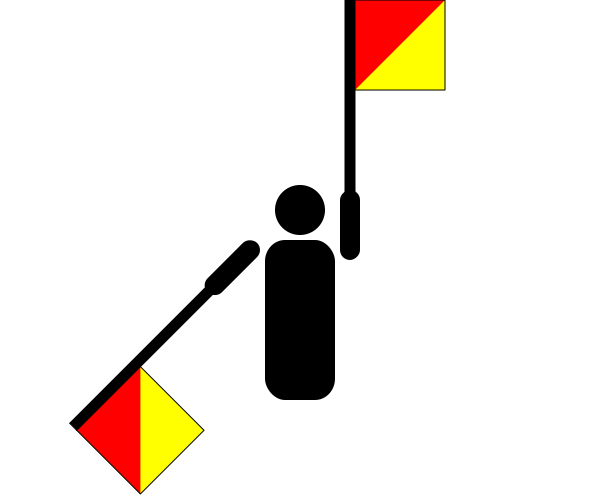
Semaphore


There are approximately 143 people named Klee in the UK. That makes it one of Britain's least common surnames. Only around two in a million people in Britain are named Klee.
Origin: English
Region of origin: British Isles
Country of origin: England
Religion of origin: Christian
Language of origin: English
