KLAUS
Klaus is a surname of Germanic origin that is widespread across Europe and the Americas. It is recognized as one of the most common family names in Germany and is also well established in Austria, Switzerland, and various English‑speaking countries.
The name is a patronymic form derived from the given name Klaus, a contracted variant of the Germanic Nicolaus. The original Greek form of the name, Nikolaos, translates literally as “victory of the people” or “people’s triumph”. Consequently, the surname Klaus may be interpreted to mean “descendant of Nicholas” or “son of the victorious one”.
Historical documentation of the surname appears in medieval German charters, with the earliest recorded instance being that of Uzo Claus of Eblingen in the city charter of 1294. Subsequent records include Henricus Claus of Eblingen (1323), Wolframus Klusner of Goddelau (1398), and Tobias Clausnitzer of Thun (1619). These entries confirm the surname's presence in the Holy Roman Empire from at least the early thirteenth century.
Throughout its history, Klaus has undergone a wide range of orthographic variations. Common variants include Claus, Clauss, Klaus, Klauss, Klause, Kloß, Klose, and Klausen. In Polish, the surname appears as Kłaus. Other language‑specific spellings are found in Dutch (Klaatsen), Danish (Klaaues), Swedish (Klasson), Italian (Clausi), Hebrew (Koohes), and Spanish (Claus).
In the modern era, Klaus remains a popular surname in southern Germany, ranking within the top twenty in the states of Bavaria and Baden‑Württemberg according to the 2018 census. It is likewise highly ranked in Austria and Switzerland, frequently appearing among the most common family names in both nations.
In North America, the surname is borne by more than thirteen thousand individuals in the United States. It is most common in the states of Wisconsin and Iowa, where it falls within the top five hundred surnames. Canadian and Latin American populations also contain bearers of the name, with significant numbers recorded in Mexico, Brazil, and Argentina.
Beyond Europe and the Americas, Klaus can be found in diverse locales including South Africa, Indonesia, Iraq, Iran, and Israel. This dispersion reflects migration patterns from Germanic regions throughout the twentieth and early twenty‑first centuries.
The cultural significance of the surname has been underscored by its association with knightly and noble families in the Middle Ages. Records indicate that the name was carried by princes, counts, and other high‑ranking individuals within the Holy Roman Empire, where it signified status and prestige. Such heritage continues to be recognised today, contributing to the name’s enduring reputation for success and distinction.
Notable contemporary bearers of the surname include Klaus Iohannis, who was elected president of Romania in 2011, and Andreas Dresch, a respected physiotherapist whose work has gained international recognition. These examples illustrate the surname’s continued relevance across multiple fields.
In summary, Klaus is a historically rich surname rooted in Germanic tradition, with a meaning tied to victory and people’s triumph. Its extensive record in medieval documents, widespread contemporary distribution, and association with nobility underscore its lasting prominence within the European cultural landscape and beyond.
Similar and related surnames
Related and similar names are generated algorithmically based on the spelling, and may not necessarily share an etymology.
How to communicate the surname Klaus in...
Braille
⠅⠇⠁⠥⠎
Morse
-.-.-...-..-...
Semaphore
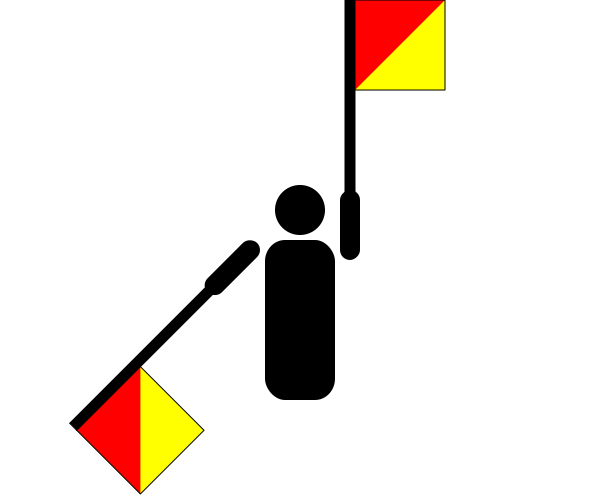


There are approximately 88 people named Klaus in the UK. That makes it one of Britain's least common surnames. Only around one in a million people in Britain are named Klaus.
Region of origin: Europe
Country of origin: Poland
Language of origin: Polish
