KINNEAR
Kinnear is a surname of Scottish origin, founded upon the Gaelic language and historically linked to the Christian communities of the British Isles. The etymology is chiefly derived from the Gaelic phrase Mac an Fhir, which translates literally as “son of the man.” This patronymic construction indicates that the earliest bearers of the name were identified as descendants of an individual named Fhir. Over time, the form evolved into the modern spelling Kinnear, and the name found its way into historic documents throughout Scotland and later into other English‑speaking territories.
Another substantial element of the surname’s origin is locative in nature. Records from the early medieval period, including the Records of the Priory of St. Andrews, document a place called Kinneir in the county of Fife, near the village of Wormit. The earliest written reference, namely the entry Symon de Kyner dated 1216, occurs during the reign of King Alexander I of Scotland (1214–1249). The placename itself appears as “Kyner” at the start of the thirteenth century, derived from the Gaelic ceann meaning “headland” and the suffix ‑iar meaning “to the west.” The family that adopted this toponymic surname were vassals of the priory of St. Andrews, holding their lands until the early eighteenth century. Notable historical figures bearing the name include Petrus Kynior, elected common councillor of Aberdeen in 1477, and John de Kynor, admitted burgess of the same city in 1439. In 1574 Henry Kinneir of Kinneir was appointed commendator of Balmerino Abbey.
Evidence of the surname’s reach beyond Scotland appears in the early nineteenth century. A document records James Kinner and his family, of whom the son Edward was aged two, emigrating from Liverpool aboard the Columbia bound for New York on 31 July 1846. The surname continued to be used in diverse contexts, as illustrated by the marriage of Thomas Kinnear to Elisabeth Mason at St. Leonard’s, Shoreditch, on 28 September 1780.
The heraldic tradition associated with the name includes a coat of arms awarded to a Kinnear family. The blazon describes a black field with a gold bend bearing three canary birds proper. The crest is composed of two anchors saltireways proper. These symbols are recognisable in the lineage of families who have borne the surname.
Distributionally, Kinnear remains most common in Scotland, with the largest density concentrated in Aberdeenshire, where, according to the United Kingdom Office for National Statistics, approximately 0.29 % of the local population carries the name. It is also found in Clendon and other areas of Scotland, as well as in certain parts of England, notably along the northeast coast, the West Midlands, and Devon and Cornwall in the southwest. Within Ireland, the name is most closely associated with County Tyrone, particularly the Strabane district, where around 0.19 % of the population bears the surname. The name occurs, in smaller numbers, in County Cork, Down, Londonderry, Dublin, Wicklow and Wexford. Outside the British Isles, the surname is detected in Canada’s Ontario province at a frequency of roughly 0.09 %, and in the United States, chiefly in Pennsylvania, New York and North Carolina. Smaller but tangible communities are also present in Australia, New Zealand and Germany.
Variants of the surname are widely recognised and include Kenner, Kinner, Kinnar, Kynor, Keanor, Kinnier, Kinair, Kinear and others. These alternate forms typically arise from differing pronunciations, dialects or orthographic conventions within Scots and surrounding languages. Some derivative surnames or compound forms, such as Kinnearson, have also appeared, reflecting the evolution of naming practices over time. Although unverified, the surname has occasionally morphed into similar‑sounding surnames in other cultures, such as Kinney, Kenney and MacQuinney, often reflecting anglicisation or regional linguistic influences.
In all recorded instances, the surname Kinnear retains a clear association with Scottish heritage, Gaelic linguistic roots and a historical lineage of landholding, ecclesiastical involvement and community standing. The continuity of the name across centuries and geographic boundaries attests to its enduring cultural significance within the United Kingdom and its diaspora.
Typical given names associated with the Kinnear surname
Male
- Andrew
- Anthony
- Brian
- David
- Ian
- James
- John
- Michael
- Paul
- Robert
- William
Female
- Catherine
- Christine
- Elizabeth
- Fiona
- Gillian
- Jean
- Jennifer
- Kathryn
- Margaret
- Pamela
- Patricia
- Sarah
- Susan
Similar and related surnames
- Kanner
- Kenner
- Kenar
- Keiner
- Kanar
- Kennear
- Kenear
- Kannar
- Kennar
- Kennare
- Kiener
- Kinary
- Kinear
- Kineary
- Kiner
- Kinnair
- Kinnar
- Kinnard
- Kinnare
- Kinneard
- Kinneary
- Kinneer
- Kinneir
- Kinner
- Kinnery
- Kinniar
- Kinnier
- Kinniry
- Kannair
- Kennair
- Kennier
- Kinard
- Kiniry
- Kinna
- Kinnaird
- Kinnarny
- Kinnay
- Kinnerly
- Kinory
- Kinra
- Kunar
- Kunner
- Connor
- Gunner
Related and similar names are generated algorithmically based on the spelling, and may not necessarily share an etymology.
How to communicate the surname Kinnear in...
Braille
⠅⠊⠝⠝⠑⠁⠗
Morse
-.-..-.-...-.-.
Semaphore
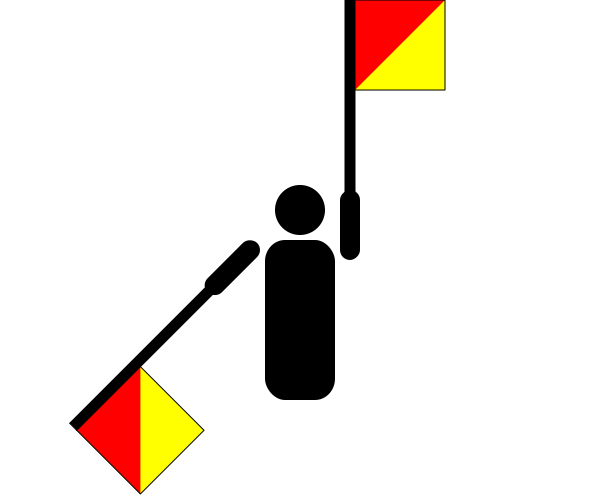
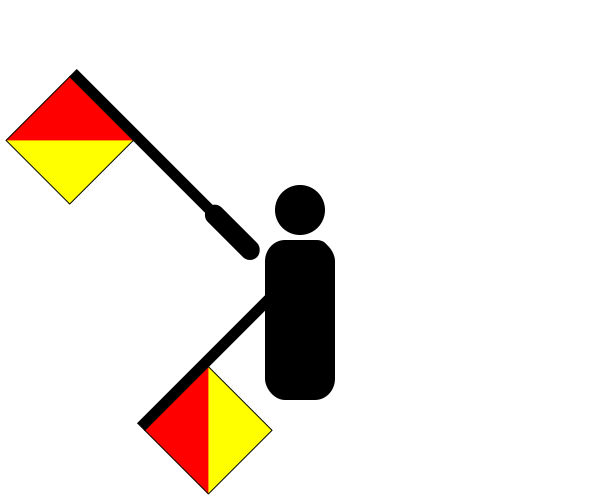
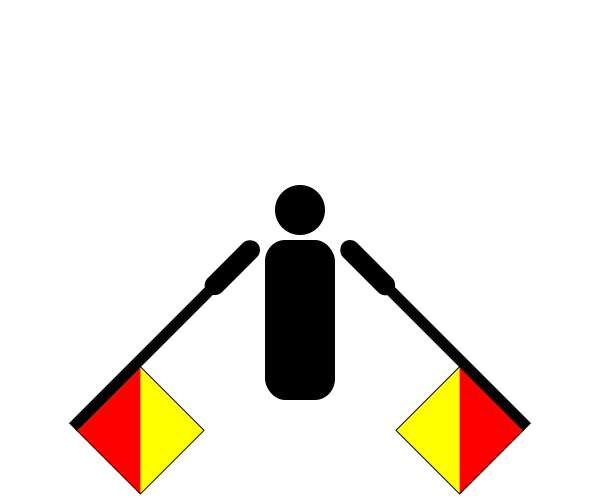


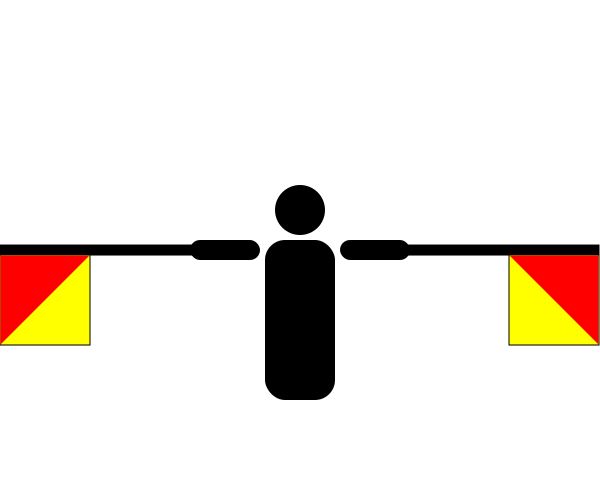
There are approximately 2,110 people named Kinnear in the UK. That makes it roughly the 4,017th most common surname in Britain. Around 32 in a million people in Britain are named Kinnear.
Origin: Celtic
Region of origin: British Isles
Country of origin: Scotland
Religion of origin: Christian
Language of origin: Gaelic

Famous people named Kinnear
- Rory Kinnear - Actor and playwright
- Roy Kinnear - Actor (1934 to 1988)
- Greg Kinnear - American actor
- Roy Kinnear - Scottish rugby union and rugby league football player (1904 to 1942)
- Dominic Kinnear - American soccer player-coach
- Norman Boyd Kinnear - Scottish zoologist and ornithologist (1882 to 1957)
- Wally Kinnear - Rower (1880 to 1974)
- Bert Kinnear - Swimmer (1923 to 2011)
- Alexander Kinnear, 1st Baron Kinnear - Judge (1833 to 1917)
Names and descriptions courtesy of Wikipedia, and may contain errors. This is not intended to be an exhaustive list of every famous person with this name.