KILDUFF
Kilduff is a surname of Gaelic origin, traditionally associated with the British Isles, particularly Ireland and Scotland. It is a patronymic name, employed historically to identify the descendants of a specific male ancestor.
The name derives from the Old Irish term Mac Giolla Dhuibh, which translates literally as “son of the dark‑haired servant.” The element Giolla indicates a servant or follower, while Dhuibh denotes dark‑haired or black‑haired, giving the surname a clear descriptive element.
Early records show a variety of spellings, including Macildue, Macilduy, Macilduf, MacKilduff, and the shortened form Kilduff. Other variants that have been documented are Kildoff, Kildof, Kildough, Kildoof, and Kildorf, as well as surnames of the same root such as Kildow, Kilday, and Killduff.
The earliest surviving reference to the name occurs in 1275, when Gillicrist Macgilliduffi granted lands at Ouchter‑Tarradale to the monks of Beauly. In 1461 a person identified as Gilbert Mc ilduf held a tenement in the town of Dumfries. Such instances confirm the presence of the name in both Ireland and Scotland from at least the late thirteenth century.
There are several historic structures bearing the Kilduff designation. Two Kilduff castles or homesteads are situated in Scotland, at Kinross and in East Lothian, while a third is located in County Galway, Ireland. The name of the castles is not derived from the literal meaning “black‑headed one” but rather serves as an identifier of the families who once occupied or owned the properties.
In contemporary times the surname remains most commonly found in countries settled by the Irish diaspora. Within the United Kingdom it is frequent in London, East Anglia and the North West, and it tends to be associated with Roman Catholic heritage. In Australia it appears among residents of Canberra, Adelaide and Brisbane, ranking within the top fifty surnames according to 2018 data. In the Republic of Ireland it featured among the top one hundred surnames in the 1890 census, particularly within County Cork, Clare and Limerick. In the United States, it is predominantly recorded in New York, as well as in California and Massachusetts, while in Canada it is generally common in Ontario and also present in Alberta, British Columbia and Quebec.
Although the Kilduff lineage is no longer recognised as a formal clan or held positions of noble status, the surname continues to be borne by individuals worldwide, preserving a link to its ancient Gaelic heritage and the historical communities of Ireland and Scotland.
Typical given names associated with the Kilduff surname
Male
- David
- Gary
- James
- Joseph
- Martin
- Michael
- Nicholas
- Paul
- Peter
- Stephen
- Thomas
- Tony
Female
- Christine
- Claire
- Deborah
- Elizabeth
- Emma
- Fiona
- Hilda
- Irene
- Julia
- Laura
- Lisa
- Marie
- Mary
- Sarah
Similar and related surnames
Related and similar names are generated algorithmically based on the spelling, and may not necessarily share an etymology.
How to communicate the surname Kilduff in...
Braille
⠅⠊⠇⠙⠥⠋⠋
Morse
-.-...-..-....-..-...-.
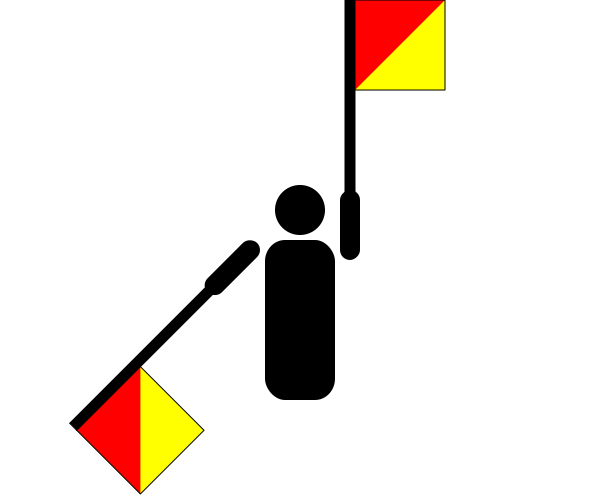
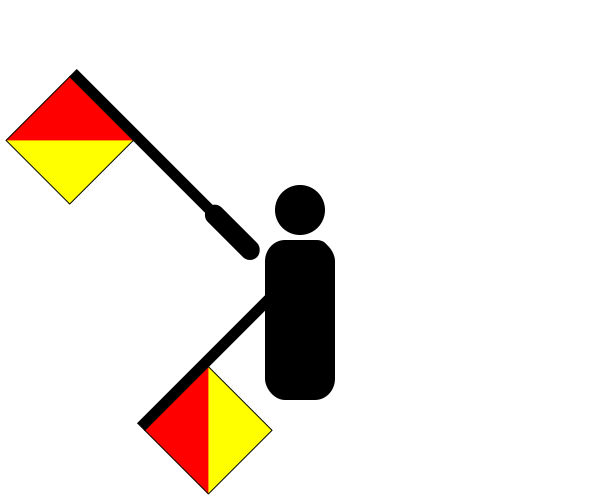
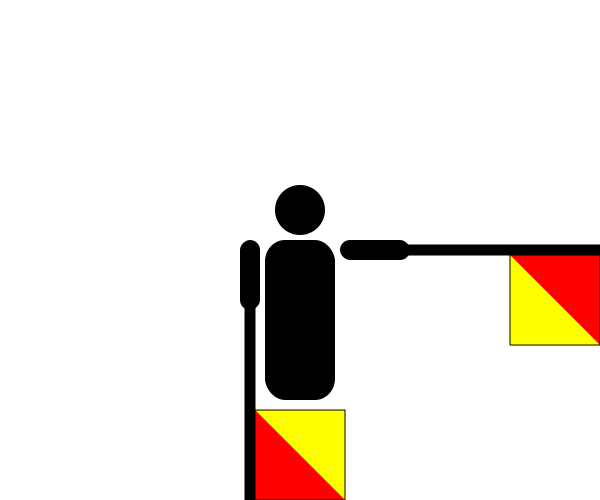
Semaphore


There are approximately 401 people named Kilduff in the UK. That makes it one of Britain's least common surnames. Only around six in a million people in Britain are named Kilduff.
Surname type: From name of parent
Origin: Celtic
Region of origin: British Isles
Country of origin: Ireland
Religion of origin: Christian
Language of origin: Gaelic
