KIER
Kier is a surname of distinctly Scottish heritage, originating from Gaelic roots. The word ceàrr in Gaelic means "left-handed" or "awkward," and historically the name was applied as a descriptive surname to individuals who possessed such a trait. Another etymological perspective identifies the name as a locational surname derived from the village of Keir in Stirlingshire, or alternatively from the personal name Ciar, which means "dark" or "swarthy." This dual possibility reflects the complexity of surnames in early Scotland, where personal and place-based origins often overlapped.
The earliest documentary evidence of the name appears in the mid‑thirteenth century. A record from 1242 lists Patrick Ker as a juror on the Marches of Fedale, Scotland, during the reign of King Alexander III. Further evidence shows a man named Alexander del Keire receiving a grant of money from the king in 1260, while Andrew del Ker is noted to have rendered homage to the Interregnum republican government of Scotland between 1296 and 1306. In 1366, a John Kere is recorded as holding lands in Aberdeen, and a monk named Robert Kar is documented in 1544 at Inchaffray. Subsequent references include Thomas Kere, treasurer of Forfar in 1558, and the brothers Donald Alexander Keir and Malcolm Keire, who witnessed a land charter in Ayrshire in 1553. These entries collectively demonstrate that the surname was firmly established in Scottish records from at least the fourteenth century.
The name has long been known in various spellings, including Keir, Kerr, Kere, Keir, and Ker. Over the centuries, phonetic changes and dialectical variation produced forms such as Keare, Keire, Keer, MacKeir, and McKeir. Connections have also been drawn with the surnames Carr and Scandinavian variants like Kjær and Kjer, although these latter forms arose independently in Denmark and Norway, often referring to marshy places or settlements named Kier or Kyr.
The Kier family possess two recorded coats of arms. The first, granted in Stirlingshire, features a silver field bearing a black cross engrailed between four red roses. An unusual second grant appeared in Calcutta, India, in 1766; it is largely the same composition but includes three gold lozenges placed on the cross. These heraldic symbols underscore the family's long-standing presence in Scotland and its later reach into the wider British Empire.
During the eighteenth and nineteenth centuries, waves of Scottish emigration carried the name to the United States, Canada, Australia, and other parts of the British Commonwealth. Because many emigrants settled in colonies and new territories, the surname is now common outside of Scotland itself, particularly in regions that were prime destinations for Scottish settlers. While the name remains a marker of Scottish origins, its distribution across multiple continents reflects historical patterns of migration and the dispersal of families over time.
In contemporary contexts, the surname Kier continues to be used in the United Kingdom and abroad. Its roots lie firmly in Gaelic language and Scottish history, and its various iterations attest to the dynamic evolution of surnames across centuries of linguistic and cultural change.
Typical given names associated with the Kier surname
Male
Female
Similar and related surnames
- Keer
- Keir
- Kire
- Iker
- Kie
- Kiero
- Kahr
- Kair
- Kaira
- Kaire
- Kairo
- Kar
- Kare
- Karr
- Kear
- Keare
- Keere
- Keers
- Kehr
- Keiro
- Keirs
- Keiry
- Keor
- Ker
- Kera
- Kere
- Keri
- Kero
- Kerr
- Kerre
- Kers
- Keyre
- Khair
- Kheir
- Kher
- Khir
- Kiar
- Kieras
- Kieres
- Kierl
- Kiers
- Kierys
- Kir
- Kira
- Kiri
- Kirr
- Kirs
- Kiru
- Kirui
- Kiry
- Koor
- Kor
- Kore
- Korr
- Kour
- Kur
- Kure
- Kurr
- Kyer
- Caira
- Carre
- Core
- Corr
- Correa
- Correia
- Corrie
- Cree
- Curr
- Gare
- Gor
- Gora
- Kaura
- Keery
- Keirl
- Kerai
- Khera
- Kierce
- Kirk
- Kirt
- Quarrie
Related and similar names are generated algorithmically based on the spelling, and may not necessarily share an etymology.
How to communicate the surname Kier in...
Braille
⠅⠊⠑⠗
Morse
-.-....-.
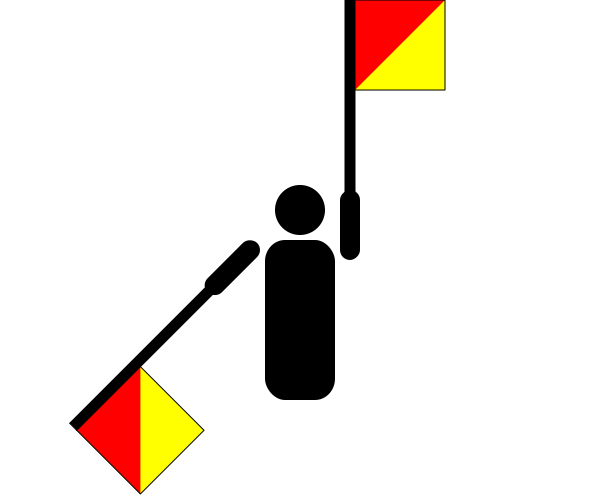
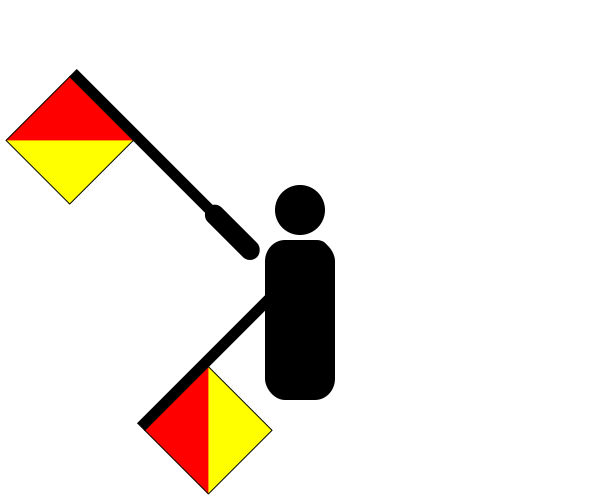
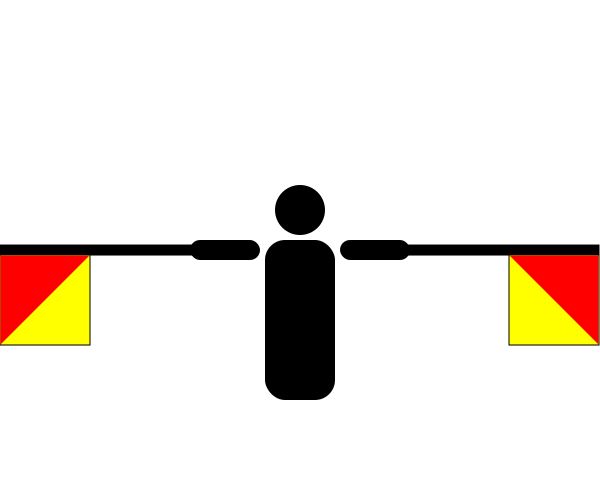
Semaphore

There are approximately 95 people named Kier in the UK. That makes it one of Britain's least common surnames. Only around one in a million people in Britain are named Kier.
