KELLAR
Kellar is a surname of German origin. Its earliest recorded spelling in England appears as William le Kylnere in the year 1292, in a Lancashire document dated during the reign of King Edward I (1272‑1307). The name is first documented in the context of the Middle English surnames of occupation.
In the German linguistic tradition, the name derives from the Middle High German word kelle, meaning “spoon”, and was traditionally an occupational surname applied to a spoon‑maker or a person who regularly used spoons. The name may also have been employed to describe an individual with a spoon‑shaped or rounded head, a notable physical characteristic documented in some medieval records.
A parallel German derivation records kellære, meaning “cellarer” or “cellar‑master”. In this sense the surname indicates a person responsible for the wine cellars or storehouses of a great house or castle. The term is a dialectal variant of Kellner, the Old High German kelnari and the Latin cellarium. The modern German sense of Kellner as “waiter” is comparatively recent, whereas the medieval use referred to cellar management. Variants such as Keller, Kelert, Kellerman and Keillor appear in the historical record and have spread to other linguistic groups.
The name also has a recognised Scottish association. Here it is understood as a topographic surname meaning “from the kettle‑hollow” or “dweller by the deep glen”. The Gaelic roots of the Scottish form comprise the words ceallaire, meaning “cellar man” or “wine merchant”, and ceall, meaning “church”. Historical records suggest a place called Kellar may have existed in Scotland during ancient times, providing a local place‑name basis for the surname. Over time, the spelling has varied to produce forms such as Keillor and Keller, with the adaptation reflecting the linguistic environment of each region.
Throughout the early modern period the surname was common across England, particularly in the Midlands and the Lancashire area. The name entered the United States with German immigrants in the late eighteenth and early nineteenth centuries and remains present in German, Austrian, Canadian, Australian and American populations today. The surname has also appeared in Irish records under the spelling Kelleher, linked to the Gaelic patronymic Ó Céileachair meaning “companion dear”, though this form is largely a linguistic adaptation rather than a direct lineage.
Notable bearers of the surname include the celebrated magician Harry Kellar, whose career in the United States is often cited as a precursor to the work of Harry Houdini. The name exemplifies a synthesis of occupation, topography and cultural migration, reflecting the varied histories of the families who have carried it across the English‑speaking world and beyond.
Typical given names associated with the Kellar surname
Male
- Charles
- Christopher
- David
- Ian
- Jonathan
- Michael
- Neil
- Paul
- Richard
- Robert
- Stephen
- Tony
- William
Female
- Andrea
- Audrey
- Dallas
- Elaine
- Emma
- Fay
- Frances
- Helen
- Jennifer
- Joanne
- Nadia
- Rachel
- Sandra
- Sarah
- Stephanie
Similar and related surnames
- Callar
- Callear
- Callari
- Caller
- Keller
- Keillor
- Kaehler
- Kahler
- Calliar
- Calar
- Callair
- Callara
- Kella
- Kahlar
- Kalair
- Kalar
- Kalare
- Kalari
- Kaler
- Kaliere
- Kallar
- Kallaur
- Kaller
- Kealer
- Keeler
- Keellar
- Keeller
- Keelor
- Kehlar
- Kehler
- Keilar
- Keiler
- Keillar
- Keiller
- Keilor
- Kelar
- Keler
- Kellard
- Kellaris
- Kellas
- Kellay
- Kellehar
- Kellers
- Kellery
- Kellhar
- Kellier
- Kellor
- Kellory
- Keyler
- Kielar
- Kieler
- Kieller
- Kiellor
- Callor
- Kalaria
- Kalir
- Kallaras
- Kallard
- Kalluri
- Kalor
- Kayalar
- Kayler
- Kaylor
- Keilaus
- Kela
- Kelaart
- Kelair
- Kelehar
- Kelhar
- Kellaher
- Kellam
- Kellan
- Kellat
- Kellaway
- Kellerd
- Kellert
- Kellord
- Kellorn
- Khella
- Klear
- Kueller
- Cleare
- Cleere
- Coller
- Collier
- Galer
- Gallier
- Gowler
- Guyler
- Kalra
- Kohler
Related and similar names are generated algorithmically based on the spelling, and may not necessarily share an etymology.
How to communicate the surname Kellar in...
Braille
⠅⠑⠇⠇⠁⠗
Morse
-.-..-...-...-.-.
Semaphore
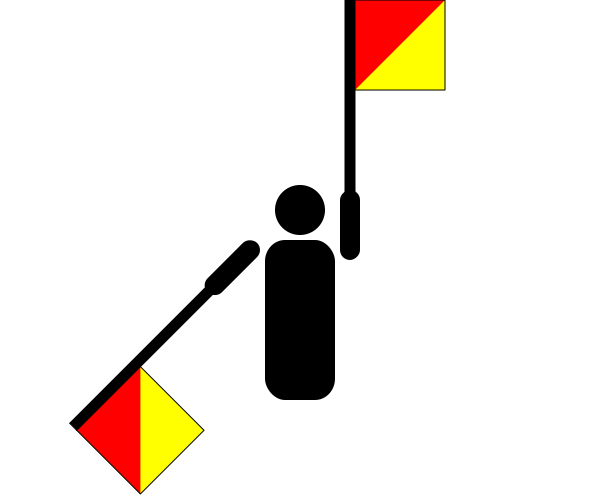


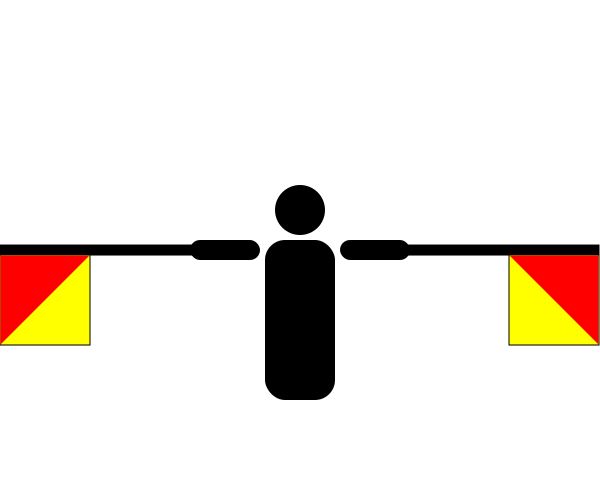
There are approximately 214 people named Kellar in the UK. That makes it one of Britain's least common surnames. Only around three in a million people in Britain are named Kellar.
Origin: English
Region of origin: British Isles
Country of origin: England
Religion of origin: Christian
Language of origin: English
