KEAVENEY
Keaveney is a surname that carries an intricate web of historical and linguistic connections within the British Isles, particularly Ireland. Its roots can be traced back to several Gaelic and Hebrew influences, and it has been associated with both Celtic and Christian traditions through the centuries.
The most widely cited derivation links Keaveney to the Gaelic patronymic Mac Dáibhí or Mac Dáibhidh, which translates directly as “son of David.” The personal name David itself originates from Hebrew, meaning “beloved” or “friend.” Consequently, the surname indicates an ancestral link to a male line bearing the name David, a name that entered Irish naming conventions through Christian influence during the early medieval period.
In addition to the patronymic origin, historical records reveal that the name was also recorded in a variety of forms such as Keaveney, Keveney, Kevany, Geaveny and even Geany. These variants were sometimes used with an O’ or Mac prefix, reflecting the fluidity of early medieval naming practices in Ireland. The earliest documented version, dating to 1697, appears as Cavaney, married by Agatha to Edward Trim in Antrim during the reign of King William. An earlier reference from 1846 shows a John Kevanny emigrating to New York in the wake of the Great Famine, demonstrating the surname’s presence beyond Ireland before the 20th century.
In County Connacht, the Keaveney name is historically connected to the ancient Gaelic chieftain O’Geibheannaigh. This clan claims a pre-10th-century origin, with its name believed to signify “the son of the descendant of St. Caomhan.” St. Caomhan was an abbot at Glendalough in the sixth century, and the clan’s presence is noted in both County Mayo and County Galway in 1659. Although early Irish registers were largely destroyed during the 1922 IRA actions, surviving entries from 1865 record a Catherine Keaveny’s baptism in Roscommon, providing a tangible link to the mid-19th-century bearers of the name.
Another line of scholarship associates the surname with the ancient Irish personal name Cian, meaning “ancient.” Here, Keaveney is thought to denote the “descendant of Cean.” The Kéeveney genealogy traces back to the early king Eoghamh Ceannfaelad, who held a kingdom in Ulster around 400 AD. These accounts emphasise the deep-rooted loyalty, strength, and courage traditionally attributed to the Keaveney descendants in the Ulster provinces. While different sources highlight distinct tribal affiliations—be it the Cenél Maíl Brigte in County Antrim or the Uí Néill dynasty in Ulster—each narrative underlines a longstanding martial reputation.
In the late 17th and early 18th centuries, the surname appears in land records in County Roscommon. Keaveneys were noted as land guardians in Kilronan, underscoring the family’s involvement in agricultural and community stewardship throughout the Midlands and extending into Leitrim, Carlow, Longford, Westmeath, Laois, and Offaly. The name’s concentration in these areas is consistent with the distribution patterns of many Irish septs during that era.
Contemporary bearers of the surname are found not only in Ireland but also in the United Kingdom, North America, and Australia. In the British Isles, the name remains most common in Ireland, particularly in County Roscommon and County Galway, with significant numbers reported in County Armagh in Northern Ireland. The movement of families in the 19th and early 20th centuries—whether driven by famine or economic opportunity—has left a diaspora that recognises the Keaveney heritage through both first names and surnames. In some families, the surname continues to be used as a middle name, reflecting its cultural significance.
Across all these accounts, the surname Keaveney demonstrates the layering of linguistic and cultural identities typical of Irish nomenclature. Whether seen as a Gaelic patronymic reflecting a connection to the biblical David, as a derivative of a 6th-century abbot, or as a marker of descent from an ancient king, the name carries a legacy that is profoundly interwoven with Irish history. The various spellings and geographical associations, while presenting challenges to genealogical research, also testify to the adaptability and resilience of the families who carry the name.
Typical given names associated with the Keaveney surname
Male
- Andrew
- James
- John
- Joseph
- Mark
- Martin
- Michael
- Patrick
- Paul
- Peter
- Thomas
Female
- Angela
- Catherine
- Christine
- Deborah
- Elizabeth
- Enda
- Frankie
- Julie
- Lisa
- Margaret
- Mary
- Sarah
- Yvette
Similar and related surnames
Related and similar names are generated algorithmically based on the spelling, and may not necessarily share an etymology.
How to communicate the surname Keaveney in...
Braille
⠅⠑⠁⠧⠑⠝⠑⠽
Morse
-.-..-...-.-..-.--
Semaphore
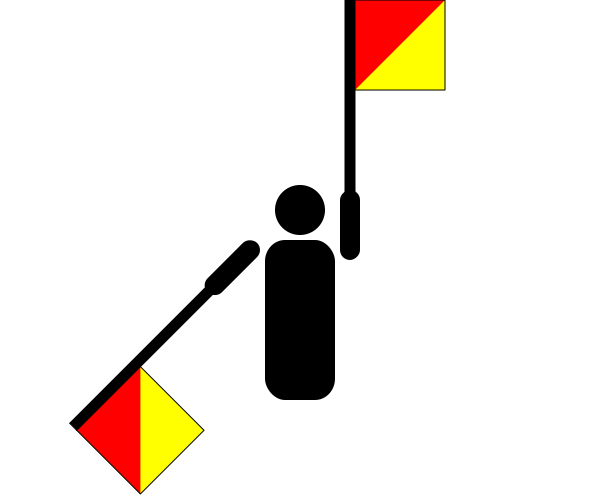


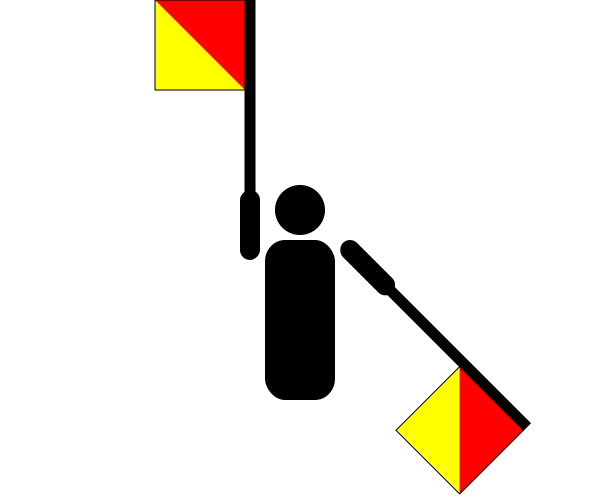
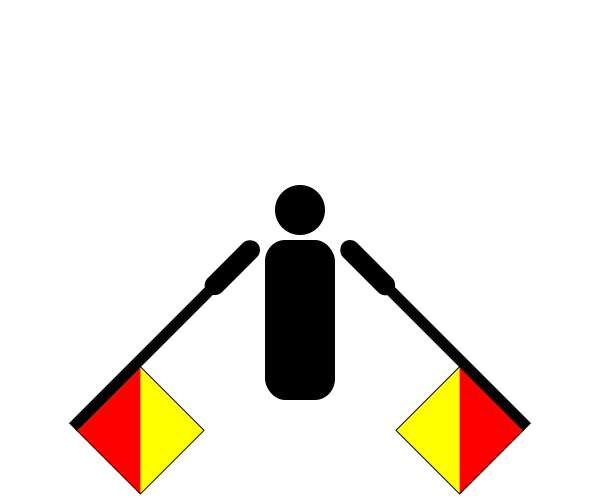
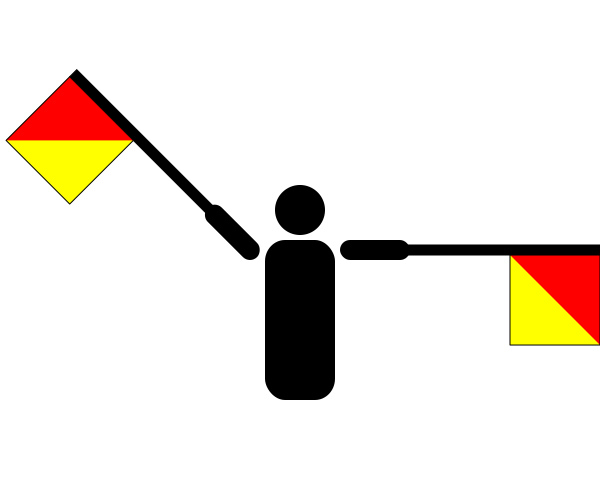
There are approximately 486 people named Keaveney in the UK. That makes it one of Britain's least common surnames. Only around seven in a million people in Britain are named Keaveney.
Surname type: Location or geographical feature
Origin: Celtic
Region of origin: British Isles
Country of origin: Ireland
Religion of origin: Christian
Language of origin: Gaelic

Famous people named Keaveney
- Anna Keaveney - Actress (1949 to 2004)
- Cecilia Keaveney - Irish politician
Names and descriptions courtesy of Wikipedia, and may contain errors. This is not intended to be an exhaustive list of every famous person with this name.