KASPAR
Kaspar is a surname of German origin, derived from the personal name Kaspar, itself a variant of Caspar.
The name is traditionally linked to the biblical figure of one of the Three Wise Men who arrived to pay homage to the infant Jesus. In this context, Kaspar is associated with the gift of frankincense. The transmission of the name into surnames reflects the practice of adopting Christian names introduced during the Middle Ages, often by Crusaders and pilgrims returning from the Holy Land.
Through the centuries the surname has appeared in over a hundred different orthographic forms across Europe. Common variations include Caspar, Gaspar, Gaspard, Gasparo, Jaspar, Jesper, Jasper, and many others adapted to national languages and dialects. These variants can be found throughout German‑speaking regions, France, the Netherlands, the Czech Republic, Poland, Russia, Ukraine, and other Slavic countries.
Etymologically the root of Kaspar is a Persian word meaning “treasurer”, as recorded in early sources such as the 12th‑century accounts of the Three Wise Men. The name was further shaped in Greek as Kaspar, and later adapted into Latin and Germanic forms. This semantic lineage explains the association of the surname with the notion of faithfully serving or managing resources.
Official documentary evidence of the surname first appears in 1441, with the record of Johan Caspar of Schaffhausen in Germany. In England the earliest surviving mention is that of Mary Jesper registered at St Mary Aldermary in London in 1672. The spread of the name is historically tied to migration movements, particularly the settlement of German and Czech families in central and eastern Europe and subsequent immigration to the United States.
In contemporary times the surname is most frequently encountered in Germany—especially in Bavaria and the north—Austria, the Czech Republic, parts of Poland, Russia and Ukraine. In the United States, Kaspar is predominantly found in the Midwestern states of Wisconsin, Minnesota and Illinois, where descendants of German and Polish immigrants settled in the 19th century. A smaller concentration exists in Washington, D. C., reflecting later internal migration.
Recent demographic surveys note a modest decline in the use of the spelling Kaspar in Germany and the United States, as families increasingly adopt alternative variants or hyphenated forms. Nevertheless, the surname remains in active use across many Eastern European and German‑speaking countries.
The extensive array of related surnames, including Kaspar, Kasparek, Kasper, Kasparov, Kasperovich and other cognates, all share the same traditional origin. These variations illustrate the linguistic adaptation of a single ancestral name across diverse cultural and linguistic landscapes.
Similar and related surnames
Related and similar names are generated algorithmically based on the spelling, and may not necessarily share an etymology.
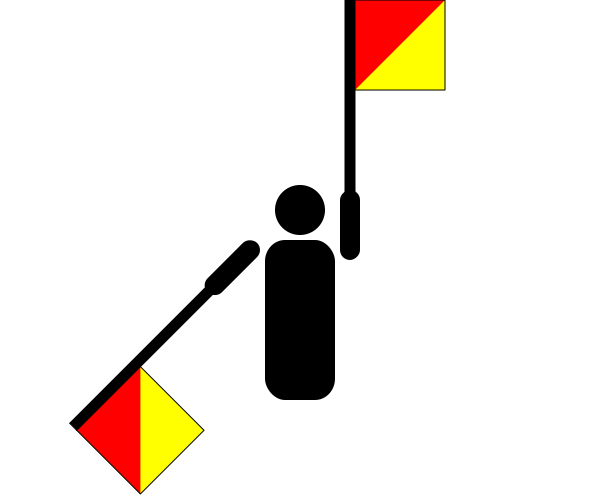
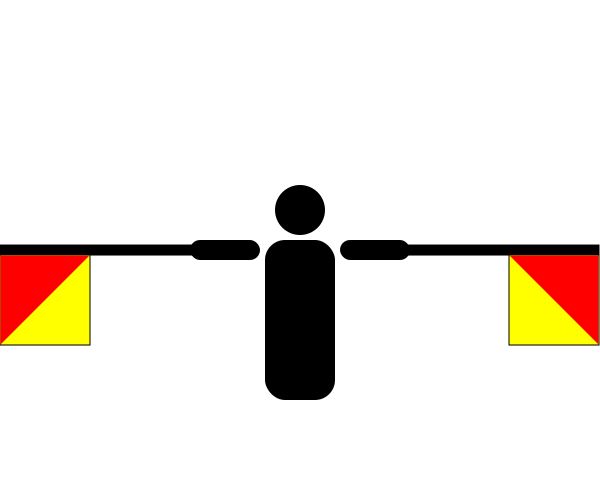
How to communicate the surname Kaspar in...
Braille
⠅⠁⠎⠏⠁⠗
Morse
-.-.-....--..-.-.
Semaphore


There are approximately 62 people named Kaspar in the UK. That makes it one of Britain's least common surnames. Only around one in a million people in Britain are named Kaspar.
