JOB
The surname Job is traditionally understood to be a patronymic formation, signifying “son of Job” or “descendant of Job”, and is most commonly employed in English‑speaking contexts. It originates from the medieval given name Job, itself derived from the Hebrew personal name Iyov; the biblical figure of Job is renowned for his extraordinary patience and faith when confronted with severe suffering. The adoption of this given name as a family surname reflects a cultural affinity for the moral attributes embodied by the biblical character.
First recorded in the early twelfth century, the name appears in the Court Rolls of Norfolk as the surname of William Job in 1202, falling within the reign of King John (1199–1216). During this period several alternative forms were noted: Job, Jobb, Jupp, Jopp, and the diminutives Joblin, Jobling, Jobbling, Jopling, Jobbing, Jobbings; as well as dialectal variants such as Joberne, Joburn, Joburne, and Yerborn. These variants demonstrate both the phonological flexibility of Middle‑English spelling and the emergence of the surname in a variety of regional dialects across the British Isles.
There are at least four primary sources of the name recorded by scholars. The first is the “Crusader” origin introduced by returning knights from the Holy Land in the twelfth century; this version derives directly from the Hebrew personal name and carries the ancient interpretation of the “persecuted one”, alluding to the tribulations of the biblical Job. The second proposes that the name arose as a nickname for a person who suffered illness, borrowing from the French word job meaning “unfortunate”. The third identifies an occupational origin linked to the English word jobbe, a four‑gallon vessel, which suggests a connection to coopering or barrel‑making. The fourth traces the name to the Old French word jube, a long woolen garment for men, indicating that the surname may have been designated to a maker or seller of such apparel.
Later medieval records and the Domesday Book attest to the Norman influence on the name, with entries such as Jobe, Jobele, and Jubbe. The Arabic style description of the family in later heraldic registries associates the coat of arms with an argent field, charged with a blazon of a sinister azure chevron situated between three azure eagle’s heads erased. This description aligns with heraldic conventions of the period and reflects the symbolic representation of strength and resoluteness in the family identity.
In addition to its prevalence in England, the surname has been documented in South Asian contexts, notably in India and Bangladesh. The appearance of the name in these regions often correlates with local linguistic adaptations, such as Jau or Jobby, and it is recorded among Gujarati, Marathi, and other speaking communities. A similar presence exists in the Caribbean, especially Jamaica, where the name is thought to have Afro‑West African roots, possibly derived from the Wolof language. In North America, particularly the United States and Canada, the surname is observed among descendants of English and French‑Canadian immigrants, bearing a range of spellings including Jobb and Jop.
Modern genealogical research shows that bearers of the surname Job often exhibit a distribution concentrated in the southern counties of England, with notable concentrations in Norfolk and the surrounding counties. The surname also remains comparatively uncommon in German‑speaking areas, where it appears mainly among families traced back to German immigration during the seventeenth and eighteenth centuries. Variants such as Jobe, Jopp, and Jupp remain in use, reflecting the continued evolution of spelling conventions across centuries and geographies.
Overall, the surname Job encapsulates a historical lineage that intertwines biblical heritage, medieval occupational identities, linguistic variation, and cross‑cultural migrations. Its endurance through centuries of social and linguistic change demonstrates the resilience of patronymic surnames within the broader tapestry of English and global onomastics. .
Typical given names associated with the Job surname
Male
- Christopher
- Daniel
- David
- Matthew
- Michael
- Nicholas
- Paul
- Peter
- Philip
- Richard
- Robert
- William
Female
- Annabelle
- Christine
- Diane
- Emma
- Helen
- Joan
- Judith
- Karen
- Margaret
- Penelope
- Rachel
- Sarah
- Sheila
- Susan
- Wj
Similar and related surnames
Related and similar names are generated algorithmically based on the spelling, and may not necessarily share an etymology.
How to communicate the surname Job in...
Braille
⠚⠕⠃
Morse
.-------...
Semaphore
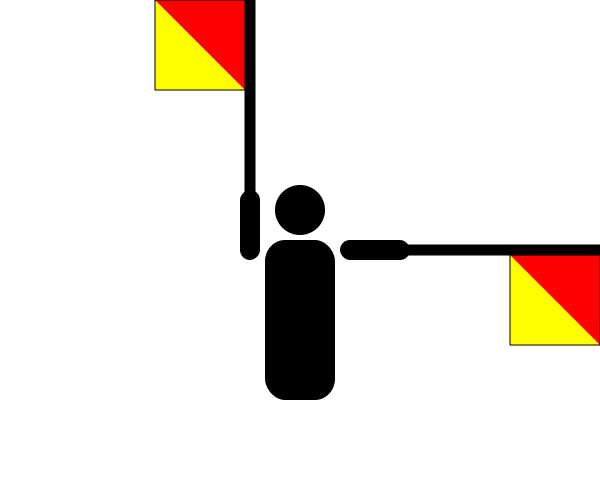
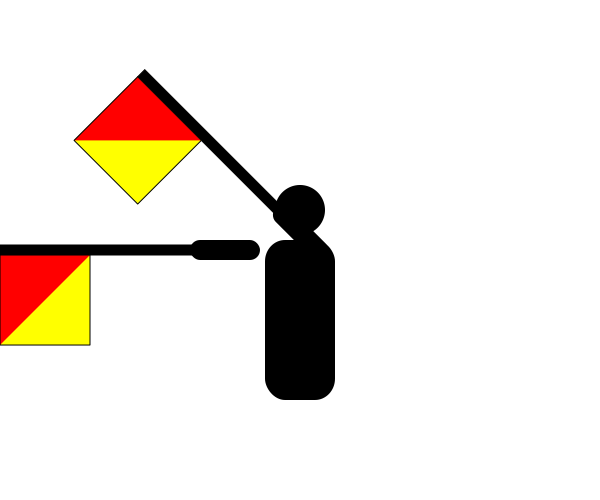
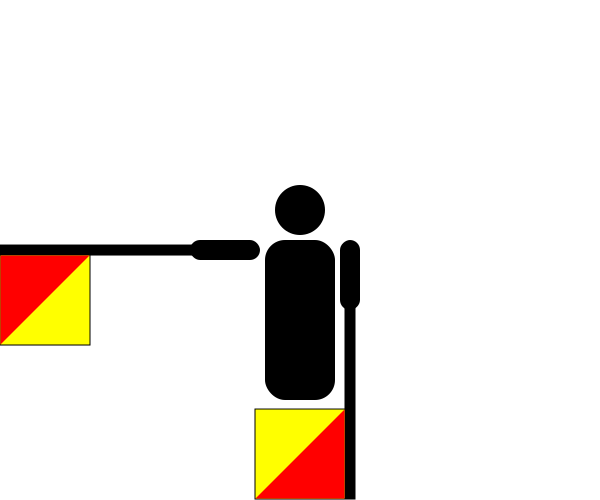
There are approximately 1,241 people named Job in the UK. That makes it roughly the 6,248th most common surname in Britain. Around 19 in a million people in Britain are named Job.
Surname type: From given name or forename
Origin: English
Region of origin: British Isles
Country of origin: England
Religion of origin: Christian
Language of origin: English

Famous people named Job
- Nick Job - Golfer
- John Thomas Job - Welsh bard (1867 to 1938)
Names and descriptions courtesy of Wikipedia, and may contain errors. This is not intended to be an exhaustive list of every famous person with this name.