JENNY
Jenny is a surname of English, Hebrew and Scottish origin, often considered a patronymic derivative of the feminine given name Jane or Jennifer. These names in turn descend from the Hebrew Yochanan, which translates literally as God is gracious. Consequently, the surname can be interpreted to mean “descendant of Jane” or “descendant of Jennifer”, and, more broadly, it carries the biblical connotation of divine grace.
The name appears in a broad range of medieval forms – Jane, Jan, Jaine, Jenes, Jenn, Jenne, Jenney, Jeens, Genn and Genney – all of which are linked to the Middle English variant Jan, a precursor to the European Johannes and the English John. The transition of the name from a male form to a female variant was largely a consequence of the Crusader influence at the end of the thirteenth and beginning of the fourteenth centuries, when biblical names were widely adopted for their spiritual significance.
Authentic records document the surname in the late Middle Ages. In 1297, a certain Simon Jans appears in the accounts of the Earldom of Cornwall during the reign of King Edward I. Later, a John Gyney of Norfolk is listed in the tax rolls known as the Feet of Fines for the county in 1395, followed by a John Jenney who held the post of sheriff of Norwich in 1486. A more detailed record of a family named Jenny comes from the christening register of Anne Jane, dated 6 September 1563, in the parish of Little Hampston in Devonshire.
The development of the surname in Britain demonstrates a fluid interchange between male and female forms. Although Jane had not entered regular baptismal usage until the seventeenth century – largely within the Puritan movement – the surname Jenny itself was already well established as a patronymic derivative of the male given name Jan. This reverse evolution is comparatively rare, as most surnames derived from female given names are later creations.
Variations of the name have proliferated across linguistic and national boundaries. In French contexts it is rendered as Jeannie or Jenni, while Scandinavian records often use Jennys. Other forms include Jennie, Jenner and Jenney, all of which can be traced back to the same underlying concept of God is gracious, whether derived from the Hebrew, Latin or Celtic roots associated with the name “John” or “Johannes”.
In contemporary demographics, the surname remains widespread. In the United States it is most frequently encountered in states such as New Jersey, New York, Massachusetts, Pennsylvania, California and Florida; in Canada it is chiefly found in Ontario; and in Europe it persists across Germany, France and Poland, among other countries. The global distribution of the surname reflects its Indo-European roots and its continuity through centuries of migration and cultural integration.
Overall, the surname Jenny retains a clear connection to its biblical etymology and to the notion of divine grace. Its medieval evolution, its documented appearances in legal and ecclesiastical records, and its modern prevalence across a broad range of languages and cultures demonstrate the enduring nature of this name within the tapestry of onomastic history.
Typical given names associated with the Jenny surname
Male
Female
Similar and related surnames
Related and similar names are generated algorithmically based on the spelling, and may not necessarily share an etymology.
How to communicate the surname Jenny in...
Braille
⠚⠑⠝⠝⠽
Morse
.---.-.-.-.--
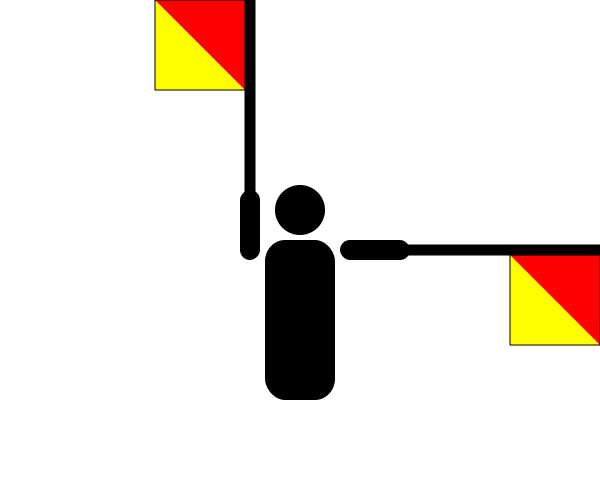
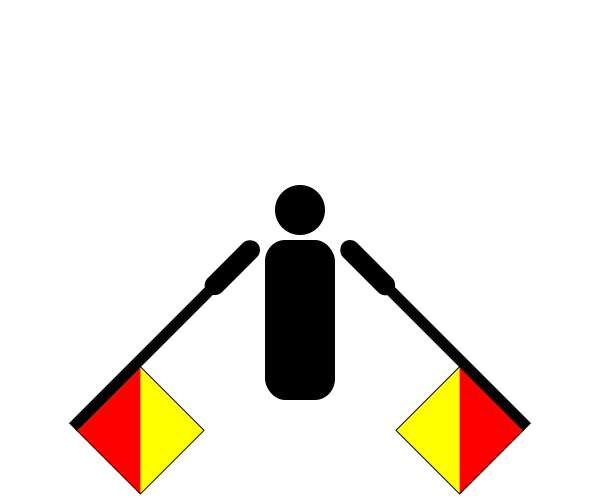
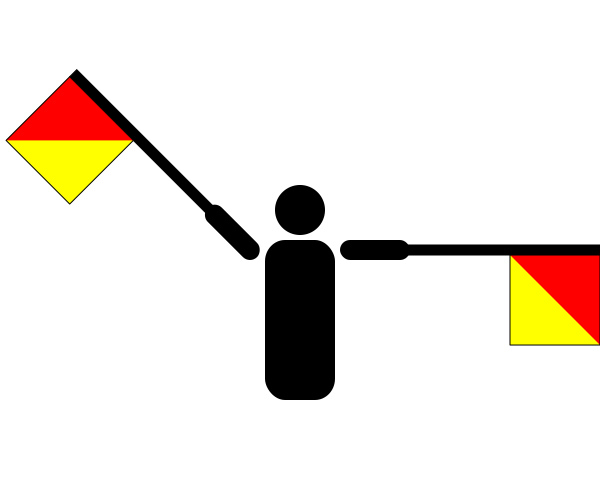
Semaphore

There are approximately 177 people named Jenny in the UK. That makes it one of Britain's least common surnames. Only around three in a million people in Britain are named Jenny.
