JANDA
Janda is a surname of Slavic origin that is chiefly found in Central and Eastern Europe, with considerable representation in the Czech Republic, Poland, Slovakia, Hungary, Croatia, Serbia and Ukraine. It also occurs, to a lesser extent, in Austria, Germany, Latvia, Lithuania, Russia, Slovenia and Ukraine, and has a substantial diaspora presence in North America and Australia.
The etymology of the name is reported in several redacted sources. One explanation links the surname to the old Slavic word janda, which in both Czech and Polish has been translated as “widow” and is therefore thought to have been originally applied to women who had lost their husbands. An alternative derivation connects janda with a Slavic root meaning “lord of the soil” or “man of the soil”, a reference to land ownership or stewardship in the largely agrarian societies of the Czech lands. Both interpretations suggest a social and familial association with the household.
The surname is attested in medieval documents. The earliest recorded spelling, Pertus Johannis, appears in the Close Rolls of Suffolk dated 1230 and was produced in the reign of King Henry of England. Later references include Thomas John noted in the Hundred Rolls of Buckinghamshire in 1279, Arnold Johan mentioned in London’s 1280 Letter Book, and records from German towns in the 14th century such as Walterus filius Johannis in Vaihingen (1323) and Baumeister Johannssen in Friedberg (1344).
Throughout the 12th and 13th centuries the surname spread across Europe. Return‑ee crusaders and frontier families adopted variants of the name, with spellings evolving across linguistic borders. In the British Isles the name appeared in connection with the common biblical name John and its derivatives such as Jon, Ian and Evane while in continental Europe it was rendered as Giovanni, Zanni and other regional forms.
Various regional spellings of Janda have been documented. In Czech regions Jandá is common, while variants such as Jiandá, Xandá, Gandá, Yandá, Jovandá and Iovandá appear in certain dialects. Other scholars list surnames such as Jandara, Yandara, Yindara, Jandahl, Jenahl and Yendel as cognates in neighboring Germanic and Scandinavian areas. Polish renditions include Janda, Jandrić and Jandra; Hungarian forms are often Jánd, Jándi and Jándiós; and in Serbia the surname occurs as Jandrić and Jandera.
In modern contexts Janda is regarded as a unisex surname that carries connotations of family, lineage and agricultural association. It is frequently linked with professions such as farming or gardening, reflecting the historical “man of the soil” interpretation. The name’s adaptability has permitted it to persist across different languages and cultures, while still maintaining its Slavic heritage.
Today, the surname remains prolific in its homeland regions and among the diaspora communities. It serves as a marker of Central and Eastern European heritage and continues to be a recognised family name within diverse professional and social settings worldwide.
Typical given names associated with the Janda surname
Male
- Hardeep
- Harjit
- Kenneth
- Makhan
- Manvir
- Mark
- Martin
- Masimba
- Neal
- Nicholas
- Robin
Female
- Amandeep
- Amita
- Barbara
- Emma
- Giovanna
- Iwona
- Katarzyna
- Lesley
- Nina
- Priya
Similar and related surnames
Related and similar names are generated algorithmically based on the spelling, and may not necessarily share an etymology.
How to communicate the surname Janda in...
Braille
⠚⠁⠝⠙⠁
Morse
.---.--.-...-
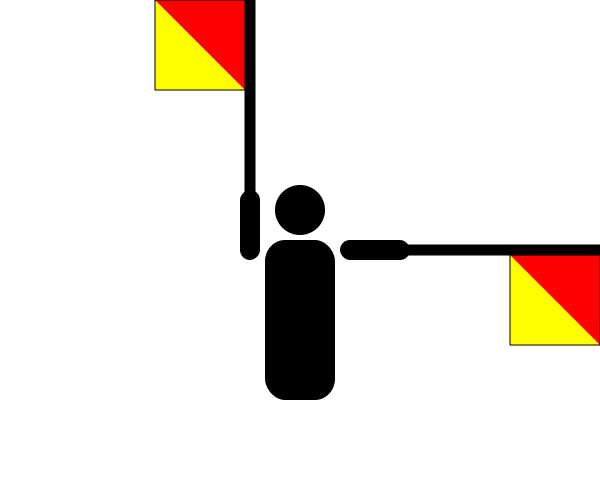
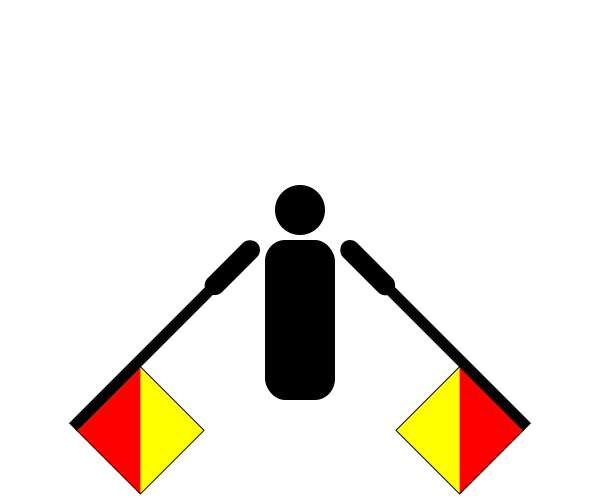
Semaphore


There are approximately 194 people named Janda in the UK. That makes it one of Britain's least common surnames. Only around three in a million people in Britain are named Janda.