IVERS
Ivers is a surname with a complex and multi‑cultural heritage that traces back to the British Isles. The name is first recorded in the early twelfth century in mid‑western England and has since been documented in Ireland, Scotland, Wales and across the wider Commonwealth.
The origin of the name is Gaelic in form yet Norse in root. The Irish Gaelic Ó hÍomhair meaning “descendant of Íomhar” is the source of the surname. Íomhar itself comes from the Old Norse personal name Ívarr, a compound of í (yew) and varr (warrior). Consequently, Ivers can be understood as “descendant of the yew warrior.” Earlier forms of the name appear as Ivor and Iver, both found in early medieval legal records such as the Domesday Book of 1086 where a John Iware is listed for Shropshire.
In the Domesday Book and in the subsequent centuries the name evolved into the patronymic Ivers and related surnames such as Iverson, MacIvor and MacIver. It was also adopted by the Irish, Scots and Welsh from the early Viking settlement period and later by the English. The surname was recorded in London church registers in the late sixteenth century: the marriages of Ambros Ivers to Ann Barlowe in 1578 and of Richard Ivers to Hellen Sharman in 1599 are two examples.
Evidence of the name’s presence in England dates back to 1296 when a record in the Subsidy Rolls of Sussex lists a Robert Yuor, the earliest known spelling that is still recognised as an ancestor of the modern family. By the fifteenth century the surname had spread into Ireland, originally settling in the Staffordshire region and later, during the plantation era, moving westward to County Galway. Modern census data in Ireland show that more than three hundred individuals carry the name Ivers, while in England and Scotland there are still significant numbers of families with the surname.
The Ivers line possesses a heraldic achievement granted to an early family in England. The blazon describes a silver shield with a blue bend bearing three gold fleurs‑de‑lis. The crest is a demi‑lion rampant in gold, collared in black, a design that illustrates the martial and enduring qualities associated with the name’s Norse and Gaelic roots.
Across the twentieth century the surname travelled to the New World, and today it can be found in Canada, the United States, Australia, New Zealand and South Africa. Despite this geographic dispersion the meaning of the name has remained stable. Those who bear the surname Ivers today can take pride in a lineage that exemplifies the strength and resilience symbolised by the yew tree and the warrior heritage of their ancestors.
Typical given names associated with the Ivers surname
Male
- Andrew
- David
- Gerard
- James
- John
- Michael
- Paul
- Richard
- Robert
- Thomas
- William
Female
- Frances
- Jacqueline
- Joanne
- Judith
- Julie
- Kathleen
- Lorraine
- Louise
- Margaret
- Mary
- Michelle
- Patricia
- Sharon
- Tracey
Similar and related surnames
Related and similar names are generated algorithmically based on the spelling, and may not necessarily share an etymology.
How to communicate the surname Ivers in...
Braille
⠊⠧⠑⠗⠎
Morse
.....-..-....
Semaphore
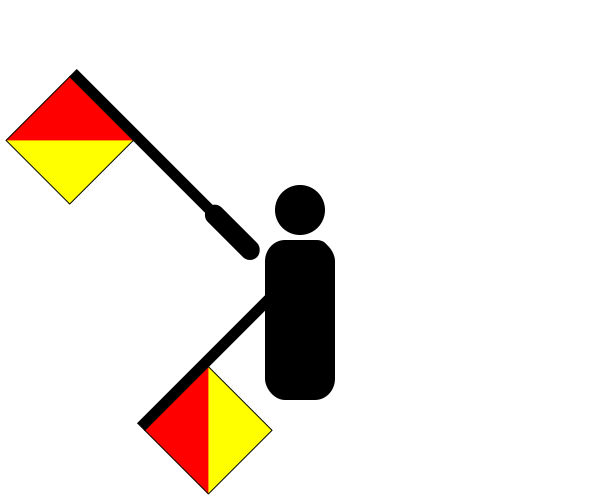
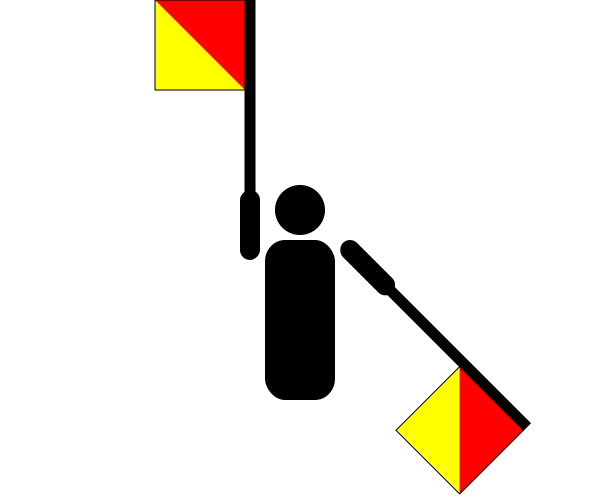

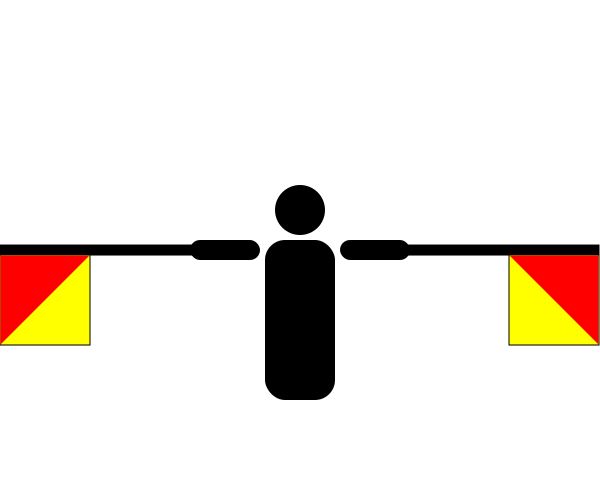

There are approximately 446 people named Ivers in the UK. That makes it one of Britain's least common surnames. Only around seven in a million people in Britain are named Ivers.
Origin: English
Region of origin: British Isles
Country of origin: England
Religion of origin: Christian
Language of origin: English
