ISLAND
Island is a surname of English origin that remains relatively uncommon. The name historically denoted a connection either to a specific place known by that name or to a geographical feature resembling an island.
The etymology of the surname can be traced to the Old English word igland, which meant “land surrounded by water” or simply “island.” In a medieval context, a person who lived on or near such a piece of land was often identified by this descriptor, giving rise to the surname Island. The name could also be a habitational marker for someone originating from any of the settlements named Island in the British Isles.
Recorded variations of the name are comparatively rare and include spellings such as Eslan, Eslin, Eslon, Esland, Izeland. These forms all appear in parish registers and other historical documents, reflecting the phonetic interpretations of local clerks and the absence of standardised spelling during the Middle Ages.
The earliest surviving entries for individuals bearing the surname are found in the church registers of St. Margaret’s Westminster, where a Alice Island is recorded on 28 November 1581, and in the registers of St. Brides in Fleet Street, with a James Esland noted on 28 October 1606. These documents provide the earliest documentary evidence of the surname’s use in England.
Several place‑names within the British Isles carry the designation Island, including a village in Berkshire, a settlement in Gloucestershire, an island on Loch Lomond in Scotland, and a parish in County Cork, Ireland. The surname may therefore have arisen independently in different regions, each relating to its local island or island‑shaped terrain. In some instances, the descriptor may have applied to a raised plateau that appeared isolated from its surrounding countryside.
Despite its distinct etymological roots, the surname Island is not widespread. Contemporary surname databases indicate a relatively low global incidence, with a modest concentration in the United States, likely a consequence of historical migration patterns. Occasional occurrences are also noted in the United Kingdom, Australia, Switzerland, and Nigeria, reflecting the broader dispersal of English surnames over the twentieth century.
In sum, the surname Island exemplifies a traditional English topographic or habitational name that identified individuals by their association with an island or an isolated geographic feature. Its scarcity in modern records, coupled with its clear linguistic derivation from Old English, underscores the enduring legacy of medieval naming practices in contemporary genealogical studies.
Similar and related surnames
Related and similar names are generated algorithmically based on the spelling, and may not necessarily share an etymology.
How to communicate the surname Island in...
Braille
⠊⠎⠇⠁⠝⠙
Morse
......-...--.-..
Semaphore
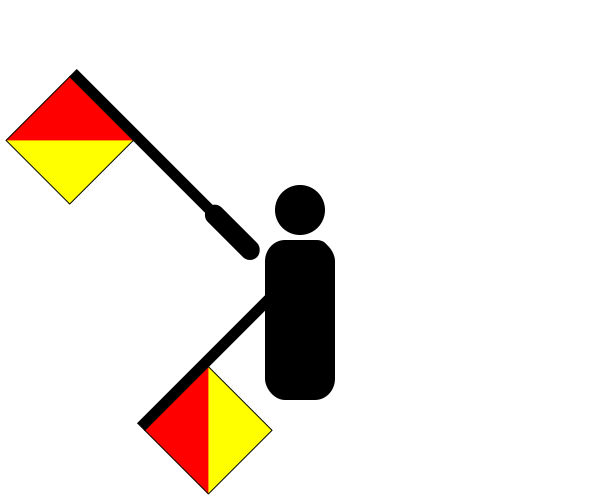


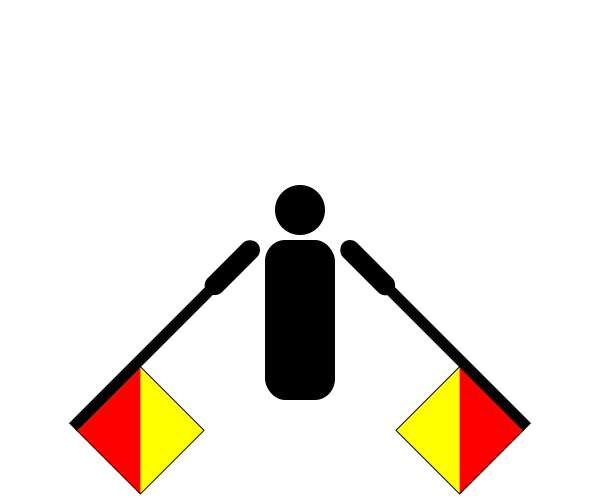

There are approximately 51 people named Island in the UK. That makes it one of Britain's least common surnames. Only around one in a million people in Britain are named Island.
Origin: English
Region of origin: British Isles
Country of origin: England
Religion of origin: Christian
Language of origin: English