ISABELL
Isabell is a family name that can be traced back to the personal name Isabel, itself a late medieval vernacular form of Elizabeth. The root of the name is the Hebrew Elisheva, which translates as “God is my oath” or “pledged to God.” Consequently, the surname is often interpreted as signifying an individual who is devoted or committed to a divine principle.
In early medieval England the adoption of surnames was frequently linked to ancestry or to the name of a parent. The eldest male in a household would be known by his own personal name, while his children might be identified by the name of their mother, particularly when the mother was a well‑known or respected figure. The surname Isabell originates from such a tradition, being derived from the given name of the mother, Isabel. This method of forming surnames is relatively uncommon, but it contributes to the uniqueness of the name.
The earliest documented instance of the family name occurs in 1202, recorded in the Early Charters of the Cathedral Church of St. Paul, London as the name of William Isabelle. The 13th century introduced further evidence: William Isabel appears in the 1275 Subsidy Rolls of Worcestershire, while John Isbell is recorded in the 1379 Poll Tax returns of Yorkshire. These entries show the surname in a variety of spellings, including Isabell, Isbell, and Isbill, a pattern which persisted into the early modern period.
London church registers provide additional snapshots of the name’s usage. In 1617 the marriage of Ann Isbell and Thomas Brickell was documented at St. Antholin's, Budge Row on 16 November. Further, on 28 September 1690 the christening of Richard, son of Richard and Mary Isbell, took place in St. Andrew's, Holborn. Such records illustrate the surname’s ongoing presence in the capital during the 17th century and hint at its association with the wider urban population.
While the name has an early English provenance, it is also found in French and Spanish contexts. A French origin is noted in the evolution of the Latinised Isabella, a name brought to England by the Normans and popularised throughout the continent during the Middle Ages. The same process gave rise to the Spanish variant Isabel. In Spanish-speaking countries the surname is often interpreted as a patronymic, meaning that it originally indicated “child of Isabel.” Thus, the name functions both as a matronymic in Britain and as a patronymic in Iberian contexts.
Throughout history the surname has manifested in a broad array of spellings and variants. These include Isabelle, Izabell, Izabelle, Ysabell, Ysabelle, Isobel, Izobel, and Isobelle. Anglicised versions such as Bell or Bella sometimes appear, particularly in families that migrated South West through France or Italy. The spelling Isobel is noticeably more common in Scotland, whereas Isabel and Isabella dominate in Spain and Portugal respectively. In France, the resemblance of the ending to the word belle has, in some cases, led to the variant Belle.
In contemporary usage the surname is not extremely frequent. It has a modest but noticeable presence in the United States, especially in the states of Texas, California, Georgia, Alabama, and North Carolina. Within the United Kingdom the name is usually found in scattered pockets rather than in high concentration. Australia also records the surname, indicating post‑colonial migration from Britain and Europe. Though the name remains uncommon, the assortment of dialectal variants often creates a sense of continuity across geographic and cultural borders.
Overall, the surname Isabell demonstrates the layering of linguistic influences and familial practices that characterise many European family names. Its roots in the Hebrew meaning of Elisheva, its medieval adoption as a matronymic in England, and its later expansion into French, Spanish and English contexts all contribute to a name that embodies both religious heritage and the mobility of the past two millennia.
Similar and related surnames
Related and similar names are generated algorithmically based on the spelling, and may not necessarily share an etymology.
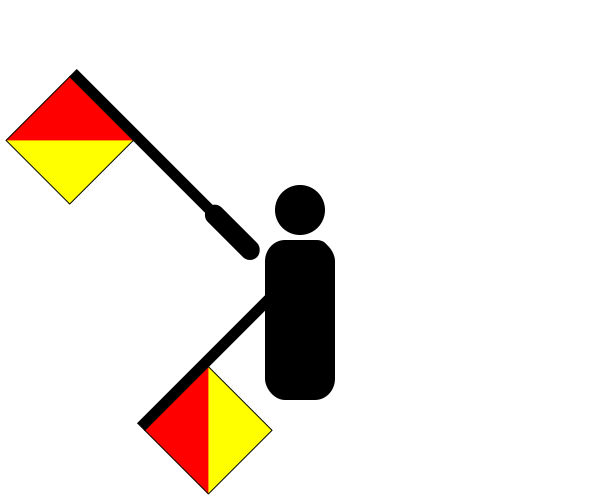
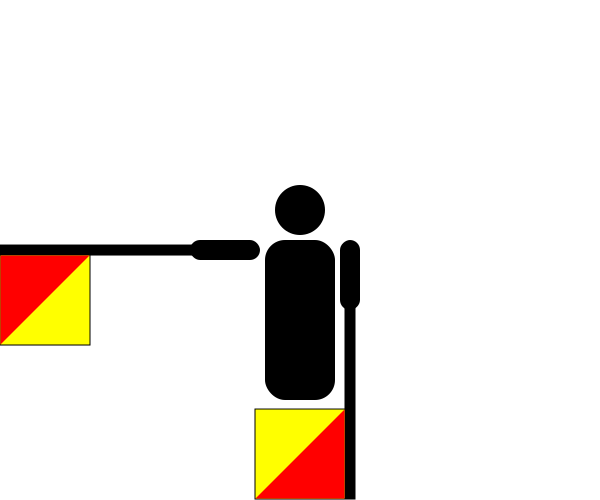
How to communicate the surname Isabell in...
Braille
⠊⠎⠁⠃⠑⠇⠇
Morse
......--.....-...-..
Semaphore




Sorry, we don't have any statistics on this name. That's probably because it's very uncommon in Britain.
