INNIS
The surname Innis is of Gaelic origin, with a presence in both the Scottish and Irish strata of the British Isles.
In its Scottish derivation it stems from the Gaelic word inis, meaning “island” or a tract of land set amid water. Consequently the name was usually allocated to those dwelling on or near an island or to those inhabiting a flood‑plain enclosure where two rivers met.
In County Donegal, the Irish version of the name is likewise found among families whose ancestors lived close to a meadow, as the Gaelic word for meadow can be rendered inis in that context. Thus, the name serves as a topographic marker for the bearers, signalling residence near a distinctive physical feature.
The spelling of the surname has varied considerably over the centuries. Recorded forms include Innes, Ennis, Ineys, Inyis, Eneas, Enns, Ennes, Eynes and other variants such as Innes and Inno‑sion. Such differences arise from the transcription of oral names in written records.
The earliest known form of the name appears as Walter de Ineys, dated to 1226 when he witnessed a charter under King Alexander XI of Scotland (1214–1249). Following this, numerous entries in church registers confirm the use of the surname throughout the sixteenth and seventeenth centuries, including the marriage of John Innys to Elizabeth Turner on 7 May 1560 at St. Margaret’s Westminster, the christening of James Innes on 18 July 1609 at Elgin, and the marriage of Elizabeth Eneas to Evan Bowen on 24 August 1734 at St. Mary‑le‑Bone, London.
A heraldic device associated with one branch of the family depicts a silver shield bearing a cross pattee, surrounded by three blue stars. The motto accompanying this coat of arms is Ditat servata fides, which translates to “Duty and fidelity enriches.”
Historically, the name is linked with Clan Innes, one of Scotland’s oldest clans. The clan asserted influence during the wars for independence and retained a family seat in Perthshire, while its eastern stronghold lay in Moray, the original homeland of the clan. The clan’s prominence is reflected in the continued prevalence of the surname in that region.
In contemporary times the surname has spread beyond the British Isles, with significant populations found in the United States, Canada and the United Kingdom. A distinctive diaspora exists in Barbados, where Scottish emigrants bearing the name participated in the sugar industry, leaving a lasting patronymic legacy.
Typical given names associated with the Innis surname
Male
- Christopher
- David
- Glenn
- Gordon
- James
- Jeffrey
- John
- Lee
- Michael
- Philip
- Robert
- Stephen
Female
- Emily
- Helen
- Irene
- Jackie
- Jennifer
- Katie
- Louise
- Margaret
- Maureen
- Sally
- Sara
- Susan
- Valrey
Similar and related surnames
Related and similar names are generated algorithmically based on the spelling, and may not necessarily share an etymology.
How to communicate the surname Innis in...
Braille
⠊⠝⠝⠊⠎
Morse
..-.-......
Semaphore
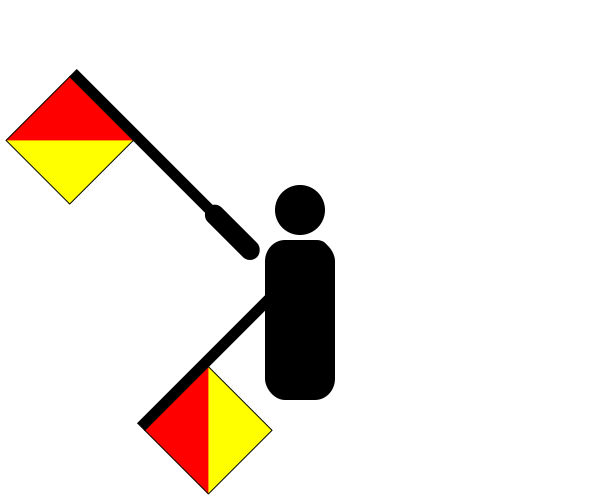
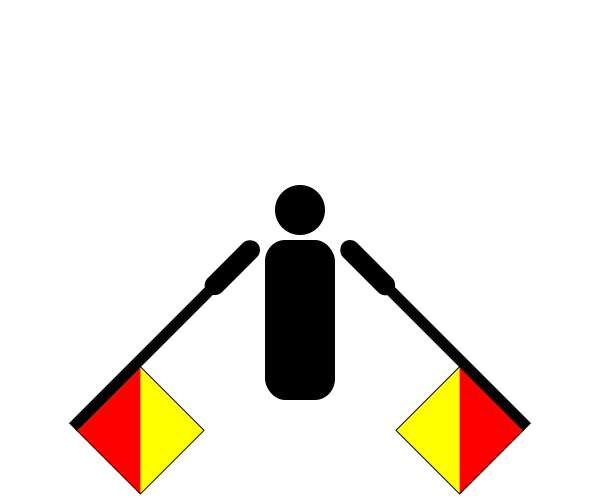

There are approximately 351 people named Innis in the UK. That makes it one of Britain's least common surnames. Only around five in a million people in Britain are named Innis.
Surname type: From given name or forename
Origin: Celtic
Region of origin: British Isles
Country of origin: Scotland
Religion of origin: Christian
Language of origin: Gaelic
