INGLES
The surname Ingles is a family name that originated in the British Isles, particularly in England and northern Scotland. It is traditionally recognised as a patronymic form of the Old English and Middle English word Englisc, meaning “English”. The name was historically applied to individuals who were born in England or who claimed English ancestry, especially in regions where English and Celtic populations co‑existed.
In the medieval period the surname appears in documentary records from the late thirteenth century. The earliest reliable entry is found in the Hundred Rolls of Suffolk, 1273, where an individual named Edmund Ingold is recorded. Subsequent references – for example, Peter Ingold in the London Letter Books of 1312 – demonstrate that the name was established in the urban milieu of the capital during the reign of King Edward the First.
Other archival material, such as the Domesday Book of 1086 and the chartulary of Ramsey in 1114, records the personal name Ingald or Ingold in Yorkshire, Huntingdonshire and Lincolnshire. Those forms derive from the Old Swedish Ingaeld and Old Norse Ingialdr, a compound of the elements ing (a modest god associated with fertility) and gialdr (tribute). The resulting meaning – “Ing’s tribute” – is linked to place‑names such as Ingoldmells, Ingoldsby and Ingoldisthorpe. In the nineteenth century, the personal name was recorded as a source of surnames, giving rise to the variant Ingold and, by extension, Ingles.
Another tradition associates the surname with the Old English word ingle, meaning “fire” or “hearth”. This nickname was often bestowed on a person who lived adjacent to a prominent hearth or who worked as a servant in a large house with a sizeable fireplace. The similarity in appearance between ingle and Englisc has led to a convergence of spelling in the modern period, giving rise to the variety of forms including Ingle, Inglis and Ingles.
In Scotland the spelling Ingles is considered a variant of the surname Inglis, which itself denotes a person of English origin or a person who had connections with England. The name was sometimes used derogatorily during times of Anglo‑Scottish hostility, but over time it became an accepted identifier. In recent centuries the surname has spread beyond the British Isles through emigration to North America and the colonies. British, Canadian and American records show concentrations of bearers of the name in California, Florida, Texas and Ontario, reflecting patterns of settlement within the Scottish diaspora.
Contemporary genealogical studies recognise more than a dozen orthographic variations of the name – for instance Ingall, Inggall, Ingold, Ingle, Ingles and Hingle – which may reflect regional dialects, transcription practices or deliberate changes adopted by families integrating into new linguistic communities. While the surname is not exceptionally common in modern Scotland, it remains a visible element of the nomenclature in the United Kingdom, the United States and Canada, a testament to its enduring medieval origins and adaptability across linguistic and cultural boundaries.
Typical given names associated with the Ingles surname
Male
- Andrew
- Christopher
- David
- James
- John
- Paul
- Peter
- Philip
- Richard
- Robert
- William
Female
- Charlotte
- Elizabeth
- Irene
- Jane
- Jean
- June
- Laura
- Louise
- Margaret
- Patricia
- Penelope
- Sara
- Sarah
- Victoria
Similar and related surnames
Related and similar names are generated algorithmically based on the spelling, and may not necessarily share an etymology.
How to communicate the surname Ingles in...
Braille
⠊⠝⠛⠇⠑⠎
Morse
..-.--..-......
Semaphore
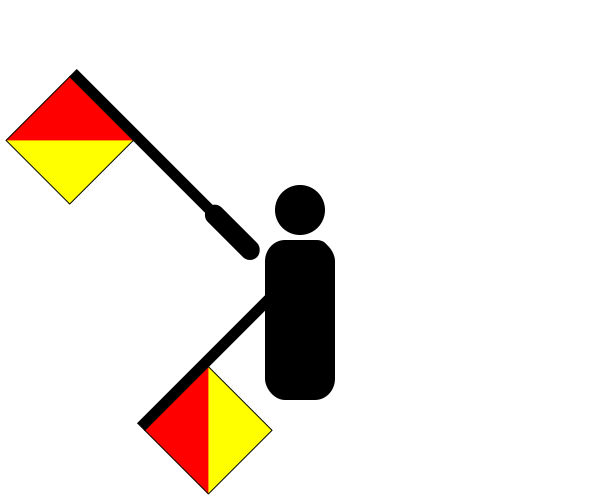
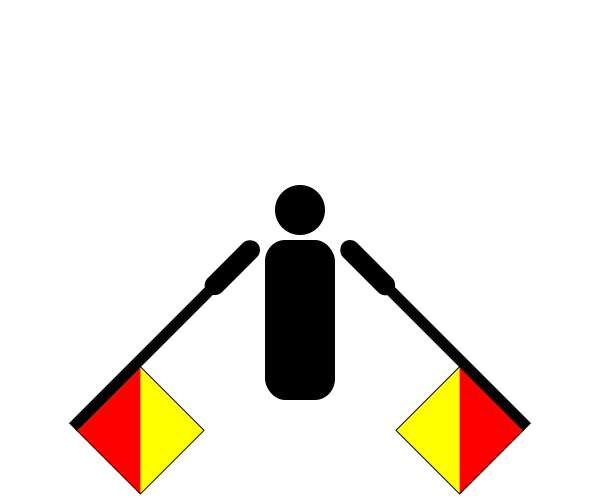


There are approximately 628 people named Ingles in the UK. That makes it one of Britain's least common surnames. Only around ten in a million people in Britain are named Ingles.
Origin: English
Region of origin: British Isles
Country of origin: England
Religion of origin: Christian
Language of origin: English
