INGHAM
The surname Ingham is of Anglo‑Saxon origin and is derived from several places in England that bear the same name. These place‑names, recorded in the Domesday Book of 1086 as Ingeham, Hincham and Ingham, arise from the Old English elements Ing – a personal name associated with the pre‑7th‑century Germanic god of fertility and agriculture – and ham, meaning village, hamlet or homestead. Consequently, the name literally translates to “the homestead or village of Ing’s people.”
The surname first appears in written records in the 12th century, notably with the entry for Alwinus de Ingham dated 1049 in the Old English By‑name register for Oxfordshire, during the reign of King Edward the Confessor. By the time of the Domesday survey, individuals bearing the surname were noted in regions such as Norfolk, Lincolnshire, and Suffolk, indicating a locational origin for those who had departed these settlements and retained their place‑of‑birth as an identifier.
Ingham became particularly common in the northern parts of England. Parish registers and civic documents show a concentration of the name in Yorkshire and Lancashire during the 16th and 17th centuries. For example, John, son of Johis Ingham, was christened on 23 October 1546 at Halifax, Yorkshire, and Thomas Ingham married Mary Nuttall at Rothwell, Yorkshire, on 15 July 1559. These entries demonstrate the continued use and regional settlement of the surname.
Variations of the surname have emerged over time, largely as a result of differences in dialect and the lack of standardised spelling before the advent of modern orthography. Common alternate forms include Inghem and Inghim, all of which retain the same locational meaning. Less frequent variants such as Ingom and Ingeham also appear in historical documents, reflecting regional pronunciation differences.
In modern times the surname remains widely dispersed, but its highest density is still noted in the north of England. Ingham is also found in English‑speaking countries such as Australia, Canada and the United States, a distribution pattern that mirrors historical migration movements from Britain in the 19th and 20th centuries.
Beyond its locational roots, some historical entries suggest an alternative, nickname derivation from the Old French word engaingne or the Latin ingania, meaning trickery or ingenuity. This hypothesis, however, is supported only by isolated medieval records such as that of William Ingania in Huntingdonshire, and remains a minority theory in relation to the prevailing locational explanation.
Typical given names associated with the Ingham surname
Male
- Andrew
- Christopher
- David
- James
- John
- Michael
- Paul
- Peter
- Richard
- Robert
Female
- Elizabeth
- Helen
- Janet
- Jean
- Karen
- Margaret
- Mary
- Michelle
- Patricia
- Sarah
- Susan
- Victoria
Similar and related surnames
Related and similar names are generated algorithmically based on the spelling, and may not necessarily share an etymology.
How to communicate the surname Ingham in...
Braille
⠊⠝⠛⠓⠁⠍
Morse
..-.--......---
Semaphore
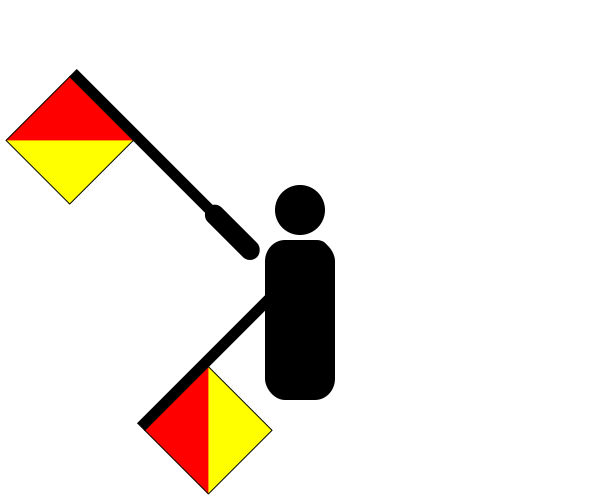
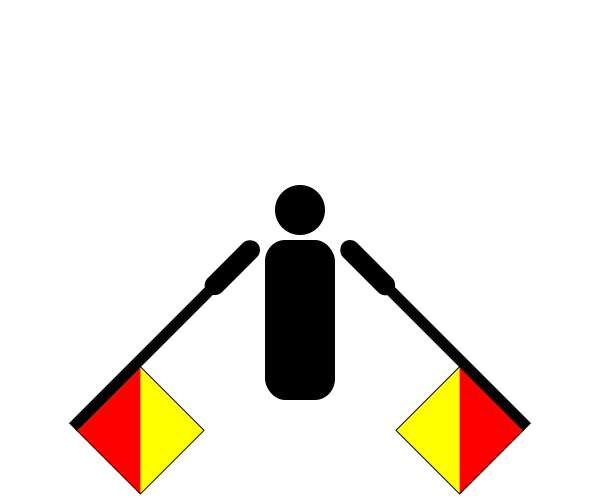


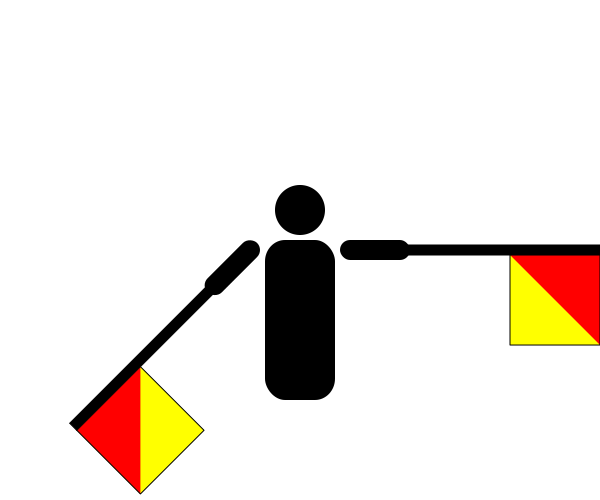
There are approximately 9,494 people named Ingham in the UK. That makes it the 980th most common surname in Britain. Around 146 in a million people in Britain are named Ingham.
Surname type: Location or geographical feature
Origin: English
Region of origin: British Isles
Country of origin: England
Religion of origin: Christian
Language of origin: English

Famous people named Ingham
- Barrie Ingham - Actor (1932 to 2015)
- Bernard Ingham - Journalist
- Michael Ingham - Football player
- Mike Ingham - Football commentator
- Albert Ingham - Mathematician (1900 to 1967)
- Philip Ingham - Geneticist
- Keith Ingham - Musician
- Gary Ingham - Football player (1964 to 2012)
- Benjamin Ingham - American missionary (1712 to 1772)
- Bryan Ingham - Artist (1936 to 1997)
- John Ingham - Former professional football player (1924 to 2002)
- Peter Ingham - County cricketer
Names and descriptions courtesy of Wikipedia, and may contain errors. This is not intended to be an exhaustive list of every famous person with this name.