HYND
Hynd is a surname of Scottish origin that is found throughout the British Isles. The name is associated with the Gaelic language and the Christian heritage that have characterised Scotland for many centuries.
Its earliest documented form is linked to the Middle English word hinde, which meant a servant or farm labourer. According to the linguistic studies of the 19th and 20th centuries, the word was originally applied as a nickname to someone who performed domestic or agricultural work. The nickname later became hereditary, and families bearing the name have been able to trace their ancestry back to the early Scottish servants and farm workers who first used the appellation.
Spelling variations of the surname have been recorded over the centuries, for example Hind, Hinde, Hynd and Hyndes. The first surviving reference to the name is that of Henry Hynde, dated 1285 and found in the Assize Court rolls of Essex at Colchester during the reign of King Edward the First. Later examples include William Hind, who emigrated to Virginia in 1635, and James Hind, a Royalist officer who was executed for treason in 1652.
There is scholarly debate over the precise meaning of the surname. Professor George Black considered the pre‑7th century Old English word hine – meaning a senior servant, estate manager or bailiff – to be the most probable source. Professor Reaney argued that the name derived from the medieval nickname hind, describing a timid or gentle person, perhaps in contrast to the wit of Chaucerian humour. Other researchers note that the same word also referred to a female red deer and suggested that the surname could denote a gentle or shy character.
Today, the name Hynd is uncommon but remains in use in Scotland and has spread to countries such as Australia, the United States, England, Canada and New Zealand through migration of earlier bearers. The surname has maintained a strong link to its Scottish heritage, even as it appears at low frequency in other regions.
The Hynd name is linked to a number of other Anglo‑Scottish occupational surnames. Examples include Henderson, derived from the Gaelic MacEanruig meaning “son of Henry”; MacKendrick, a Gaelic form of the same root; Kendrick, an anglicised variant; and Hendrie or Hendry, common connections. These relations illustrate how surnames that originated from descriptors of servant or managerial roles have evolved into distinct family names over time.
Typical given names associated with the Hynd surname
Male
- Alan
- Andrew
- Colin
- David
- Gary
- Ian
- James
- John
- Peter
- Robert
- Thomas
- William
Female
- Agnes
- Caroline
- Catherine
- Elaine
- Elizabeth
- Fiona
- Heather
- Jacqueline
- Jean
- Karen
- Margaret
- Mary
- Patricia
- Sarah
Similar and related surnames
Related and similar names are generated algorithmically based on the spelling, and may not necessarily share an etymology.
How to communicate the surname Hynd in...
Braille
⠓⠽⠝⠙
Morse
....-.---.-..
Semaphore

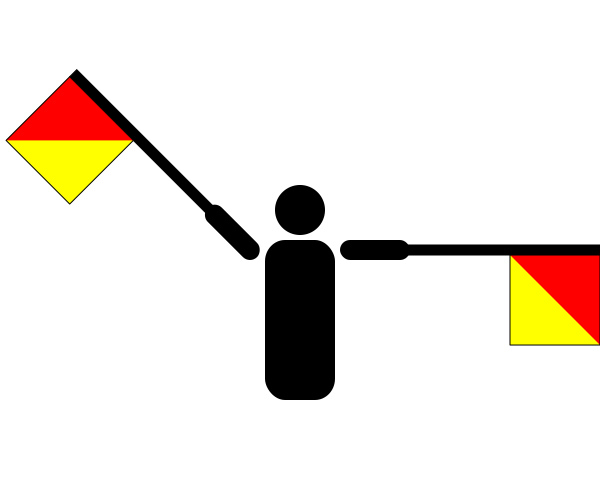
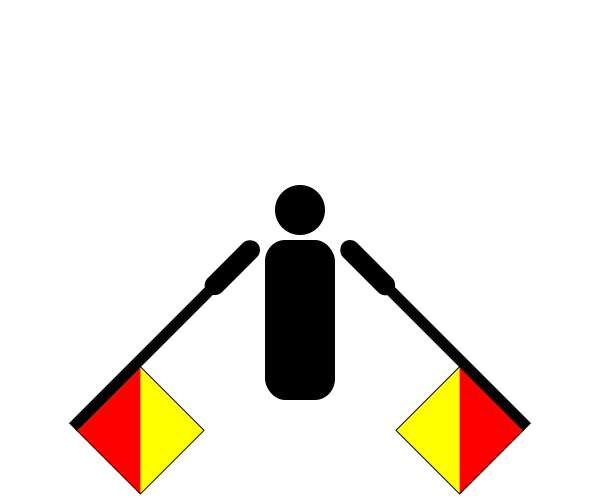

There are approximately 1,768 people named Hynd in the UK. That makes it roughly the 4,658th most common surname in Britain. Around 27 in a million people in Britain are named Hynd.
Origin: Celtic
Region of origin: British Isles
Country of origin: Scotland
Religion of origin: Christian
Language of origin: Gaelic

Famous people named Hynd
- Ronald Hynd - Choreographer
- John Hynd - Politician (1902 to 1971)
- Harry Hynd - Politician (1900 to 1985)
- Roger Hynd - Scottish football player (1942 to 2017)
Names and descriptions courtesy of Wikipedia, and may contain errors. This is not intended to be an exhaustive list of every famous person with this name.