HUSCROFT
Huscroft is a surname of English origin, derived from the Old English words hus meaning “house” and croft meaning “small enclosed field or farm”. This etymology is commonly understood to signify a person who dwelt or worked on such a property, hence the literal interpretation “dweller at the small enclosed field or farm”.
The surname is considered locational, suggesting it originally referred to someone from a now‑lost medieval hamlet or village whose name incorporated the terms hus and croft. It is likely that the place was a small house situated on an enclosed field large enough to sustain a family, or that it was simply an estate with a cottage on a croft. The use of these terms throughout the British Isles, dating back to Roman occupation, provides the linguistic foundation for a range of place‑based surnames, including Huscroft.
Early surviving records in the diocese of Greater London record the name in several forms. In 1634 Mary Huscroft married William Smith at St Martin Orgar; in 1696 Richard Housecroft, son of William Housecroft, was christened at St Sepulchre; and in 1743 Henry Hustcroft married Mary Landes at St Olaves, Hart Street. All of these events occurred in the ancient city of London, illustrating the surname’s presence in the capital during the seventeenth and eighteenth centuries.
Several spelling variants are attested, including Housecraft, Housecroft, Huscroft, Huscrofte, Hoscrofte, Hescroft, and Huscraft. These variations arise from differences in regional pronunciation and spelling practices in the Middle Ages. In modern use, the standard form remains Huscroft.
Geographically, the surname is most commonly found in England, particularly in the north‑west, with substantial concentrations in Lancashire, Cheshire and neighbouring counties such as Cumbria, Durham and Yorkshire. It also appears in smaller numbers in Scotland, Ireland and Wales. In Scotland, it remains extremely rare, whereas in northern and western England it is comparatively more frequent. The surname’s distribution reflects historical settlement patterns and the movement of families during the nineteenth‑century inland migration.
The earliest documentary evidence of the name in England appears in the Cheshire Subsidy Rolls of 1332. Subsequent records list Huscroft families in the freemen’s list of Oldham, Lancashire in 1635. By the 1800s, many Huscroft families had relocated to Herefordshire, Shropshire and Worcestershire. Census data from 1891 show 986 Huscroft families distributed across England, with a focus in the north‑west.
Internationally, the surname is present in very small numbers. In the United States it is most often found in Ohio, Pennsylvania, Missouri, Arizona and California. In Canada, the name is mainly concentrated in British Columbia and Alberta, with a slightly higher presence in Toronto, Ontario. Australia records a comparatively larger Huscroft population, largely situated in Victoria. In addition, minor numbers of individuals bearing the surname can be found in India, South Africa, Germany and New Zealand.
Today, Huscroft remains a relatively rare surname. While its origins can be traced to a variety of rural or estate‑based contexts, the name continues to signify a link to an ancestral home or small farmstead. Its persistence in historical records and its continued usage in certain regions of the United Kingdom and abroad attest to the enduring legacy of locational surnames in the British cultural and linguistic landscape.
Typical given names associated with the Huscroft surname
Male
- Alan
- Brian
- Christopher
- David
- Ian
- John
- Mark
- Nigel
- Richard
- Robert
- Simon
- Thomas
Female
- Claire
- Jane
- Janet
- Julie
- Laura
- Margaret
- Marie
- Paula
- Sarah
- Sharon
Similar and related surnames
Related and similar names are generated algorithmically based on the spelling, and may not necessarily share an etymology.
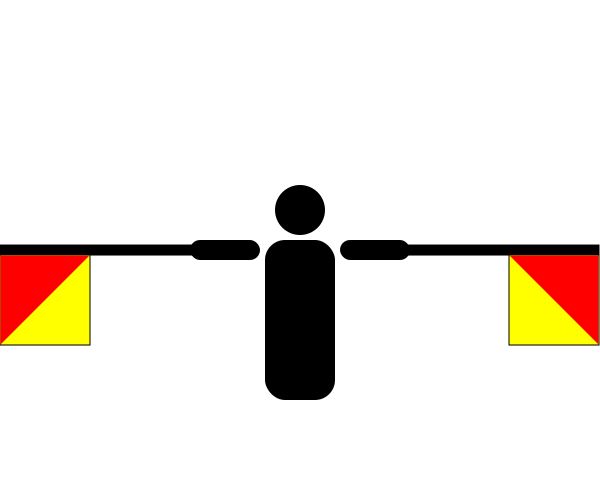
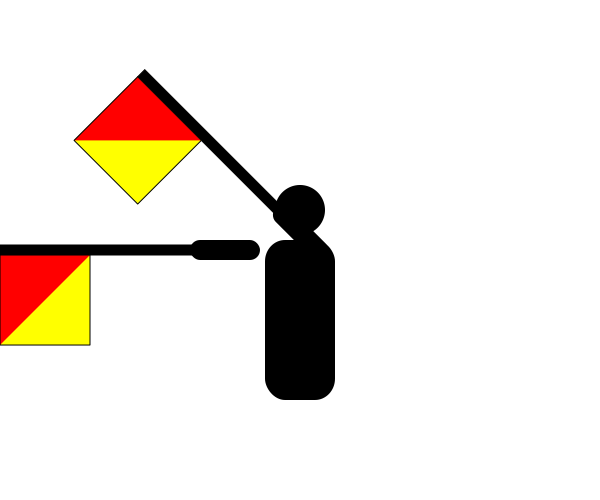
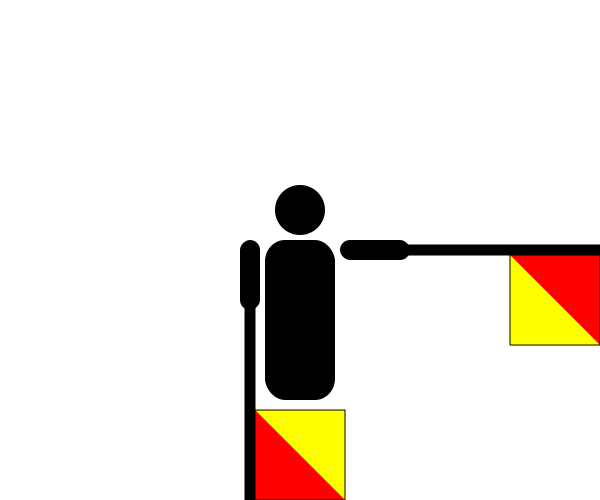
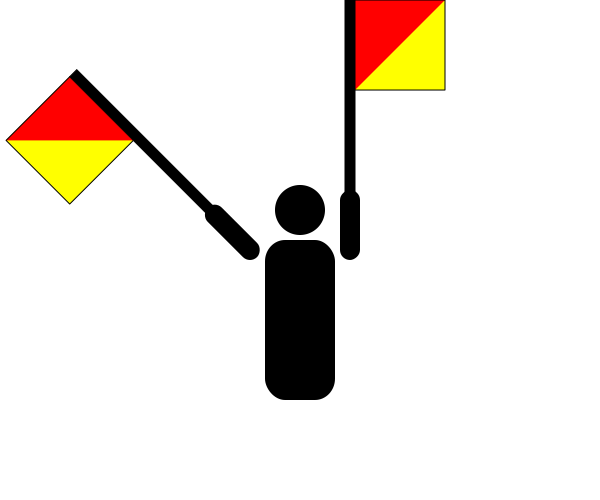
How to communicate the surname Huscroft in...
Braille
⠓⠥⠎⠉⠗⠕⠋⠞
Morse
......-...-.-..-.---..-.-
Semaphore


There are approximately 374 people named Huscroft in the UK. That makes it one of Britain's least common surnames. Only around six in a million people in Britain are named Huscroft.
