HUNTING
Hunting is an English surname whose origins lie in the Old English word hunta, meaning “hunter”. As an occupational name it was originally bestowed upon individuals who hunted game, whether for sustenance or as part of a courtly pastime. The name preserves an ancestral connection to the practice of hunting and reflects the historical role of these individuals within English society.
The derivation of Hunting can be traced to the pre‑7th century term hunta and the related verb huntian. These early forms suggest a specialised occupation, possibly an official hunter employed by a noble household. Hunting was a privilege constrained to the aristocracy, and the designation was typically reserved for those who served the royal or noble hunts, rather than for lay poachers or casual game hunters.
Records from the 13th century provide some of the earliest attestations of the name. In 1209 the Manchester archives record Geoffrey Hunthing of Leicester, and the Hundred Rolls of Kent in 1275 mention Roger Hunting. These entries illustrate that the surname had become established within England by the early Middle Ages.
Variations of the surname have appeared throughout history, including Hunt, Hunter, Huntin, Huntyn, and Huntingdon, among others. The diversity of spellings reflects the lack of standardised spelling in medieval England and the influence of local dialects. Some families adopted the patronymic forms such as Huntsman or its variants Hunteman and Huntmen.
Prominent individuals bearing the surname contribute to its historical record. James Henry Leigh Hunt (1784–1859) was an essayist and poet who played a key role in introducing the works of Keats and Shelley to the public through his journal The Examiner. The Hunt family of Derbyshire was granted a coat of arms in the reign of Henry V, featuring a silver shield with a black buglehorn, and is recorded in the early 12th century as Humphrey le Hunte.
In contemporary times, the surname appears most frequently in the United States, with significant concentrations in Virginia, North Carolina, South Carolina, and Texas. It also maintains a presence in Australia, Canada, the United Kingdom, and other European and global locales, reflecting migration patterns that have spread the name beyond its English origins.
Thus, the surname Hunting is an enduring testament to English linguistic heritage and the societal importance of the hunting profession. Its persistence across centuries, both in spelling variations and geographical distribution, attests to the lasting legacy of the people who first bore it.
Typical given names associated with the Hunting surname
Male
- Alan
- Andrew
- David
- James
- Joe
- John
- Jonathan
- Michael
- Paul
- Peter
- Richard
- William
Female
- Betty
- Charissa
- Claire
- Elizabeth
- Jennifer
- Kathleen
- Katie
- Lucy
- Pauline
- Sarah
- Sonia
- Susan
- Sylvia
- Tina
- Valerie
Similar and related surnames
Related and similar names are generated algorithmically based on the spelling, and may not necessarily share an etymology.
How to communicate the surname Hunting in...
Braille
⠓⠥⠝⠞⠊⠝⠛
Morse
......--.-..-.--.
Semaphore


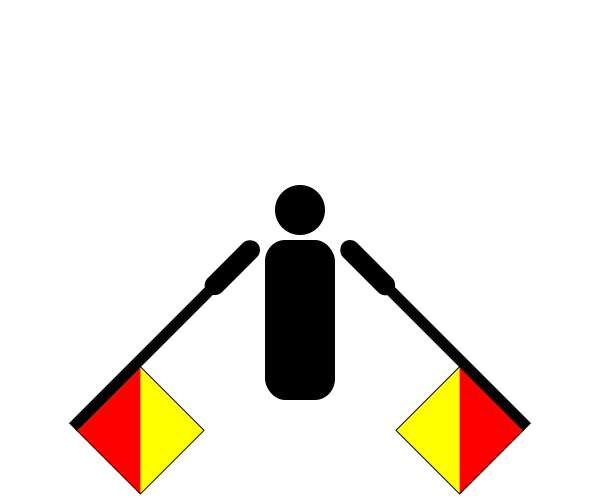
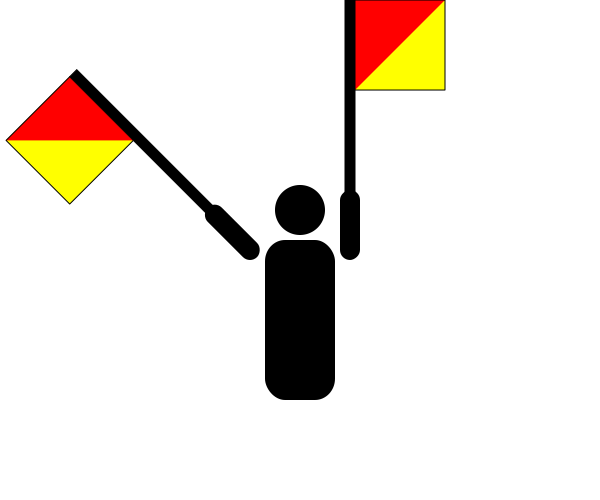
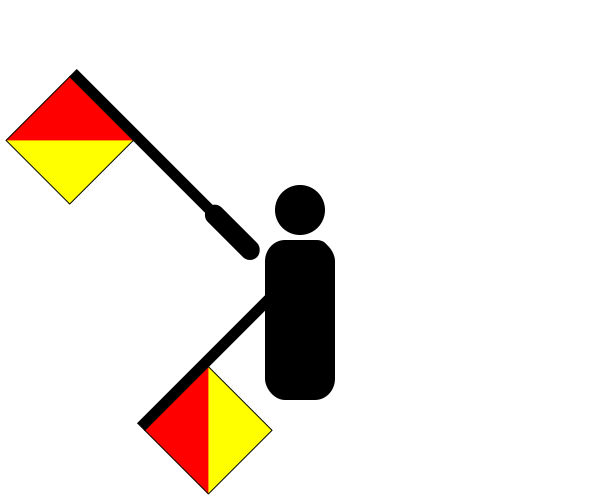

There are approximately 582 people named Hunting in the UK. That makes it one of Britain's least common surnames. Only around nine in a million people in Britain are named Hunting.
Surname type: Location or geographical feature
Origin: English
Region of origin: British Isles
Country of origin: England
Religion of origin: Christian
Language of origin: English
