HUNNICUTT
Hunnicutt is a surname of English provenance, first recorded in manuscripts dating to the sixteenth century. The name reflects a combination of personal and locational elements common in Anglo‑Saxon onomastics.
The earliest identifiable occurrence is the marriage of Elena Huncoate to Richard Thorpp, which took place on 11 November 1543 at Whalley, Lancashire, during the reign of King Henry V. The spelling Huncoate demonstrates the variation that characterises early English surnames.
In the Domesday Book of 1086 the place that would give rise to the surname is recorded as Hunnicot in Lancashire and Hunecote in Leicestershire. Both entries are interpreted as deriving from the Old English personal name Huna, itself a derivative of the Germanic root hun meaning “bear cub.” The second element cot, in Middle English cote, denotes a shelter or cottage. Consequently, the name translates as “Huna’s cottage” or, more literally, “bear cub’s cottage.”
Alternative etymologies note that hund (hound or dog) could combine with cot to give “hound’s cottage” in the Lancashire locality of Huncoat. Regardless of the precise root, the name is entirely locational, indicating residence near or ownership of the settlement now called Huncoat.
As families moved eastward or westward, the surname evolved through orthographic changes, producing forms such as Hunniott, Hunicoet, Honeycote, and Honnicutt. The variants reveal the absence of a standardised spelling until the fourteenth century, when the Great Vowel Shift and the rise of court courts began to codify names. Because of this fluidity, thorough genealogical research often encounters multiple spellings for a single lineage.
The name entered North America during the early colonial period. Its bearers migrated chiefly from Lancashire and Leicestershire, settling initially along the Atlantic coast before dispersing inland. By the early nineteenth century, the spelling Hunnicutt had become common in the Southern United States, particularly in South Carolina, North Carolina, and Georgia. Contemporary distribution records indicate that the surname remains most populous in these states but is also represented nationwide.
In addition to the geographic origin, the surname bears a patronymic flavour. It is suggested that Hunigheard, an Old English personal name meaning “honey‑hearted” or “brave as a bear,” may have been an earlier forerunner. Over time, the personal name blended with the place name, producing the modern form.
Historic records also document early marriages that further illustrate the surname’s presence in London. For instance, Sarah Hunicut married George Stockall at St. Antholin’s, Budge Row, in December 1612. Such evidence shows that the name was not confined to rural Lancashire but had penetrated urban court society by the early seventeenth century.
An essential characteristic of surnames such as Hunnicutt is the tendency for spelling variations to reflect regional dialects, transcription errors, and intentional alterations for administrative purposes. Consequently, the same family line may appear under differing surnames in parish records, wills, and land deeds. Modern genealogists therefore rely on corroborating evidence – dates, locations, kinship ties – rather than sole dependence on the surname spelling.
While the name does not contain a single “meaning” beyond its locational origin, it conveys a sense of belonging to a specific rural community. The “cottage” element underscores the practical nature of medieval surnames, which often described a person’s dwelling or occupation, such as Barker (from bark) or Smith (metal worker). These names remain common, serving as a reminder of how medieval society encoded identity in concise linguistic forms.
In sum, Hunnicutt is a surname rooted in early English place names, evolving through centuries of orthographic change and migration. Its record in parish registers, legal acts, and colonial documents provides a tangible thread linking contemporary bearers to their Anglo‑Saxon forebears and to the pastoral settlements that gave them name.
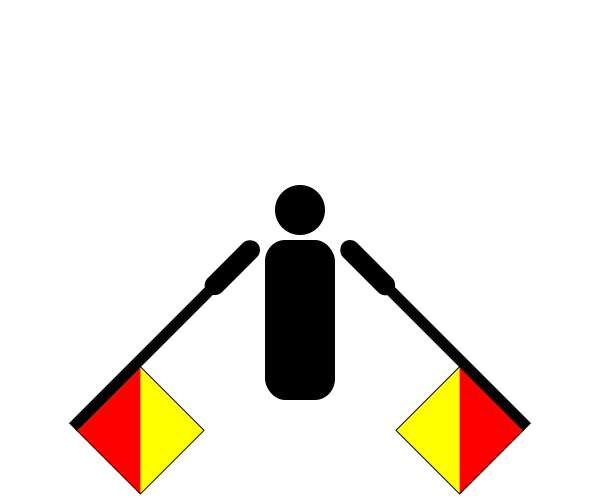
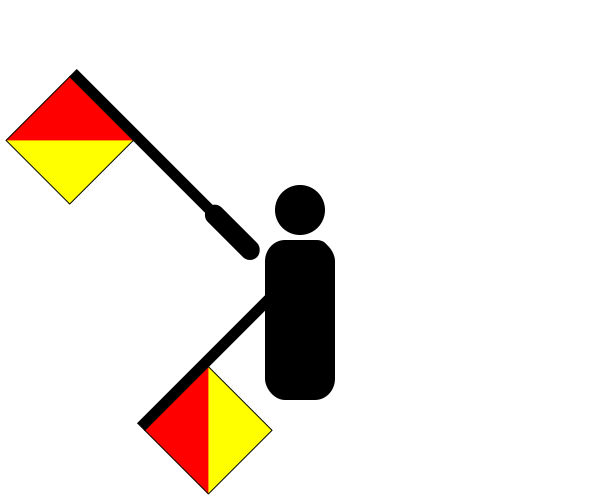
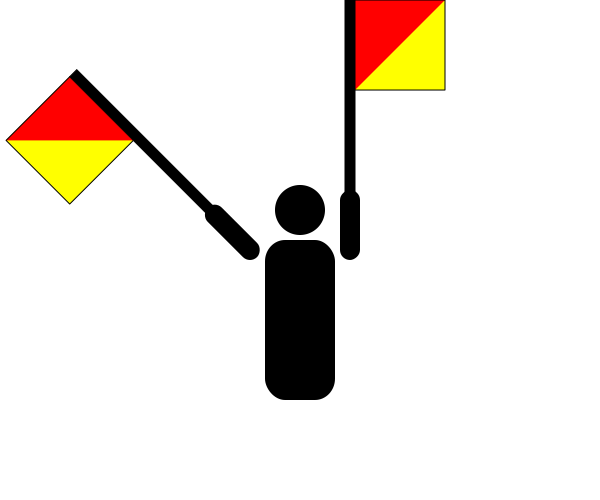
How to communicate the surname Hunnicutt in...
Braille
⠓⠥⠝⠝⠊⠉⠥⠞⠞
Morse
......--.-...-.-...---
Semaphore



Sorry, we don't have any statistics on this name. That's probably because it's very uncommon in Britain.