HUMBERT
Humbert is a surname of Germanic provenance, originally taken from the personal name Humbert. This name is composed of the elements hun – meaning “bear cub” – and berht, which denotes “bright” or “famous”. Consequently the etymology of the surname conveys the sense of a “bright bear cub” or “famous bear cub”, and it functions as a patronymic, signalling descent from an ancestor named Humbert.
The surname has been recorded in a variety of spellings. In the English language historical documents the forms Humbart, Humbert, Imbert, Ambart, and Umbert have all been used. In German-speaking regions the name appears as Humboldt, Humbolt, Humbricht, Humpercht, Hummer, and Humpertz, among others. Such variants are all connected to the common root hun-berht.
According to surviving records the surname entered the British Isles circa the year of the Norman conquest in 1066. It may appear as a pagan name, but it was accepted by the Christian church, as illustrated by St. Humbert who founded the abbey of Marolles in Flanders around 690 AD. Its circulation in England remained limited; for instance, in 1880 only four instances of the name appeared in the Greater London area.
The earliest extant English record of the name is a 1273 entry in the Hundred Rolls for landowners of Buckinghamshire, where an individual appears as Hugh Umberd. Subsequent accounts include Mary Imbert at St. George's Chapel, Mayfair, noted on 1 July 1753, and Jacob Himbert of the French church on Threadneedle Street, London, whose death is recorded on 10 April 1737.
In France the surname is linked closely with Normandy. It is believed that the name was brought to the region by the Norman migration in the early Middle Ages and that the Norman families bearing the name were granted lands by William the Conqueror in 1066. The surname is consequently associated with bravery, strength, and a heritage tied to the Norman period of European history.
Today, the name Humbert remains most common in France, ranking among the top ten surnames in several provinces. It is also widely found in Switzerland, Belgium, and Luxembourg. In the wider European context the surname is present in Germany, Austria, Italy, Spain, and the United Kingdom. In the United States the name has risen into the top a thousand surnames, and it also appears in French-speaking parts of Africa, notably Cameroon and Senegal, where it is among the most common family names.
The diversity of the name’s spellings reflects its long history of migration and linguistic adaptation. Common variants include Humbart, Humburg, Humpherson, and Humbourg, while emigrants have produced forms such as Humburger, Humberger, Humbergt, and Humbergen. In Romance-speaking regions the name appears as Lomberti, Lombardi, and Lombardo in Italy, and as Ubert, Umberto, and Umbert in Spain.
The surname Humbert therefore represents a genealogical thread that stretches across medieval Europe, from Germanic roots to Norman spread, and continues to be borne by individuals throughout the world today. Its enduring presence is a testament to the longevity and adaptability of the family name, which has survived changes in language, culture, and geography while maintaining its clear etymological heritage.
Typical given names associated with the Humbert surname
Male
- Arthur
- Charles
- Daniel
- Peter
- Richard
Female
- Carol
- Jacqueline
- Jocelyn
- Marie
- Suzanne
Similar and related surnames
Related and similar names are generated algorithmically based on the spelling, and may not necessarily share an etymology.
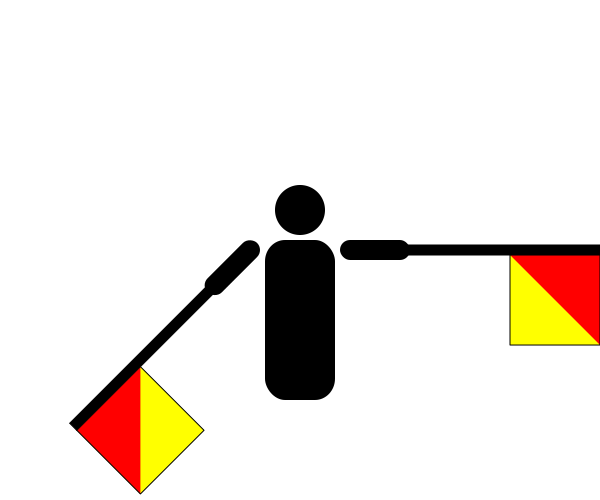
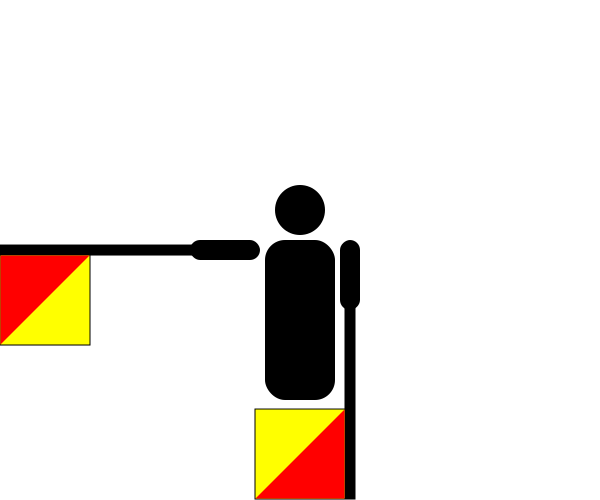
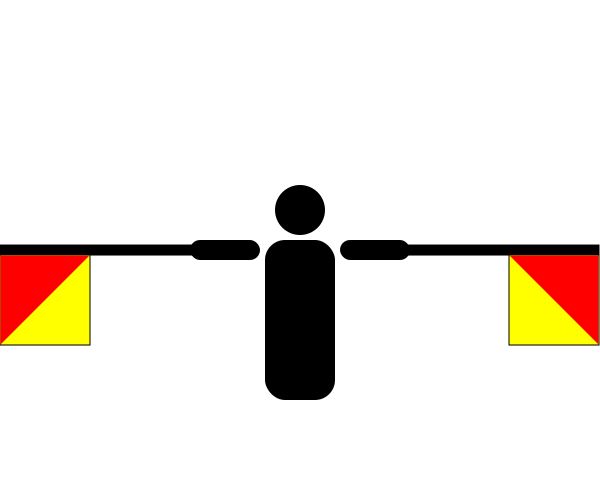
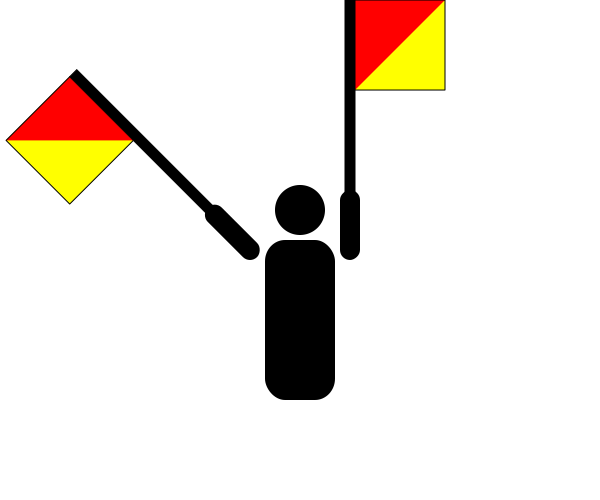
How to communicate the surname Humbert in...
Braille
⠓⠥⠍⠃⠑⠗⠞
Morse
......----.....-.-
Semaphore



There are approximately 111 people named Humbert in the UK. That makes it one of Britain's least common surnames. Only around two in a million people in Britain are named Humbert.
Region of origin: Europe
Country of origin: France
Language of origin: French
