HOWLE
Howle is a surname of purely English provenance, with its earliest documented roots situated within the British Isles. The name is firmly entrenched in the linguistic heritage of medieval England, specifically emerging in the region of England and the adjoining Welsh territories.
From a linguistical standpoint, the surname derives most prominently from the Old English word holh or hoh, meaning a hollow, depression or low-lying ground. The designation was applied topographically to inhabitants who resided near such geographical features. Consequently, the name Howle effectively marked the original bearer’s proximity to a natural valley or deepened patch of earth.
Another significant lineage for the surname is attested in the early Welsh onomastic record. The Old Welsh male given name Hywel, which translates as ‘eminent’ or ‘prominent’, appears in the Anglo-Saxon Chronicle entries for the years 926 and 950 in the north-west of the realm. The name was borne by Huwal West Wala Cyning, a king of the West Welsh, and Hywel Dda, a renowned Welsh prince known for codifying Welsh law. By the late twelfth century, individuals bearing the form Howell were recorded in a variety of English counties, such as Walter de Huwella in Lincolnshire (1165) and William Hoel in Norfolk (1221). These variants illustrate the early transition of a Welsh personal name into a recognised English surname.
The locational origin within South Lincolnshire adds further depth to the surname’s history. The parish once known as Howell is documented as Huuelle in the Domesday Book of 1086 and later as Huwell(e) in the Pipe Rolls of 1190. The place name itself was derived from the pre‑seventeenth‑century personal by‑name Huna – connected to the word hun meaning ‘bear cub’ – appended to the element well, signifying a spring or stream. Residents of this parish adopted the locational suffix, reflected in surnames such as Walter de Huwella and Alfredus de Howella.
In the early thirteenth century, documentation records several bearers of the surname in a range of counties: John Howel of Cambridgeshire (1313), Hyllar Howell of Somerset (1327) and John Howle of Cambridge (1327). The progression of spellings – from Hoel through Howel to Howle – typifies the fluid orthographic practices of medieval England, where standardised spelling was absent and regional dialects exerted considerable influence.
A further line of inquiry considers a Middle English paraphrase of the term hule, meaning ‘owl’. While some records indicate that descendants with physical or behavioural attributes reminiscent of an owl might have been nicknamed accordingly, this theory remains less substantiated when compared to the geographic derivations. Consequently, the prevailing scholarly consensus favours the topographic and locational origins over the symbolic reference to the owl.
Throughout the centuries, the surname Howle has persisted primarily within the United Kingdom, although it has also spread to several former colonies. It appears with very modest frequency in nations such as the United States, Australia, Canada and New Zealand. Modern demographic statistics mark the name as relatively uncommon on a global scale, yet it retains a distinct presence in various regions of England and Wales.
The surname is accompanied by a number of variant spellings, each a product of shifting phonology and orthography over time. Variants such as Howel, Howells, Howell, Holl, Hoole, Hool and Houle have been recorded. These variations often correspond to regional dialects or the adaptation of the name in non‑English speaking contexts where phonetic rendering was necessary.
In historical records the surname appears in contexts ranging from landholdings and court proceedings to ecclesiastical appointments. Notably, Thomas Howell served as chaplain to King Charles I in 1640, indicative of the family’s integration into the social fabric of early modern England. The earliest surviving reference to the name, that of Geoffrey Hoel, is dated to circa 1100 and appears in the Old English Byname Register of Devonshire during the reign of King Henry I, whom contemporary chroniclers famously described as “the Lion of Justice”.
Thus, the surname Howle encapsulates a rich confluence of linguistic evolution, geographical association and cultural resonance, firmly rooted within the tapestry of English onomastic history while retaining a distinct legacy that extends well beyond the borders of Britain.
Typical given names associated with the Howle surname
Male
- Alan
- Christopher
- Clifford
- David
- Douglas
- James
- John
- Kevin
- Mark
- Michael
- Nicholas
- Richard
- Timothy
- William
Female
- Alison
- Alma
- Barbara
- Catherine
- Christine
- Elizabeth
- Emma
- Janet
- Karen
- Lorna
- Margaret
- Miranda
- Nina
- Rebecca
- Sheila
Similar and related surnames
- Houle
- Hewell
- Houel
- Houles
- Houil
- Howl
- Hael
- Hahlo
- Hail
- Haile
- Haili
- Hailie
- Haill
- Hailou
- Hailu
- Hal
- Hala
- Halai
- Halaoui
- Hale
- Hali
- Halioua
- Hall
- Halla
- Halle
- Hallee
- Halli
- Hallie
- Hallo
- Halo
- Halu
- Hauile
- Haul
- Haule
- Hawl
- Hawle
- Hayle
- Hayloe
- Heal
- Heala
- Heale
- Healie
- Heall
- Heel
- Heele
- Hehl
- Heil
- Heile
- Heill
- Hele
- Helie
- Hell
- Hella
- Helle
- Helli
- Hellie
- Hello
- Helo
- Helou
- Hewal
- Hewall
- Hewel
- Hewill
- Heyl
- Heyle
- Hial
- Hiel
- Hiell
- Hil
- Hila
- Hile
- Hili
- Hill
- Hilla
- Hille
- Hilli
- Hillie
- Hilll
- Hillo
- Hilo
- Hilu
- Hla
- Hll
- Hoal
- Hoale
- Hoehl
- Hoehle
- Hoel
- Hoell
- Hohl
- Hoil
- Hoile
- Hoill
- Hol
- Hola
- Hole
- Holi
- Holl
- Holla
- Holle
- Holli
- Hollie
- Hollo
- Hollylee
- Hool
- Hoole
- Hoolle
- Houell
- Houili
- Houl
- Houll
- Houlle
- Houlli
- Howal
- Howald
- Howall
- Howee
- Howel
- Howeld
- Howele
- Howell
- Howelle
- Howelles
- Howelll
- Howells
- Howels
- Howelt
- Howely
- Howil
- Howill
- Howills
- Howles
- Howlie
- Howll
- Hoyl
- Hoyle
- Huell
- Huelle
- Hul
- Hula
- Hule
- Hulea
- Hules
- Hull
- Hulla
- Hulle
- Husle
- Huylu
- Hwyl
- Hyla
- Hyle
- Hylie
- Hyll
- Hylle
- Whowall
- Whowell
- Howley
Related and similar names are generated algorithmically based on the spelling, and may not necessarily share an etymology.
How to communicate the surname Howle in...
Braille
⠓⠕⠺⠇⠑
Morse
....---.--.-...
Semaphore

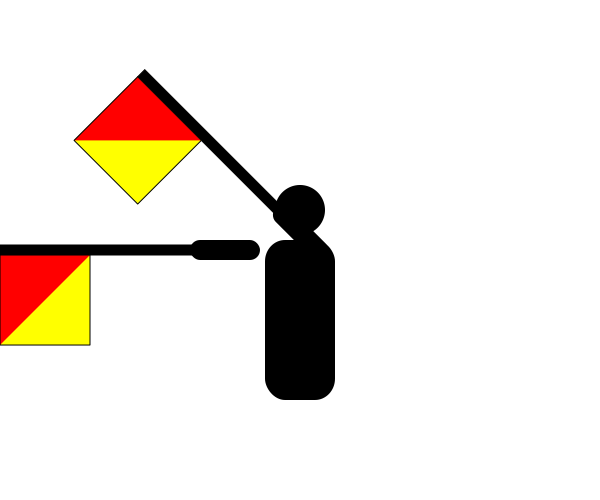
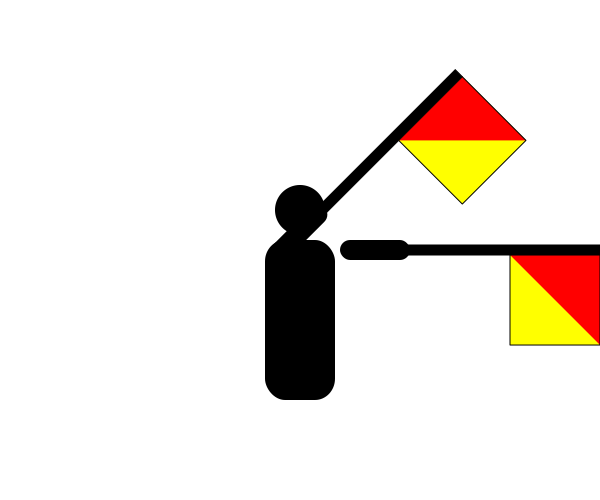


There are approximately 438 people named Howle in the UK. That makes it one of Britain's least common surnames. Only around seven in a million people in Britain are named Howle.
Origin: English
Region of origin: British Isles
Country of origin: England
Religion of origin: Christian
Language of origin: English

Famous people named Howle
- Billy Howle - Actor
Names and descriptions courtesy of Wikipedia, and may contain errors. This is not intended to be an exhaustive list of every famous person with this name.