HOUSE
House is a surname of both English and German origin, originally used in the British Isles and later recorded in France.
The name is a topographic or occupational designation. It may have been given to someone who lived in a large house, to a person who worked within a nobleman's house, or to a servant or steward managing a household. The surname is linked to the Old English pre‑7th century word hus, meaning house, and is therefore closely associated with a dwelling or a role within one.
In addition to the English form, House appears in a number of variants. In Britain it can be recorded as Howse, Hoose, Housaman or Houseman (English and Scottish). In France the forms Housse, Dehouse, Houssier, Houssay, Housseman, Houzelle, Housiaux and Houssiaux have been found. Some scholars regard these as occupational surnames for persons associated with the principal house of a settlement, or for those who lived near such a structure, which might have been the great house of a landowner or a religious house such as a monastery or convent.
The surname is also a variant of the German name Haas, meaning hare, and it can be a translation of the Jewish surname Hausman, meaning house man. In all cases the name is tied to the notion of a dwelling or a person’s position within a household.
The earliest recorded spelling of the family name is that of Simon Hus, dated 1226 in the Eynsham Cartulary of Oxfordshire. The entry occurs during the reign of King Henry, a period that the historical record situates roughly in the early to mid‑13th century. Subsequent mentions include John Houseman of Colchester in Essex, 1365; the marriage of Amie House and Phillip Foster at St. Benet Fink, London, 19 November 1594; Yvonne Houssay at Phelan le Grand, Ille-et-Villaine, 1 March 1667; and Jean Francois Housiaux at Brognon, Ardenne, 31 August 1797, at the start of the Napoleonic Wars.
During the Middle Ages most inhabitants lived in huts or cottages rather than houses, so a surname that denoted residence in a grand house or employment in a household would have set an individual apart. Over time such a name became hereditary when a son followed a father into the same occupation. The surname also covered the sense of a householder, someone who owned a dwelling rather than being a tenant.
Thus, the surname House reflects a historical association with dwelling places and household roles, a tradition preserved across English, German and French linguistic contexts through the medieval period and beyond.
Typical given names associated with the House surname
Male
- Andrew
- Christopher
- David
- James
- John
- Mark
- Michael
- Paul
- Richard
- Robert
Female
- Barbara
- Emma
- Jennifer
- Karen
- Margaret
- Mary
- Nicola
- Patricia
- Pauline
- Sally
- Sarah
- Susan
Similar and related surnames
Related and similar names are generated algorithmically based on the spelling, and may not necessarily share an etymology.
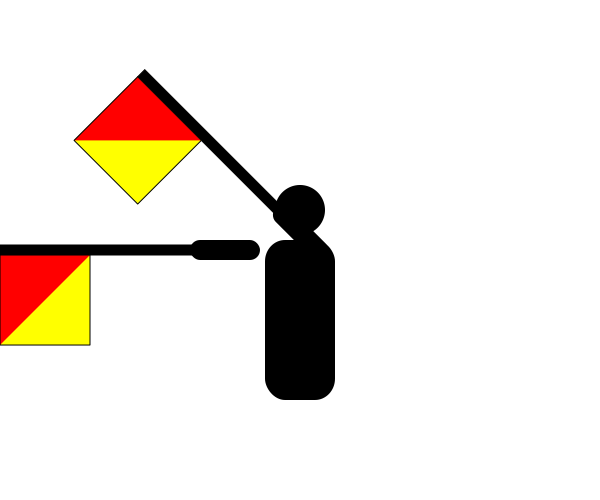
How to communicate the surname House in...
Braille
⠓⠕⠥⠎⠑
Morse
....---..-....
Semaphore



Did you know?
According to a survey carried out by Democracy Club, politicians and candidates with the surname House are most likely to say that their favourite biscuit is a Gingernut.
There are approximately 8,077 people named House in the UK. That makes it roughly the 1,168th most common surname in Britain. Around 124 in a million people in Britain are named House.
Origin: English
Region of origin: British Isles
Country of origin: England
Religion of origin: Christian
Language of origin: English

Famous people named House
- Simon House - Musician
- Andrew House - Businessman
- Ashley House - Television presenter
- John House - Geographer (1919 to 1984)
- Will House - Cricketer
- Kristian House - Racing cyclist
- Kenneth House - Cricketer (1936 to 2014)
- William John House - Recipient of the Victoria Cross (1879 to 1912)
Names and descriptions courtesy of Wikipedia, and may contain errors. This is not intended to be an exhaustive list of every famous person with this name.