HOSIER
The surname Hosier is of distinctly English provenance, tracing its roots back to the medieval period of the British Isles. It falls within the class of occupational surnames, a category that emerged between the twelfth and thirteenth centuries as a practical means of identifying individuals by their trade.
Its etymology is closely linked to the Middle English word hose, meaning stockings or socks. Consequently, a hosier was a person engaged in the manufacture or sale of such hosiery. The term itself is a compound of the older English word hos with the agentive suffix -ier, denoting one who performs a particular activity.
The earliest documented references to the name appear in medieval administrative records. In 1180, a William Husier is recorded in the Oseney Rolls of Oxford, while a Nicholas le Hosier is listed in the pipe rolls of Clerkenwell, London, in 1182. These entries indicate the name’s use as an identifier of occupation rather than as a hereditary family marker at that time.
After the Norman Conquest of 1066, the surname also acquired an auxiliary origin from the French word heuse, later rendered hosier, which described a maker of boots and shoes. This duality reflects a linguistic exchange between Anglo‑Saxon and Norman French, resulting in a surname that, over time, encapsulated both hosiery and footwear manufacture.
By the thirteenth and fourteenth centuries the name was adopted by several individuals across England. Records from the Freemen’s register of York in 1300 name a William de Kekby, hoser, and a Thomas Hosyer appears in York’s Poll Tax register of 1379. These instances demonstrate the surname’s spread beyond a single locality and its integration into the broader English fabric of family names.
While not among the most common surnames in Britain, Hosier enjoys a modest presence in a number of English‑speaking nations, notably the United States, Canada, Australia, and New Zealand. This geographical dispersion corresponds with historical migration patterns of English settlers who carried their family names across the Atlantic and to the Southern Hemisphere.
Several orthographic variants have survived in historical documents, reflecting regional pronunciation and clerical recording practices. These include Hosyer, Hoser, Hosiere, Hosear, and Hoseer. While all are tied to the same occupational origin, some records may also note unrelated names that share phonetic similarity but differ in etymology.
For those engaged in genealogical inquiry, it is advisable to consider these alternate spellings when tracing a lineage. Older manuscripts often exhibit interchangeable forms, and a single family line may appear under multiple variants depending on the scribe’s interpretation or the linguistic context of the region. This awareness can provide a more comprehensive view of the surname’s historical footprint.
In sum, the surname Hosier exemplifies the way medieval English society linked personal identity to profession, and it reflects the linguistic interplay between Anglo‑Saxon, Norman French and Middle Low German influences that shaped the development of English surnames.
Typical given names associated with the Hosier surname
Male
- Andrew
- Anthony
- Christopher
- David
- James
- John
- Kevin
- Matthew
- Paul
- Peter
- Robert
- Simon
Female
- Charlotte
- Dorothy
- Emma
- Julie
- Karen
- Katherine
- Linda
- Lisa
- Lydia
- Maureen
- Sally
- Sharon
- Susan
- Victoria
Similar and related surnames
Related and similar names are generated algorithmically based on the spelling, and may not necessarily share an etymology.
How to communicate the surname Hosier in...
Braille
⠓⠕⠎⠊⠑⠗
Morse
....---.......-.
Semaphore

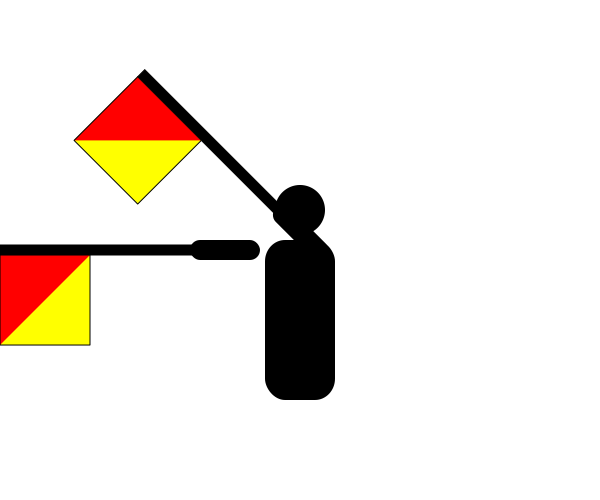

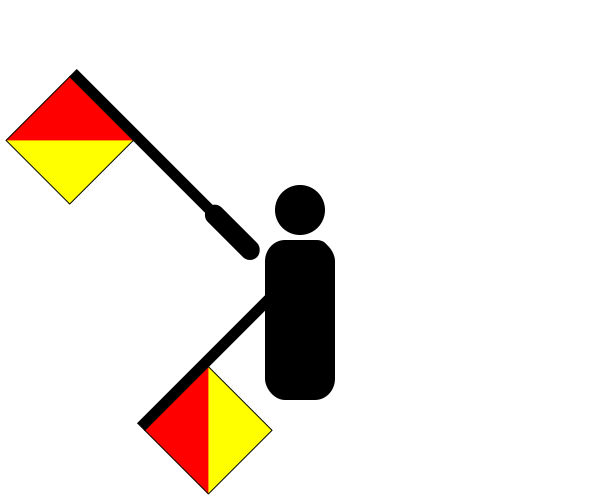

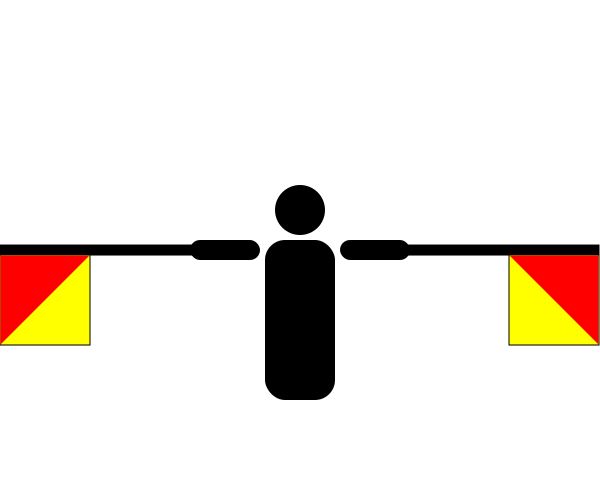
There are approximately 662 people named Hosier in the UK. That makes it one of Britain's least common surnames. Only around ten in a million people in Britain are named Hosier.
Surname type: Occupational name
Origin: English
Region of origin: British Isles
Country of origin: England
Religion of origin: Christian
Language of origin: English
