HORNING
Horning is a surname of dual linguistic origin, appearing in both English and German contexts. It is frequently encountered in records from the British Isles but also appears in continental Europe and, through emigration, in the Americas, Canada, Australia, and South Africa.
The etymological root of Horning is the word horn, a term found in Middle English and Old High German. In both languages it denotes a physical horn or an antler, and in Old English it may also refer to a protruding piece of land or a bend in a river. Consequently the surname may have arisen either as a descriptive nickname for a person with a prominent or horn‑shaped facial feature, or as an occupational name for a craftsman who made or repaired horn objects, such as a hornblower or hornmaker. It is also plausible that it was a topographic marker for someone who lived near a horn‑shaped geographical feature, such as a bend in a river or a headland that resembled a horn.
Historical documentation lists several orthographic variations, including Hornig, Horning, Hornung, Hernon, and Hernow. In England, the earliest known form is recorded as Horningga in the year 1020. The surname is believed to be locational, linked to a locality called Horning in the Fen Country, near the modern city of Norwich. The meaning may have been “the people who live at the horn”, a reference either to a dry tract in marshland or to a river bend. It is also possible that Horning was sourced from a place called the same in Norfolk, whose Old English name, Horningas, translates to “people living on a horn‑shaped piece of land.” In German contexts, the name appears in the forms Horning or Horninger and is linked to the town of Horningen, with the earliest record of a Horninger in Carygwik dated 1324.
All locational surnames follow the pattern “from” the place of origin, normally given to individuals who left their native homes for work. In England, migration to urban centres such as London is documented, and the surname is recorded there from at least the Stuart period. For example, a marriage record held by St. Giles Cripplegate records the union of Susanna Horning and Thomas Pawsey on 4 November 1691, while a later entry from St. Leonard, Shoreditch records George Hornung marrying Mary Barrett on 27 May 1770.
In contemporary distribution, Horning occurs most frequently in the United Kingdom, particularly within Norfolk, and in England at large. Outside the UK it is found in the United States, with a significant presence in Pennsylvania, Ohio, and Michigan, and throughout Canada, especially Ontario. Smaller numbers of bearers exist in Australia, Germany, and South Africa, though the surname remains considerably less common in those regions.
In summary, the surname Horning encapsulates both geographic and occupational origins. Whether derived from a horn‑shaped place, a personal characteristic, or a trade associated with horns, the name has been preserved across centuries and across migrations, illustrating the enduring link between identity and etymology within English and German heritage. The recorded variations and historical documentation confirm its long-standing presence in a variety of cultural contexts.
Typical given names associated with the Horning surname
Male
- Barry
- David
- Joachim
- Michael
- Paul
Female
- Kimberly
- Sheena
- Thelma
Similar and related surnames
Related and similar names are generated algorithmically based on the spelling, and may not necessarily share an etymology.
How to communicate the surname Horning in...
Braille
⠓⠕⠗⠝⠊⠝⠛
Morse
....---.-.-...-.--.
Semaphore

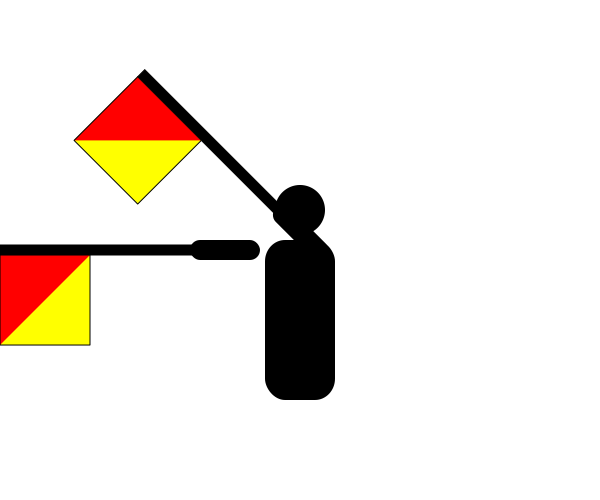
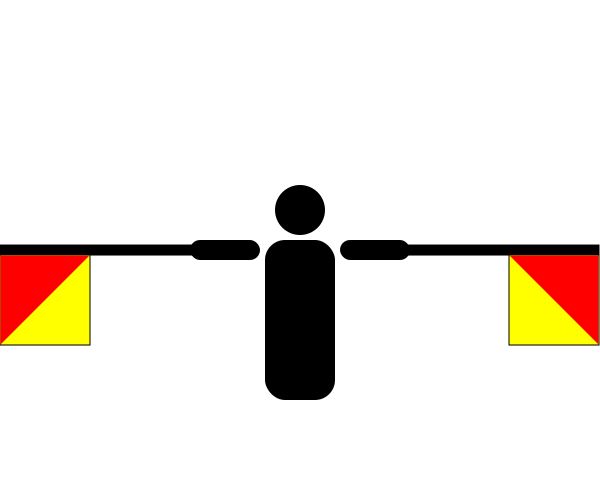
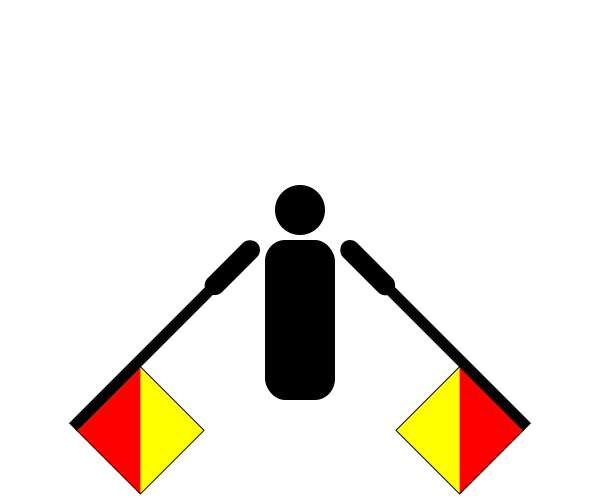
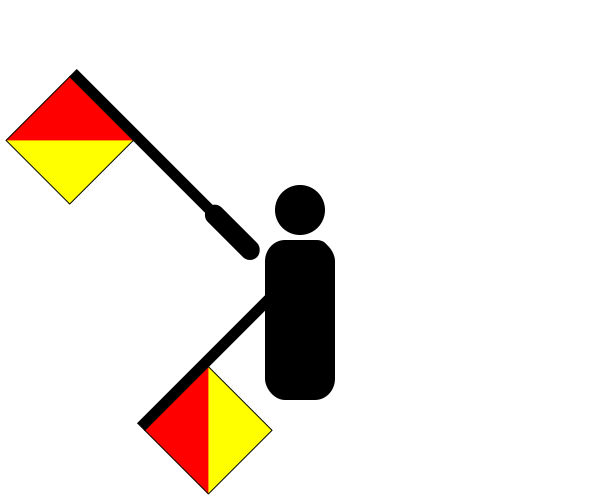

There are approximately 43 people named Horning in the UK. That makes it one of Britain's least common surnames. Only around one in a million people in Britain are named Horning.
Origin: English
Region of origin: British Isles
Country of origin: England
Religion of origin: Christian
Language of origin: English
