HORNEY
Originating in Germany, the surname Horney is derived from the Middle‑High German word horn, which literally means “horn”. As a result, it is widely regarded as a descriptive or occupational name that originally applied to an individual who either bore some resemblance to a horned animal, carried a horn as an instrument, or worked with horns in some capacity. The surname may also have functioned as a locational identifier for those who lived near a natural landmark shaped like a horn.
In the British Isles, Horney is understood to be a topographical surname. It is linked to the Old English pre‑7th century word hyrne and the Middle English herne, meaning a nook, corner or bend in the land or river. Places such as Horney Common in Sussex, the villages of Herne in Kent and Hirn in Hampshire, and other similarly called sites provide the geographical basis for the name. The surname has appeared in early parish registers in London, for example the christening of Alice Hearne in 1547 at St. Martin Ludgate and the marriage of Anne Horney to Thomas Shininge at St. Stephan's, Coleman Street in 1590. The earliest documented spelling is that of Gunnora de la Hurn dated 1279 in the Curia Rolls of Hampshire under the reign of King Edward I.
The name also has cognates in German and Dutch, where it is sometimes interpreted as “hornet”, deriving from the Middle Low German words hornt and hornte. In this context it was primarily a nickname signifying a person with a fierce or determined nature, or it could denote origin from a place named Horney. Over the centuries, members of families bearing the name migrated across Europe, eventually reaching the United States.
The first recorded arrival of a person named Horney in America was John Horney, who settled in Pennsylvania in 1753. Subsequent waves of migration carried the surname to other states such as New Jersey, Ohio, Kentucky, Texas, and California. In modern times the name remains most common in North America, with significant concentrations in the United States and Canada, particularly in Ontario. Although the surname is less frequent in the United Kingdom, it is still represented there.
Several variant spellings share the same etymological foundation, including Horneye, Hurny, Horne, and Horny. Each of these forms has been used as an occupational surname for horn makers, musicians who played a horn or a bugle, or as a topographical reference to horn‑shaped hillocks or landforms. They all trace back to the medieval concept of a “horn” and illustrate the flexible nature of surname development in English‑speaking societies.
Typical given names associated with the Horney surname
Male
- Andrew
- Carl
- Clifford
- Damon
- Darren
- David
- Ian
- John
- Nigel
- Peter
- Philip
- Raymond
- Robert
Female
- Alice
- Angela
- Barbara
- Claire
- Doris
- Heather
- Jacqueline
- Julia
- Karen
- Karin
- Kelly
- Margaret
- Mary
- Sarah
Similar and related surnames
- Harney
- Harne
- Hearne
- Haughney
- Harnes
- Harn
- Hareney
- Hearney
- Hearny
- Hawney
- Hauney
- Horne
- Hornea
- Herne
- Herney
- Hernie
- Herny
- Hirne
- Hoarn
- Hoarnes
- Horine
- Horn
- Hornes
- Horny
- Hourne
- Hurne
- Hurney
- Hurny
- Whorne
- Harene
- Harnies
- Hern
- Hernes
- Hirn
- Horanyi
- Horbey
- Horin
- Horna
- Hornbey
- Hornidge
- Hornley
- Horns
- Hornsey
- Horsney
- Hurn
- Hurni
Related and similar names are generated algorithmically based on the spelling, and may not necessarily share an etymology.
How to communicate the surname Horney in...
Braille
⠓⠕⠗⠝⠑⠽
Morse
....---.-.-..-.--
Semaphore

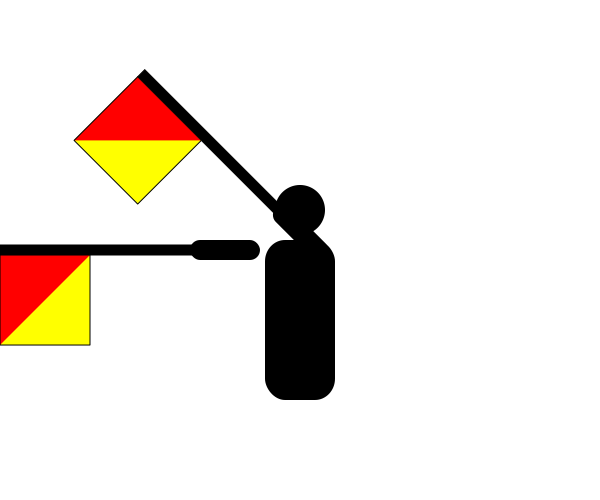
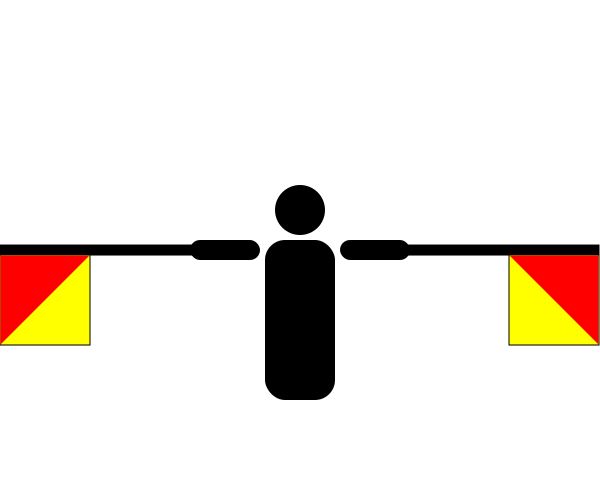
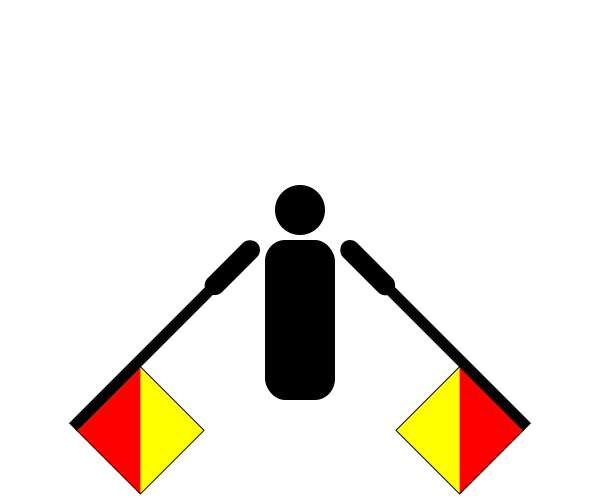

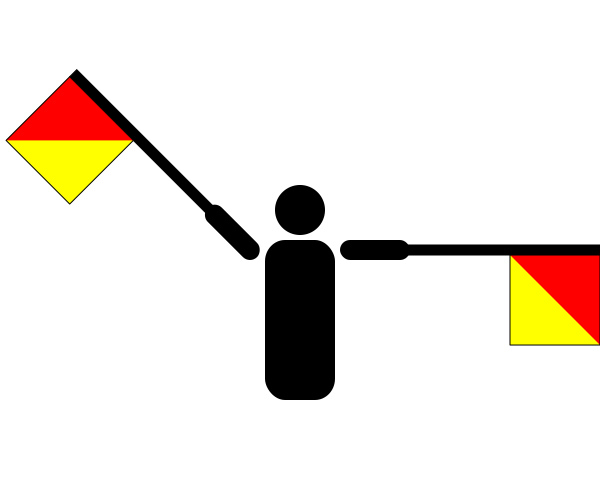
There are approximately 258 people named Horney in the UK. That makes it one of Britain's least common surnames. Only around four in a million people in Britain are named Horney.
Surname type: Location or geographical feature
Origin: English
Region of origin: British Isles
Country of origin: England
Religion of origin: Christian
Language of origin: English
