HOLSTEIN
The surname Holstein has its roots in the Germanic region of northern Europe, specifically the area that was historically known as the Duchy of Holstein. It is a habitational name, given to those who originated from this region and who later moved elsewhere, thereby identifying them by their place of origin.
The name itself is derived from the Old Saxon words holt, meaning “wood” or “forest”, and stein, meaning “stone”. Thus, Holstein literally translates to “wood‑stone”, a reference to the forested and stony terrain that characterises much of the Holstein landscape. The combination of these elements was used as a descriptive place‑name long before surnames became hereditary.
In the Middle Ages the name appears in its earliest recorded form as Holsteinin in 1382, when a person named Emmely Holsteinin zu Freiburg is mentioned in the city charters of Freiburg. Earlier indications of the name appear in German rolls and charters under variants such as Holsten and Holsteyn; a fifteenth‑century appearance at Biberach in 1192 records a Bernhard Schleichwegg, suggesting that the name was in use in different localities throughout southern Germany and northern Denmark.
The Duchy of Holstein was an important feudal entity from the twelfth to the nineteenth centuries. It was originally part of the larger Saxon duchy and later came under the direct administration of the Danish crown, when the territory was divided from the neighbouring region of Schleswig. The inhabitants of the duchy were at one time referred to as Holstianers, a demonym that later evolved into the family name.
The surname Holstein spread beyond its place of origin through migration and immigration. During the nineteenth‑century waves of German immigration to the British Isles, the United States, Canada, Australia, New Zealand, South Africa and other parts of the world, bearers of the name established settlements and, in some cases, adapted the spelling to local orthographies. The form Holeman is especially common in the United Kingdom and North America, presumably arising from dialectical attempts to render the German pronunciation of the original name.
In the United Kingdom the name has been linked to Huguenot refugees who settled in London and the East End. An early record of the name in England dates from 1744, when a John Holstein appears as a witness at the Church of St. Dunstans in Stepney, East London. This indicates that the name had already entered English society by the mid‑seventeenth century.
Variants of the surname, reflecting linguistic changes across time and geography, include Holsteyn, Holstenium, Holstyn, Holston, Holeman, Holt, Hulst, Holste, Hålstén, Holc, Hulstein, and Houlsteain. These forms appear in Dutch, Norwegian, Swedish, Polish, Romanian, and French contexts, illustrating the adaptability of the name across European languages.
The surname presents a vivid example of how place‑based names evolved into family identifiers, retaining essential links to geographic, linguistic, and historical heritage even as descendants dispersed worldwide. Bearers of the name today are most commonly found in Germany, Denmark, the United Kingdom, the United States, and other English‑speaking and European countries, where the name continues to carry its ancient Germanic roots.
Similar and related surnames
Related and similar names are generated algorithmically based on the spelling, and may not necessarily share an etymology.
How to communicate the surname Holstein in...
Braille
⠓⠕⠇⠎⠞⠑⠊⠝
Morse
....---.-.....-...-.
Semaphore

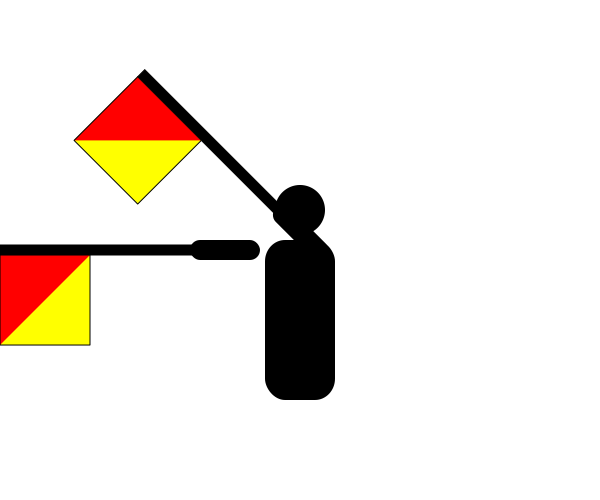


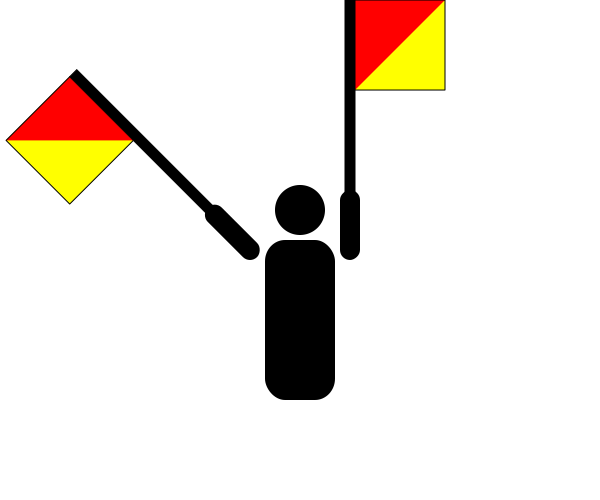

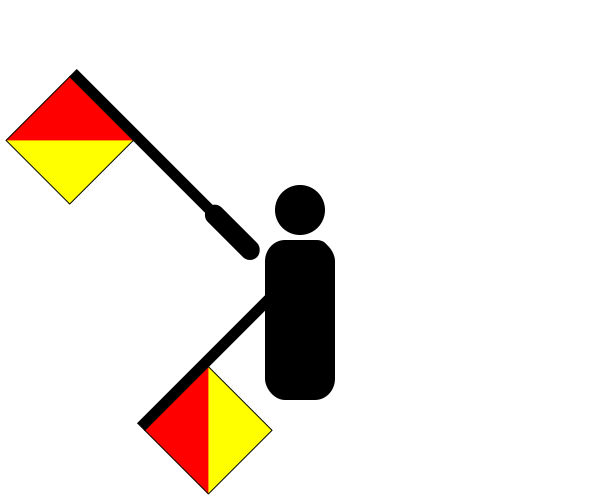
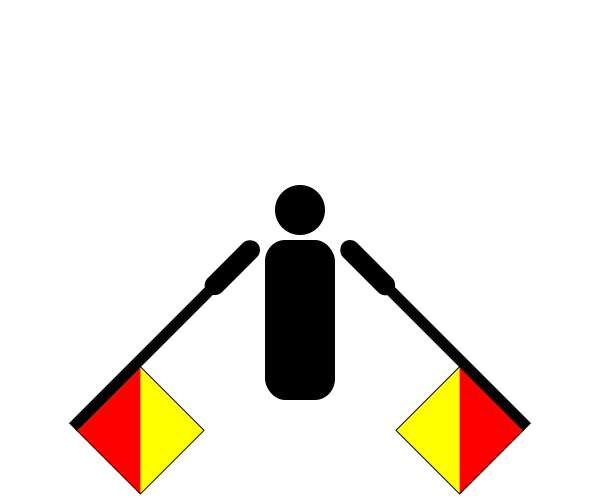
There are approximately 94 people named Holstein in the UK. That makes it one of Britain's least common surnames. Only around one in a million people in Britain are named Holstein.
Region of origin: Europe
Country of origin: Germany
Language of origin: German