HOFFNER
Hoffner is a surname of German origin, commonly associated with both occupational and locational roots. The name is derived from the Middle‑High‑German term hof, meaning a court or a farm, joined with the suffix ner, a linguistic marker for a servant or attendant. Consequently, the surname historically described an individual who performed the duties of a steward or bailiff for a noble estate or managed a rural property.
In addition to its occupational meaning, Hoffner is also recognised as a topographical surname. It refers to a person who resided at a farmstead or a village, with the original reference stemming from the Old High German word hof, denoting a settlement. As such, the name served as a descriptive identifier for those who had migrated from their place of birth, signalling their former homes in the form of a familial surname.
The surname appears in a wide range of spellings across Germanic regions. Recorded variants include Hof, Hofer, Hoeffer, Hoffer, Imhof, Hofstra, Havinga, Van Hove, Van den Hove, Van der Haven, Van der Hove, Van der Hoeven, Van der Hoven, Vanthoff and Verhoeven. These variations illustrate the medieval tendency for spellings to drift under the influence of regional dialects and the absence of standardised orthography.
Historical documentation of the name attests to its longstanding presence. A record from 1290 mentions Otto Hoffner of Bamberg, Bavaria, who witnessed a document approving the construction of a hospital. Subsequent references include Heinrich Hof of Konstanz (1294) and Lugwig von Hofer of Bayern (1446). Later entries from church registers bring forward figures such as Anna Maria Van der Hoeven of Gravenage in the Netherlands (1659) and Baalje Van der Hoven of Ouddorp (1855). In the United States, the first verifiable appearance of the name belongs to Jacob Hoffner in Pennsylvania in the late 17th century.
Several theories provide further insight into the surname’s semantics. One account states that it may have been adopted as a nickname meaning “shield bearer” or “one who carries a shield”, with ties to military or personal service. Another proposes a derivation from the Middle‑High‑German word hovan, translated as “precious stone”. While the exact origin remains ambiguous, these narratives reflect the diverse occupational and social contexts in which the name could have arisen.
Geographically, the surname persists today across a broad spectrum of countries. In Europe it is most prevalent in Germany, particularly in the northern states, and it is also found in Austria, Switzerland, the Netherlands and Denmark. Among the diaspora, the name is common in the United Kingdom, Canada, Australia, New Zealand, South Africa and the United States, with notable concentrations in Pennsylvania, New York and Ohio. The name’s endurance underscores a legacy of migration and settlement throughout the modern world.
Variants of the surname, such as Hofner and Honner, frequently appear in Eastern Germany and Scandinavia. These forms result from linguistic shifts, for example the addition of the suffix -er, a Middle‑Low‑German element indicating a resident or dweller. Such changes reveal the intertwined nature of toponymic and occupational naming traditions within Germanic societies.
In sum, Hoffner is a multifaceted surname rooted in medieval German society. Its composite meanings—spanning stewardship, habitation and, in some accounts, martial symbolism—reflect the social and economic fabric of the era. The surviving records and widespread geographic distribution the surname exhibit attest to its lasting significance across both Europe and the wider world.
Similar and related surnames
Related and similar names are generated algorithmically based on the spelling, and may not necessarily share an etymology.
How to communicate the surname Hoffner in...
Braille
⠓⠕⠋⠋⠝⠑⠗
Morse
....---..-...-.-...-.
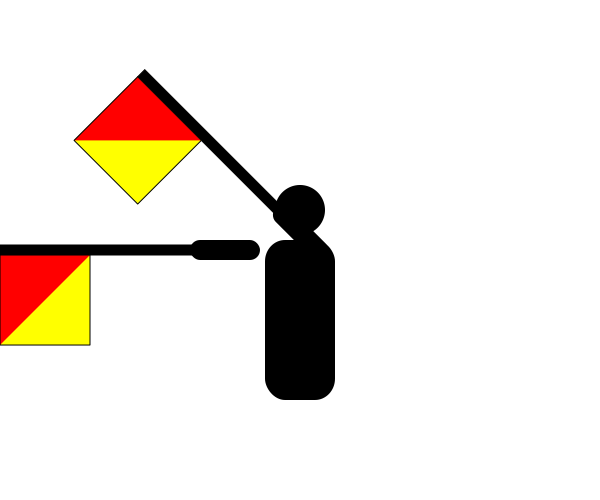
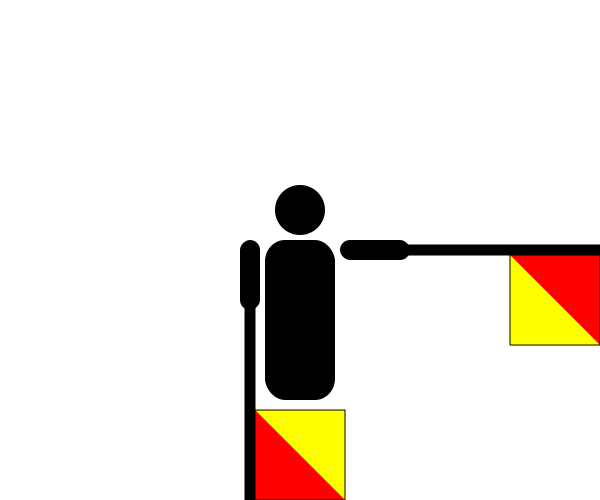
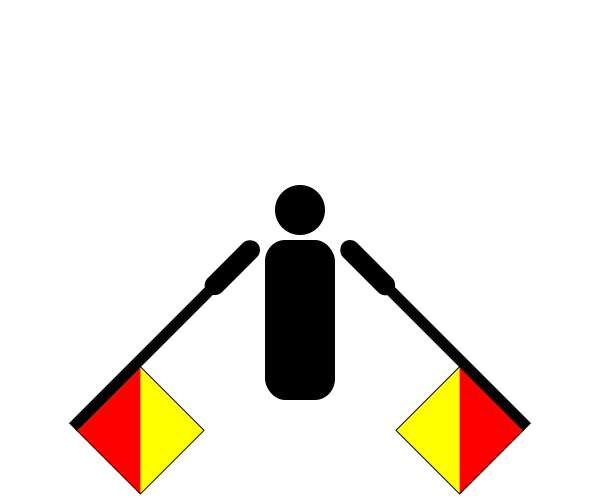
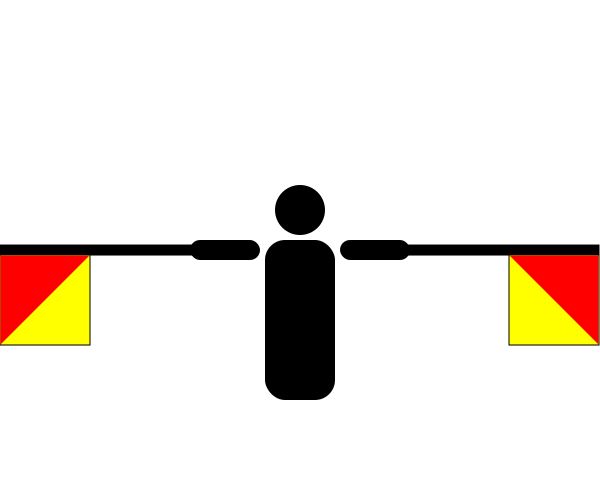
Semaphore


Sorry, we don't have any statistics on this name. That's probably because it's very uncommon in Britain.
