HODGIN
Hodgin is a surname of English origin that can trace its roots back to the medieval given name Hodge, a diminutive of Roger. The name Roger itself is derived from the Old Germanic elements hrod, meaning “renown”, and ger, meaning “spear”. Consequently the surname denotes a familial connection to an ancestor named Hodge or Roger, effectively meaning “son of Hodge” or “son of Roger”.
The formation of the surname reflects the patronymic practice of the period, whereby a child was identified by the parent’s name. In the case of Hodgin, the suffix -kin functions as a diminutive or affectionate marker, implying “little Hodge” or “son of Hodge”. Such use of -kin was common in Anglo‑Saxon naming conventions and later evolved into the spelling Hodgin that is familiar today.
Early documentary evidence shows the name being recorded in several spellings throughout the 14th and 16th centuries. In 1327 the Subsidy Tax rolls of Somerset list Alicia Hogges, the earliest surviving attestation. Other contemporary records include Ricardus Hoge in the 1379 Yorkshire Poll Tax rolls, Ebbota Hoggese in the same rolls, William Hodges in the 1524 Suffolk Subsidy Rolls, Agnes Hodgett in the 1577 London Marriage Licence lists, and Mary Hodgen noted on St Brides Fleet Street in 1654. The substitution of H for R in Hodge is attributed to the difficulty English speakers had with the Norman French r sound, which led to the adaptation of the original Norman Roger into the English Hodge.
Throughout the centuries the surname has appeared in many variants, reflecting the lack of standardised spelling in historical records. Modern spellings commonly encountered are Hodge, Hodges, Hodgeson, Hodgen, Hodgin, Hodgon, Hodgson, Hodgett, and Hodgetts. Similar surnames derived from the same source include Hodgins, Hodson, Hodgkin, and Hodgkinson. The diversity of spellings arose from regional pronunciations and transcription errors in antiquated documents.
In the 15th century, a heraldic grant attributed to the name shows a heraldry described as a gold field charged with three black crescents upon a black canton, with a gold coronet. The arms were originally granted in Gloucester and are still recorded in contemporary heraldic registers as belonging to the Hodgin family.
In terms of geographical distribution, Hodgin remains a relatively uncommon surname. Within the United Kingdom it is most frequently found in the northern counties, particularly in Tyne and Wear. The surname has spread abroad through migration, with notable concentrations observed in the United States, especially in the states of North Carolina, Indiana, and Oklahoma. Smaller frequencies are also documented in Canada and Australia, reflecting the broader diaspora of English surnames.
Academic research confirms that the name is of Anglo‑Saxon provenance and that its principal semantic component is the relationship to the personal name Roger. The addition of the diminutive -kin and subsequent evolution into Hodgin is supported by linguistic evidence rather than conjecture. Scholars note that while the surname’s components have remained stable in meaning, its orthography has varied widely over the last seven centuries.
Typical given names associated with the Hodgin surname
Male
- Alan
- David
- James
- Joe
- Joseph
- Kevin
- Mark
- Neil
- Nicholas
- Paul
- Peter
- Stephen
Female
- Ann
- Barbara
- Elaine
- Hayley
- Jacqueline
- Janet
- Linda
- Louise
- Margaret
- Mary
- Patricia
- Susan
- Tracey
Similar and related surnames
Related and similar names are generated algorithmically based on the spelling, and may not necessarily share an etymology.
How to communicate the surname Hodgin in...
Braille
⠓⠕⠙⠛⠊⠝
Morse
....----..--...-.
Semaphore

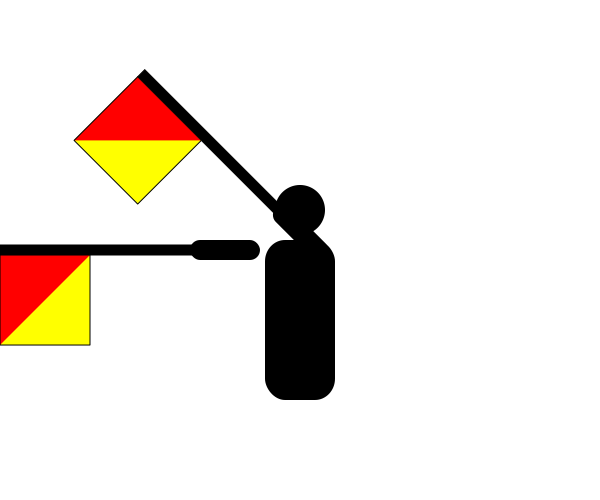


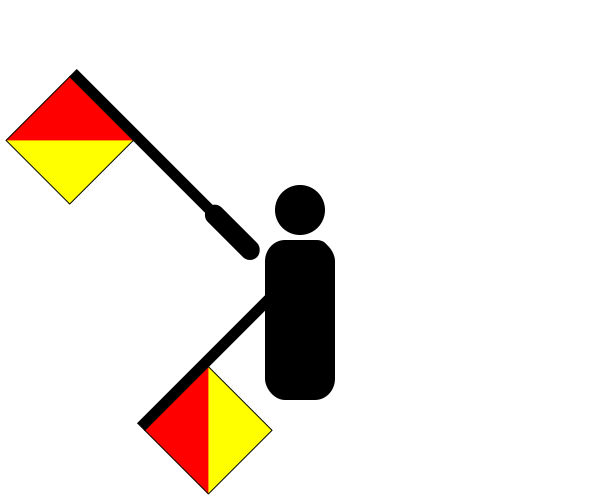
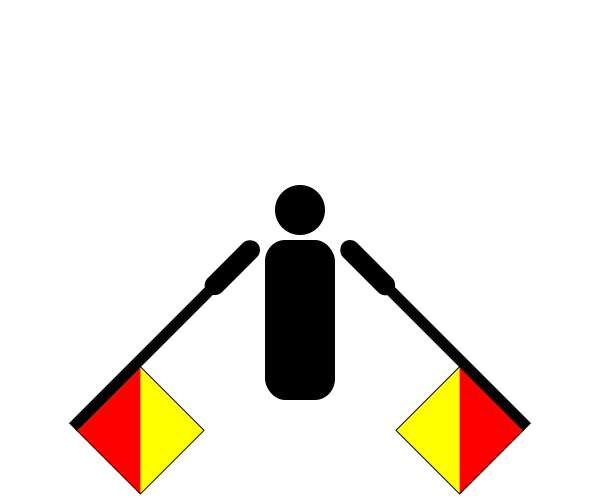
There are approximately 308 people named Hodgin in the UK. That makes it one of Britain's least common surnames. Only around five in a million people in Britain are named Hodgin.
Surname type: Diminutive
Origin: English
Region of origin: British Isles
Country of origin: England
Religion of origin: Christian
Language of origin: English