HINER
Hiner is a surname of German provenance, deriving principally from the personal name Heinrich, which translates to “ruler of the home” or “ruler of the household.” It is a patronymic surname, originally employed to identify the descendants of an ancestor bearing that given name.
In the Middle Ages the surname evolved under several orthographic variants such as Hiner, Heiner and Hinerth. Subsequent spellings also appear in Germanic languages, including Hinner, Hinnere and Hinnerer, reflecting regional dialectal influences and the process of orthographic normalisation that characterised the early modern period.
English records dating back to the 13th century provide evidence that the name has an early medieval English component. Variants such as Hine, Hyne, Hynne, Hynes and occasionally Hindson appear in official documents. These forms originate from the pre‑7th‑century word hiwan, meaning a household. In this context the surname describes an occupational role akin to steward or butler, denoting a servant or official in a noble or royal household, a position often of respect and financial reward. Early examples include Robert le Hine in the Suffolk Hundred Rolls of 1273 and Ricardus Hynne recorded in the Yorkshire pipe rolls of 1319.
In the late medieval and early modern periods, members of the Hiner line appear in a range of social settings. The name is recorded in St. Andrew’s Parish, Barbados, where Mr. Robert Hine held land in 1679. The 19th‑century landscape painter Henry George Hine (1811‑1895) further demonstrates the surname’s persistence among English and American laity.
Other historical documentation affirms the Germanic origins of the surname. The Middle High German term hinære means “one who tramps or treads down,” a descriptor suited to an occupational worker in farming, threshing or road construction. In another occupational sense, the term hüener denotes a chicken farmer or poultry dealer, giving the surname a distinct mercantile association. As with many surnames, the occupational nickname or patronymic became hereditary, passing from father to child through the 12th and 13th centuries, particularly as families settled in settled communities following the Crusades.
The concentration of the surname in contemporary populations is greatest in the United States, with significant communities in states such as California, Virginia and Ohio. It is also present, though less densely, throughout the United Kingdom, Canada and other English‑speaking countries that received waves of German immigration in the 17th and 18th centuries. The relatively low frequency of the name in the United States and United Kingdom suggests that its adoption coincided with specific immigration patterns, predominantly involving German-speaking settlers who retained their ancestral surnames.
Coat‑of‑arms tradition has linked the name to an argent shield charged with three gules anchors on a fesse engrailed azure, with a sable greyhound courant in chief. Such heraldic symbols, while not historically verified for each bearer, demonstrate the cultural importance of family identity within European noble and gentry families.
The surname Hiner therefore encapsulates a rich tapestry of linguistic, occupational and paternal origins, manifesting in multiple orthographic forms across Germany, England and the United States. Its endurance through centuries of migration, social change and cultural assimilation confirms its status as a noteworthy example of how a name can trace both lineage and professional heritage across diverse societies.
Typical given names associated with the Hiner surname
Male
- Peter
Female
Similar and related surnames
Related and similar names are generated algorithmically based on the spelling, and may not necessarily share an etymology.
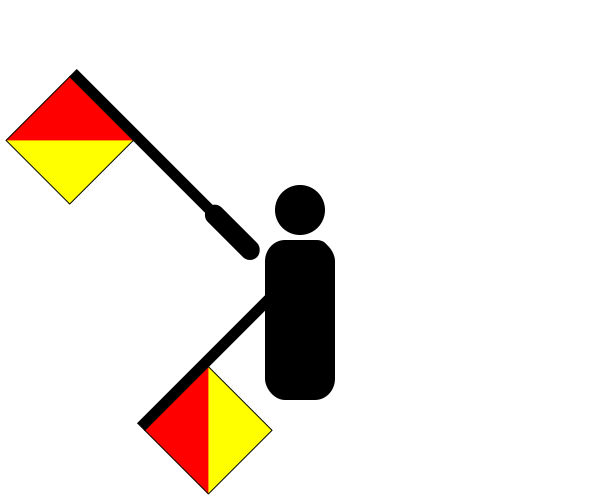
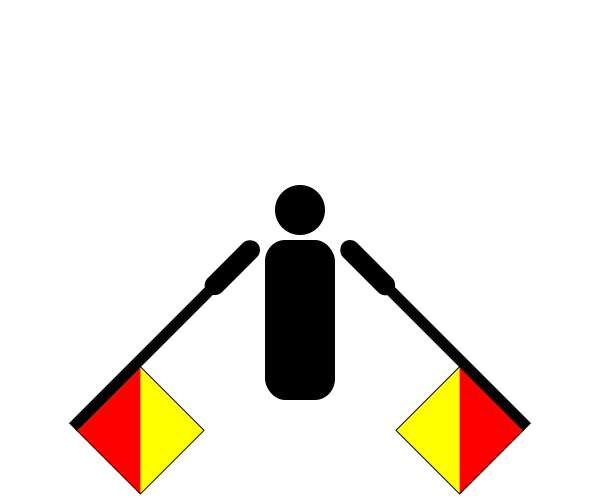
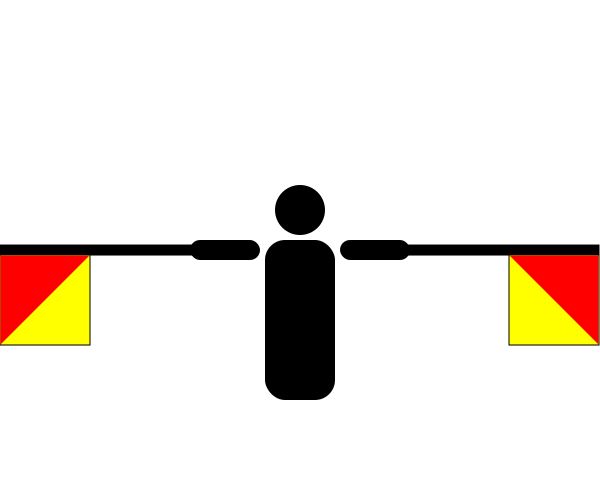
How to communicate the surname Hiner in...
Braille
⠓⠊⠝⠑⠗
Morse
......-...-.
Semaphore


There are approximately 93 people named Hiner in the UK. That makes it one of Britain's least common surnames. Only around one in a million people in Britain are named Hiner.
