HENKE
The surname Henke is of German provenance and has long been associated with the Kingdom of Germany and its adjoining states. It is a patronymic name, originally formed to signify descendants of an individual named Heinrich, a medieval given name that translates as “ruler of the home” or “ruler of the household.” Consequently, the name was used to identify a family line rather than a single person.
The etymology of Henke can be traced back to several root words in early Germanic languages. One source links it to the Old High German word henc, meaning “brave,” “strong,” or “bold.” Another derivation relates it to the pre‑7th century German personal name Heim‑ric, itself a compound meaning “home rule.” These origins detail why the surname came to be associated with strength, courage, and leadership in historical records.
In the medieval period, the name appeared in a wide range of spellings across Europe. Examples include Henrich, Hendrich, Henrick in German contexts; Hendry, Henry, Henryson in English and Scottish documents; Aimeric, Enric, Henric in French‑Provencal sources; Hendrick, Hendrik, and Hendrickson in Flemish writings; Jendircke, Gendricke, Jina, and Jindrick in Czech and Slavonic records; as well as Enriques in Spanish and Jendrassik in Hungarian. These variations illustrate the name’s widespread appeal and the way it adapted to local linguistic norms.
Recorded medieval documents provide the earliest concrete evidence of the surname. One of the earliest known examples is Thomas Henery of Kent, England, dated 1275, during the reign of King Edward the First. Other early instances include John Fitz Henrie from the Calender of Inquisitions in London, 1346; Genetiv de Heinrich of Fritzlar, Germany, 1335; and John Hendrie of Cornwall, England, 1359. These citations confirm that the surname had already been established several centuries before the formalisation of hereditary family names in the 12th century.
Geographically, the surname was most common in Central and Northern Germany, especially in north‑western regions such as Hamburg, Berlin, and Hanover. Within Germany, it is a contracted form of Hencke or Heincke, which itself derives from the masculine name Heine, a diminutive of Heinrich. The literal sense of Henke in this context is “little Henry.” In the broader European context, the name ranked within the top 2,200 most frequent surnames in Germany and the top 9,000 across the continent, representing roughly 0.10 % of the global population.
Beyond Germany, the distribution of the surname expanded through emigration. In North America, significant populations of bearers are found in the United States, particularly within the southeastern and mid‑western states, a pattern attributable to 18th‑ and 19th‑century German immigration. In Canada, the name appears notably in Ontario, Alberta, Manitoba, and Nova Scotia. It is also present in Latin America, especially Panama, where many families trace their lineage to East German settlers. Scandinavian nations such as Denmark, Sweden, and the Netherlands likewise report a measurable frequency of the surname.
Variants of the surname reflect regional linguistic differences and occupational associations. Common forms include Hänke, Hencke, Hankke, Honck, Heinke, Hincke, Henk, Henken, Henka, Henkmann, Hönke, Henkeman, Henckel, Hencker, Henckels, Hanke, Henge, Henkes, Henkle, Henkel, Henckes, and others. Some of these variants were originally occupational, such as Henke meaning “home plumber” in Low German, or referencing a brewer employed by local households. Others describe geographical ties (for example, the Low German henkel meaning “corner” in Dutch) or workmanship contexts (like hanke denoting a teamster or hank meaning “handle”).
The surname has also been historically linked to geographical subdivisions within German society. Two notable groups are the Goffenkamp and the Stadtmüller families. The former, situated in Northern Germany, carries the meaning “courageous camp of the gods” and was likely associated with individuals or families in high social or political positions. The latter, of Central‑German origin, means “city miller,” implying a connection to milling operations located within urban areas. These distinctions further highlight how the name served to differentiate individuals of varying status or profession in both medieval and early modern Europe.
Similar and related surnames
Related and similar names are generated algorithmically based on the spelling, and may not necessarily share an etymology.
How to communicate the surname Henke in...
Braille
⠓⠑⠝⠅⠑
Morse
.....-.-.-.
Semaphore


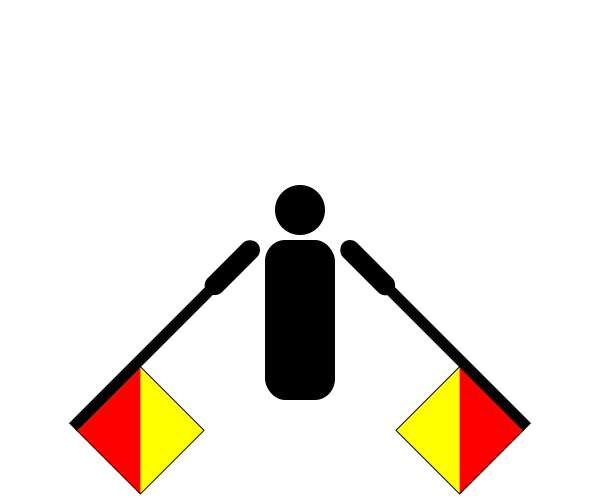
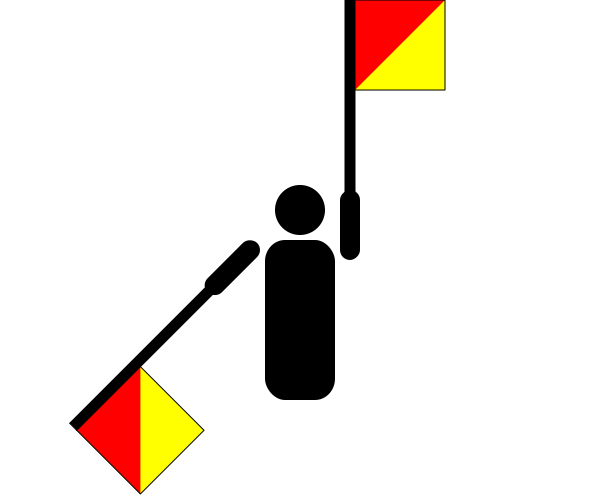
There are approximately 92 people named Henke in the UK. That makes it one of Britain's least common surnames. Only around one in a million people in Britain are named Henke.
Region of origin: Europe
Country of origin: Germany
Language of origin: German
