HEMPEL
Hempel is a surname of Germanic origin that appears in records as early as the mid‑15th century. According the oldest surviving document it is derived from the Middle High German word hempel, which referred to the hemp plant used for making textiles, rope and other utilitarian goods.
The occupational nature of the name is evident in that it was likely bestowed upon individuals who cultivated or processed hemp. The first concrete evidence of its use in Germany is the 1459 charter of the province of Biberach, in which Daniel Hemppel is recorded as a farmer in the village of Lankwart.
Several spelling variants of the surname – Hemphall, Hempsall, Hemphill, Hempill, Hempell and the modern Hempel – have been documented in English records from the 17th and 18th centuries. Witnesses named George Hempsall (Ossington, 1677), John Hemphall (Rolleston, 1749), John Hempel (London, 1792) and William Hemphill (Covent Garden, 1796) attest to a possible English locational origin. Such origins may be associated with now‑lost villages such as Hemp Hill or with a place called Hempshill in Nottinghamshire; in these cases the name literally denotes “the place where hemp is grown”. It is recognised that a small but significant proportion of British surnames – roughly 8% – derive from vanished villages; the surname Hempel is an example of this phenomenon.
Another interpretation of the surname, supported by separate medieval sources, links it to the Middle High German word hamph, meaning enclosure, hamlet or homestead. Under this derivation the name stands for a “little home” and is thought to have first surfaced in the Middle Ages as a descriptor of a farmstead that had been repurposed from an earlier settlement. In contemporary Germany the surname remains strongly associated with Schleswig‑Holstein and northern regions, areas long populated by families who carried the name across generations.
A further, less frequent but documented meaning, appears in earlier scholarly accounts where hempel is identified with the German word for a hawk or bird of prey. This use would have originally applied to people who lived near or hunted such birds. The variant spellings introduced by this view – for example Hanpel, Henpel, Heimpl – are found in German, Dutch and Frisian records.
In modern times the surname is widespread. It is common in the German‑speaking states of Germany, Austria and Switzerland, as well as in the United Kingdom. In the United States it is largely a legacy of German immigration that began in the eighteenth century; the name has also migrated to Canada, the Netherlands, South Africa, Australia, South America and several Eastern European nations. In Asia it is comparatively rare, most frequently recorded in China, Japan, North Korea and Vietnam, usually by those who have emigrated or adopted the name through colonial connections.
Prominent individuals who bear the surname include Georg Hamel, a nineteenth‑century German mathematician whose work is well respected in the field of abstract algebra. His surname, although spelled slightly differently, is frequently linked with the Hempel lineage in historical discussions of German scientific heritage.
Similar and related surnames
Related and similar names are generated algorithmically based on the spelling, and may not necessarily share an etymology.
How to communicate the surname Hempel in...
Braille
⠓⠑⠍⠏⠑⠇
Morse
.....--.--...-..
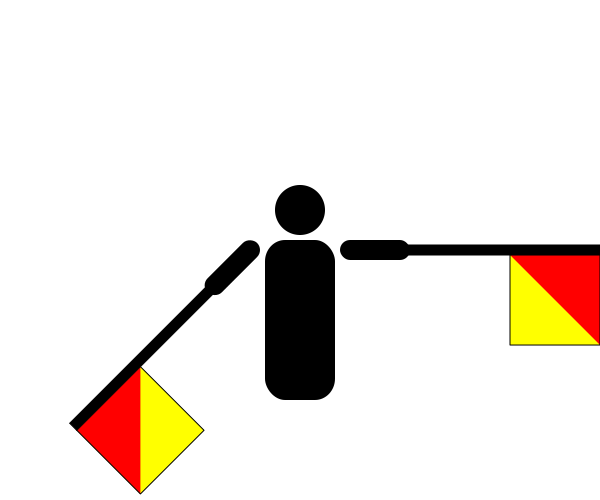
Semaphore




There are approximately 103 people named Hempel in the UK. That makes it one of Britain's least common surnames. Only around two in a million people in Britain are named Hempel.
