HEMMINGWAY
The surname Hemingway emerges in England, first documented in the late thirteenth century as a locational name. Its origin lies in the Old English personal name Hemming, a patronymic meaning “son of Hemma”.
The suffix -way, derived from the Old Norse word for a path and from the Old English weg meaning “way”, denotes a path, road or place by which the family dwelt. Combined, the components form the meaning “son of Hemming who dwelt by a particular path”.
The earliest known registration is that of John de Hemyngway, recorded in the Yorkshire Poll Tax Returns of 1379 during the reign of King Richard II. This attests to the surname’s presence in the northern counties of England from the mid‑fourteenth century.
Historical geography points to a now‑lost settlement in West Yorkshire, most likely within the parish of Halifax. Between the twelfth and fifteenth centuries many villages were abandoned owing to the plague of 1348, which claimed an eighth of the population, and to the widespread settlement of sheep pastures following medieval clearances. The loss of such places explains why the original location that gave rise to the name no longer survives on the map.
The toponymic element is also associated with the Old Norse personal name “Hem(m)ingr”, a compound of the element “heim” (home) and “ingr” (son). When combined with “wey”, the Old English word for a way or path, the name can be interpreted as “the path of Hemming”.
The spelling of the surname has varied over time. In addition to Hemingway and Hemmingway, historical records contain a wide range of forms such as Hemingwaye, Hemmingsway and Hemeway, reflecting regional pronunciations and the lack of standardised orthography in that period.
In the present day the surname, although not common, is recognised in many English‑speaking countries. Its most enduring association is with the American novelist Ernest Hemingway (1899‑1961), whose award‑winning novels have cemented the name in modern literature.
Ernest Hemingway’s texts, including A Farewell To Arms, For Whom the Bell Tolls and The Old Man and the Sea, illustrate how an individual of modest background can imbue a family name with worldwide prominence.
Therefore, the surname Hemingway encapsulates a rich linguistic heritage combining Anglo‑Saxon patronymics, Norse elements and locational suffixes, and its legacy has been preserved both in historical records and in contemporary cultural memory.
Typical given names associated with the Hemmingway surname
Male
- Andrew
- Christopher
- David
- Gary
- Ian
- James
- John
- Keith
- Mark
- Paul
- Sam
- Thomas
Female
- Ann
- Caroline
- Christine
- Jane
- Julie
- Loraine
- Mary
- Michele
- Michelle
- Nicola
- Sarah
- Susan
- Vicky
- Victoria
Similar and related surnames
Related and similar names are generated algorithmically based on the spelling, and may not necessarily share an etymology.
How to communicate the surname Hemmingway in...
Braille
⠓⠑⠍⠍⠊⠝⠛⠺⠁⠽
Morse
.....----..-.--..--.--.--
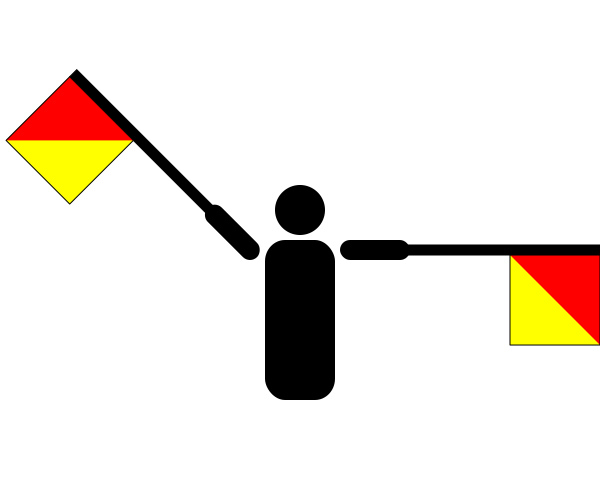
Semaphore


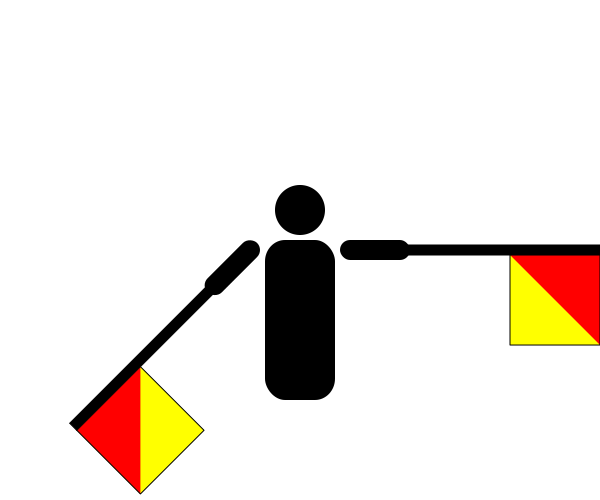
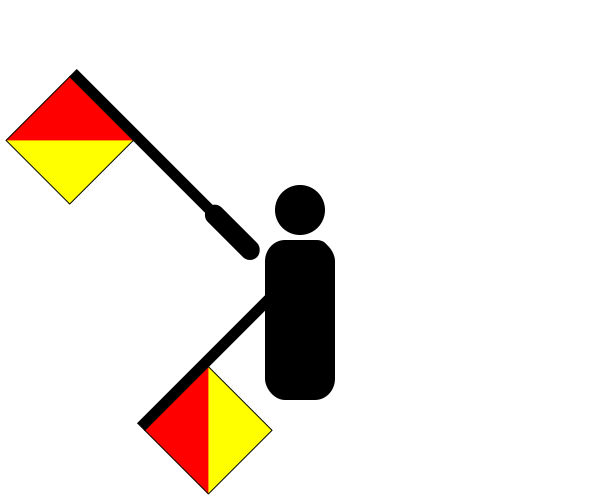
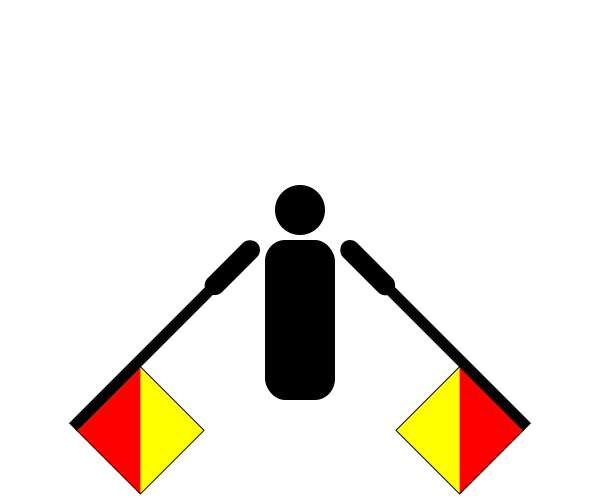

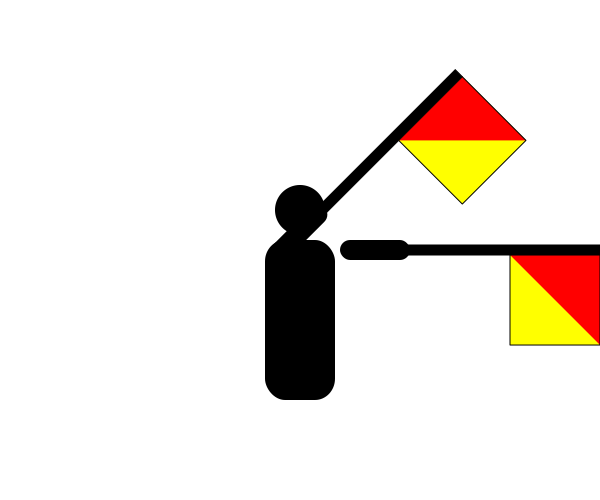

There are approximately 312 people named Hemmingway in the UK. That makes it one of Britain's least common surnames. Only around five in a million people in Britain are named Hemmingway.
Surname type: Location or geographical feature
Origin: English
Region of origin: British Isles
Country of origin: England
Religion of origin: Christian
Language of origin: English