HELLWIG
The surname Hellwig is conclusively of German origin. Its earliest attestations appear in documentary record in the late thirteenth century, and it has since spread, in varying concentrations, across Germanic and neighbouring territories.
In its primary composition the name is formed from the elements hell, meaning bright or clear, and wig, meaning battle or war. The literal sense is therefore “bright battle” or “clear war”. According to contemporary scholarship this construction would originally have functioned as a nickname designated for an individual renowned for martial prowess or courage in conflict.
An alternate, though historically related, derivation takes the saintly element helm (helmet) together with wig, producing a sense of “helmeted battle”. This variant is linked to the older personal name Hallevih, which later evolved into the family name Hellwig and indicates a warrior-like quality among its earliest bearers.
The surname is recorded in several medieval spellings, including Hellwing, Helwing, Helwig, Helwich and others. Historical sources refer to a baptised name Hell-wig, meaning “battle-battle”, and attribute it to the distinct medieval practice of bestowing on children names that reflected power, piety or glory. The first documented appearance of the name in any form is usually counted as that of Heinricus Helwig of Wimpfen, Germany, in 1292. Earlier mentions, such as the 1636 marriage of Blasius Helving and the 1801 union of Anna Catharina Hellwing, demonstrate the survival of the name into the early modern era.
There is evidence that the Hellwig family may have derived from a notable medieval noble house situated in the historical states of Baden and Rhineland – now part of Bavaria and Hesse. By the late fourteenth century members of the family were established in Frankfurt am Main, where they were recorded as being renowned for boldness on the battlefield and for undertaking courageous acts of service.
Variants of the surname have proliferated in adjacent countries. In German‑speaking regions spellings such as Hellwigh, Hellweg and Hellewig have been used, while in Dutch contexts the name appears as Hellwegge. In England a limited number of bearers are recorded under the form Hillwig. The Jewish diaspora introduced the cognate Hellwigge, which can be observed in Israelised records. These orthographic variations attest to the adaptive transmission of the name across linguistic borders.
In terms of distribution, the surname remains most frequent in western and central Europe, especially in Germany, the Netherlands and Luxembourg. It is substantially represented in the regions of Bavaria, Hesse and Rhineland. In former domains of the Austro‑Hungarian Empire, sizeable clusters are also found, though the name is comparatively rarer in southern and eastern European countries where other naming traditions prevail. In the United States, the name is primarily concentrated in the states of Pennsylvania, the Midwest, California, New York and New Jersey, reflecting historic settlement patterns of German immigrants. The surname is also present, though with lower density, in the Americas more broadly, Australia and New Zealand.
Military muster rolls from the Napoleonic period provide a valuable mechanism for tracking the spread of the Hellwig surname, revealing migration routes and settlement patterns of gun‑bearers and their families across continental Europe and beyond.
Contemporary bearers of the name retain a perception of the surname as embodying strength and courage – qualities that are directly echoed in the etymology of the name itself. While the name remains relatively uncommon compared with other Germanic surnames, it continues to hold a distinct place within the genealogical and cultural fabric of German and European heritage.
Similar and related surnames
Related and similar names are generated algorithmically based on the spelling, and may not necessarily share an etymology.
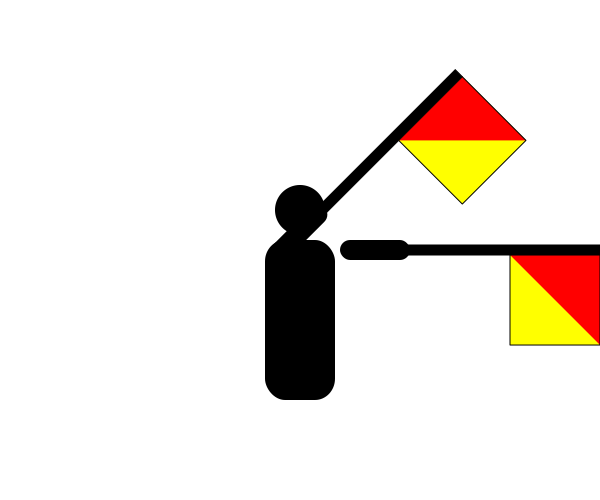
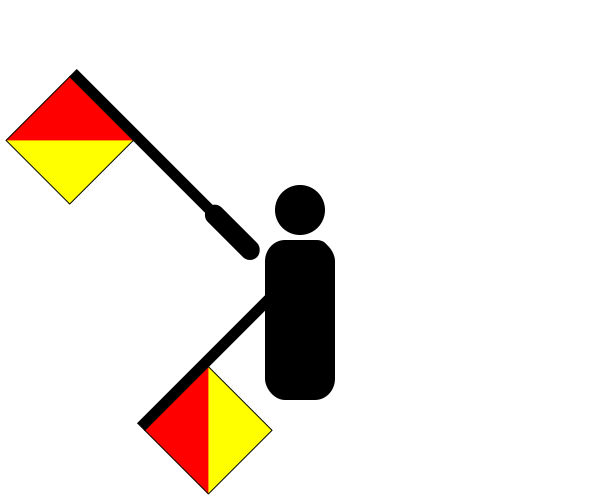
How to communicate the surname Hellwig in...
Braille
⠓⠑⠇⠇⠺⠊⠛
Morse
......-...-...--..--.
Semaphore



Sorry, we don't have any statistics on this name. That's probably because it's very uncommon in Britain.
