HEITZ
The surname Heitz is a Germanename that has been in use since the medieval period. It is principally found in Southern Germany, particularly in Bavaria and Baden‑Württemberg, and in neighbouring Switzerland. In recent surveys only around one thousand eight hundred people in Germany carry the name, while in the United States it is represented by roughly sixteen thousand individuals, mainly in Pennsylvania.
The name is a patronymic derivative of the personal name Heinrich, which in turn comes from the pre‑7th century Germanic personal name Heim‑ric. The element heim means “home” and ric denotes “rule”; together they figuratively signify “ruler of the home” or “ruler of the household.” The surname evolved as a shortened form of Heinrich, and its earliest recorded instance dates to 1275 in England, where a Thomas Henery of Kent was mentioned in a charter of King Edward the First.
Other documentary references include a 1335 entry for Genetiv de Heinrich of Fritzlar in Germany, a 1346 account of John Fitz Henrie in the London Chronicon of Inquisitions, and a 1359 record of John Hendrie of Cornwall in England. These attestations confirm the widespread use of the name across Europe during the 14th century.
Throughout history the surname has appeared in a wide variety of spellings and forms that reflect its adaptation to different linguistic and cultural contexts. In German it occurred as Henrich, Hendrich and Henrick; in English and Scottish as Hendry, Henry and Henryson; in French‑Provencal as Aimeric, Enric and Henric; in Flemish as Hendricks and Hendrickson; in Czech and other Slavic tongues as Jendrcke, Gendricke, Jina, Jindrick; in Spanish as Enriques; and in Hungarian as Jendrassik. In Ireland the surname may derive from either a 12th‑century Norman settler lineage known as FitzHenry or, more likely, from an anglicised form of the Gaelic O’Inneirghe which translates as “the descendant of the abandoned one.”
Geographically, the surname is most densely concentrated in the mountainous districts of Southern Germany, particularly Bavaria. It is comparatively rare elsewhere within Germany and has not been widely dispersed overseas in the past few generations. Outside of continental Europe it appears mainly in the United States and, to a lesser extent, in France and the United Kingdom.
The etymological roots of Heitz are anchored in German words meaning “house” or “home.” The early Middle High German origin is often cited as Heit, a word signifying “family” or “tribe,” while the suffix -itz denotes a direct connection to a particular house or household. Some accounts suggest a secondary link to the German word Heitz meaning “fear” or “terror,” but the “house” derivation is the more plausible explanation given the historical context of the name’s emergence.
Notable bearers of the surname include the contemporary Austrian artist, architect and designer Thomas F. Heitz, whose work such as the penguin table lamp and Venetian glass vases has gained international attention. Although his surname reflects Germanic heritage, his acclaimed oeuvre is primarily associated with Austrian modern design.
In contemporary census data, the surname Heitz remains recognisable both in Germany, where its prevalence is modest, and in the United States, where it is ranked as the sixteenth most common surname in Pennsylvania. The combination of its historical depth, geographic concentration and modern representation affirms that the name will likely remain a distinct element of Germanic nomenclature for the foreseeable future.
Similar and related surnames
Related and similar names are generated algorithmically based on the spelling, and may not necessarily share an etymology.
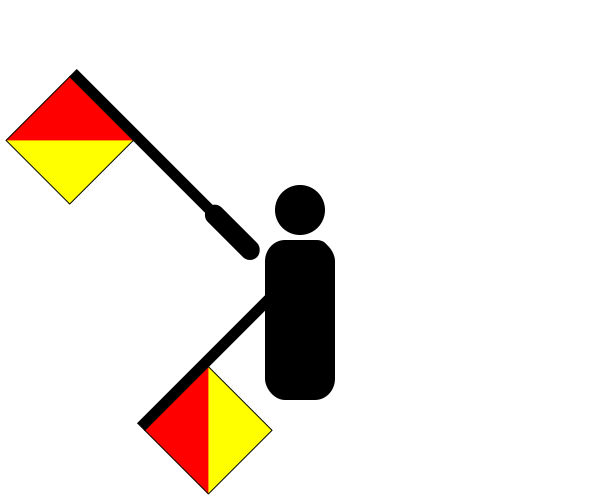
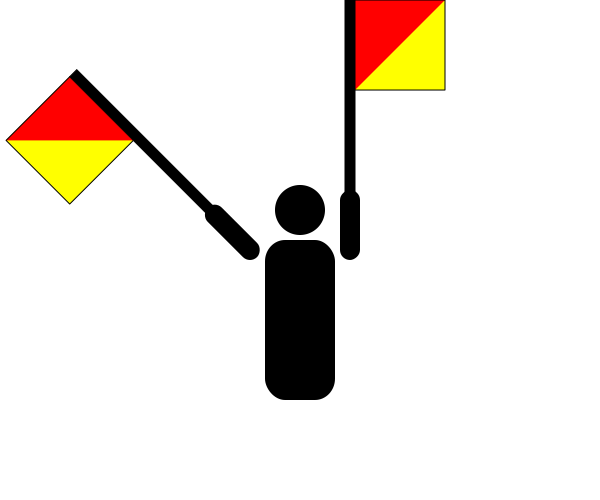
How to communicate the surname Heitz in...
Braille
⠓⠑⠊⠞⠵
Morse
.......---..
Semaphore



Sorry, we don't have any statistics on this name. That's probably because it's very uncommon in Britain.
