HEISTER
The surname Heister is a German name that has been documented since at least the early fourteenth century. Its earliest record is that of Heinrich Hester in 1403 within the charters of Eiche oder Buche, Germany, during the reign of Emperor Rupert of the Palatinate.
In Middle High German the word heister signified both “host” and “army”. The name is, therefore, an occupational surname that originally applied to individuals who served as military officers or commanders, or to those who provided accommodation for soldiers. The martial connotation is reinforced by references to the name in several medieval German military records.
From the late Middle Ages the surname was written in a variety of forms, most commonly as Hester or Heister. Contemporary scholarship considers the name to be job‑descriptive, comparable to the English crier – an officer of civil authority responsible for public announcements. It may also have functioned as a nickname for someone who, in some aspect, resembled or performed the duties of such an official, or who played a similar role in popular medieval theatres.
The Dutch influence is evident in spellings such as Van Hesteren or Hesteren, where the prefix van is used as a patronymic rather than a marker of origin. Early American records show an anglicised spelling, for example Eziekiel Hesterns, a witness at Albany Lutheran Church in 1796. Other documented individuals include Ludwig Heistermann of Marburg in 1586 and Daviot Hesters, son of Hermann and Magdalena Hesters, documented in Amsterdam in 1609.
A heraldic device traditionally associated with the surname depicts an oak tree proper on a white field, overlaid with two black pales. Such a blazon reflects the historical emphasis on strength and steadfastness characteristic of families bearing the name.
In terms of demographic distribution, the surname remains more common within Germany, with an estimated frequency of one bearer per 4,800 inhabitants. In English‑speaking countries the name is comparatively rare: approximately 2,800 in England and 6,000 in the United States. Significant populations are also recorded in Canada, Australia, France and the Netherlands. In France the name is sometimes rendered as Hester, while in Polish contexts it appears as Histry, and it is also found among Jewish communities where it is spelled Heister.
Variant spellings that derive from a common root include Haister, Hester, Hister, Hiester, Heistert, Hayster, Hastor, Hestor, Haster and Haszt. Each of these forms can be traced to the original Germanic nomenclature and retains the same essential etymological meaning.
The Heister surname thus encapsulates a legacy that spans military service, hospitality, civil authority, landownership and cultural prominence. Bearers of the name throughout history have occupied distinguished positions in the military, civil administration and commerce, reflecting the heritage associated with the designation of one who stood at the helm of community life, whether it be on a hill, in a battlefield, or within a civic institution. The name continues to be carried by individuals who honour this ancestral heritage while engaging in contemporary pursuits across a range of professional fields.
Similar and related surnames
Related and similar names are generated algorithmically based on the spelling, and may not necessarily share an etymology.
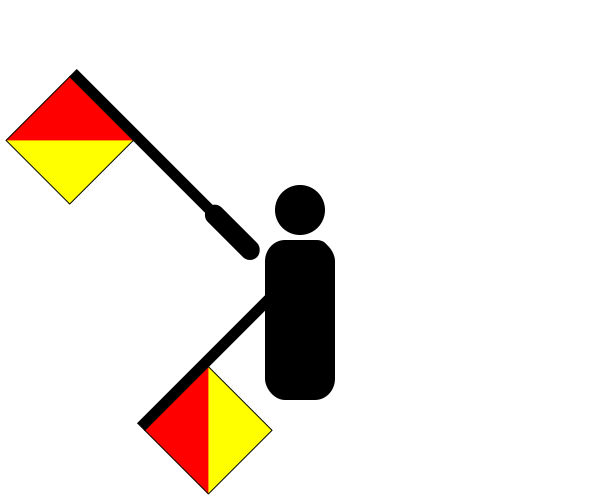
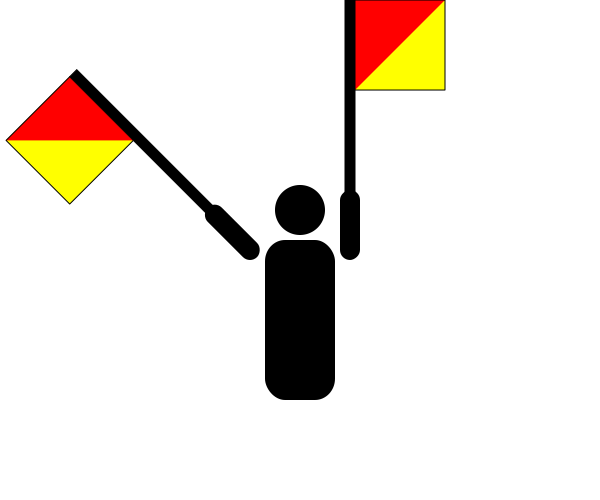
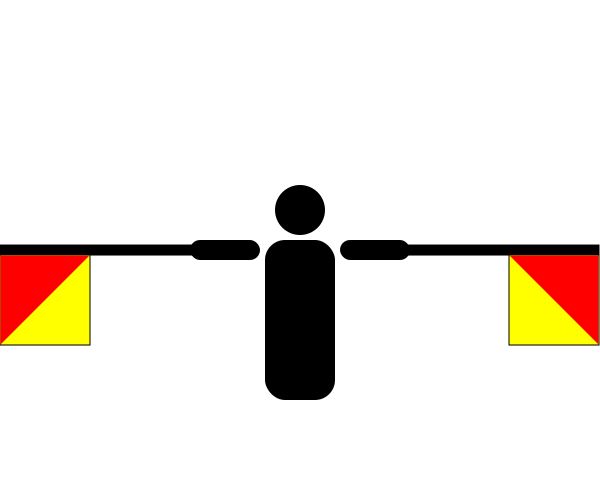
How to communicate the surname Heister in...
Braille
⠓⠑⠊⠎⠞⠑⠗
Morse
..........-..-.
Semaphore



Sorry, we don't have any statistics on this name. That's probably because it's very uncommon in Britain.
